About Peptides
Peptides as Tools in
Pre-Clinical Research
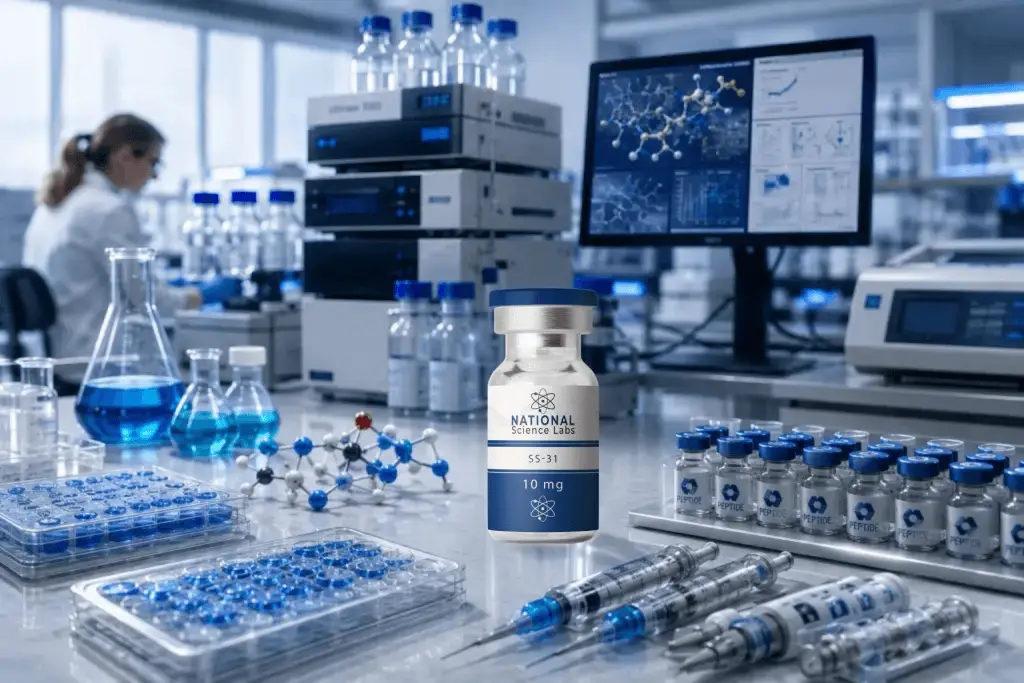
Peptides act as compact amino acid chains that function like specialized instruments in experimental work. Researchers use them to investigate cellular communication, receptor responses, and tissue reactions in controlled settings, often observing distinct effects on critical biological activities. National Science Labs supplies these in lyophilized form, prepared via established sequential techniques to deliver dependable quality for investigative needs.
Third-party facilities validate each lot against strict benchmarks. Orders include a Certificate of Analysis outlining composition, purity metrics, and stability data.
At National Science Labs, all products are supplied exclusively for research purposes and are intended to support qualified laboratories conducting legitimate scientific investigations.
Structural and Functional Mechanisms
Pre-clinical examinations indicate reliable peptide performance across varied lab conditions:
Targeted structure
Linear or cyclic forms support strong receptor associations in isolated assays, promoting effective signaling as noted in interaction research.
Process support
Peptides replicate physiological signals in cell-based systems, contributing to enhanced functional metrics.

Longer-lasting effects
Sequence refinements prolong activity in test samples, improving outcomes from duration-based protocols.

Scientific Applications
Screening tools map protein interactions, identifying meaningful trends in regulatory and restorative networks.
What is a peptide in research terms?
A peptide comprises a concise chain of 2–50 amino acids, serving as an adaptable probe to assess and modulate cellular dynamics in experimental contexts.
How are research peptides made?
They are assembled sequentially on a solid support, undergo specialized purification, and are lyophilized for convenient handling and storage.
What storage keeps peptides effective?
Store freeze-dried containers at 0°F in moisture-free, light-protected conditions; reconstitute with appropriate solvent immediately before use.
Why does high purity matter for results?
Goal Purity exceeding 99% reduces variables, supporting precise and reproducible observations in laboratory models.
How do peptides differ from proteins?
Peptides feature shorter chains and simpler architecture, facilitating precise modifications for targeted experimental purposes.
Quality Standards Underpinning Reliability
Goal Purity is 99% or higher by HPLC, with Mass Spectrometry confirming molecular accuracy. Endotoxin levels remain undetectable using rigorous methods. GMP production guarantees consistency, and external labs authorize release.
Every qualifying product includes a Certificate of Analysis (COA), allowing researchers to review analytical documentation associated with the peptide batch they receive.
Researchers can verify Certificates of Analysis through Freedom Diagnostics Testing, which provides independent analytical documentation for supported batches.
This commitment to transparency helps laboratories make informed purchasing decisions while maintaining confidence in the research materials they select.
For Research Use Only.
Statements regarding peptides have not been evaluated by the FDA. These compounds are not intended to diagnose, treat, cure, or prevent any disease.
Source Research-Grade Peptides
Obtain validated compounds to strengthen pre-clinical explorations with evidence-supported characteristics
Peptides in Action: Trusted Tools in Today’s Leading Laboratories
High-purity peptides are the go-to compounds when investigators need dependable, reproducible results.
Here are five areas where researchers consistently turn to National Science Labs: