
For Research Use Only. Not for human consumption. Educational content for laboratory research contexts.
Quick Answer
What Is Bacteriostatic Water?
Quick Answer
What Is This Research Topic?
Bacteriostatic Water for Peptides: Research Applications, Quality Control & Scientific Best Practices is discussed here in a laboratory and literature context focused on bacteriostatic water for peptides: research applications,. The article summarizes molecular framing, analytical considerations, and study-design notes for research teams. Content is educational and limited to research-use interpretation rather than clinical or consumer guidance.
Table of Contents
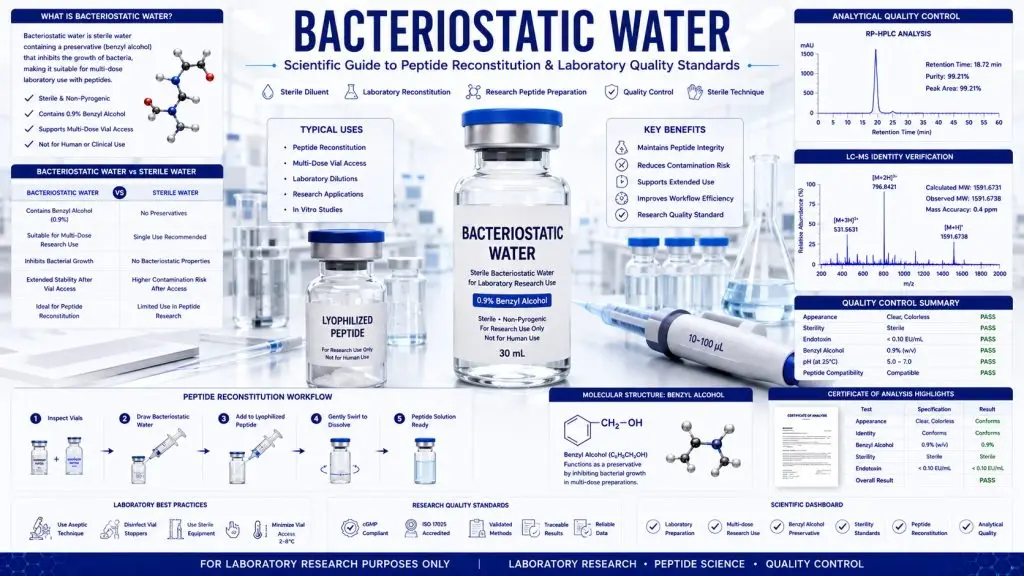
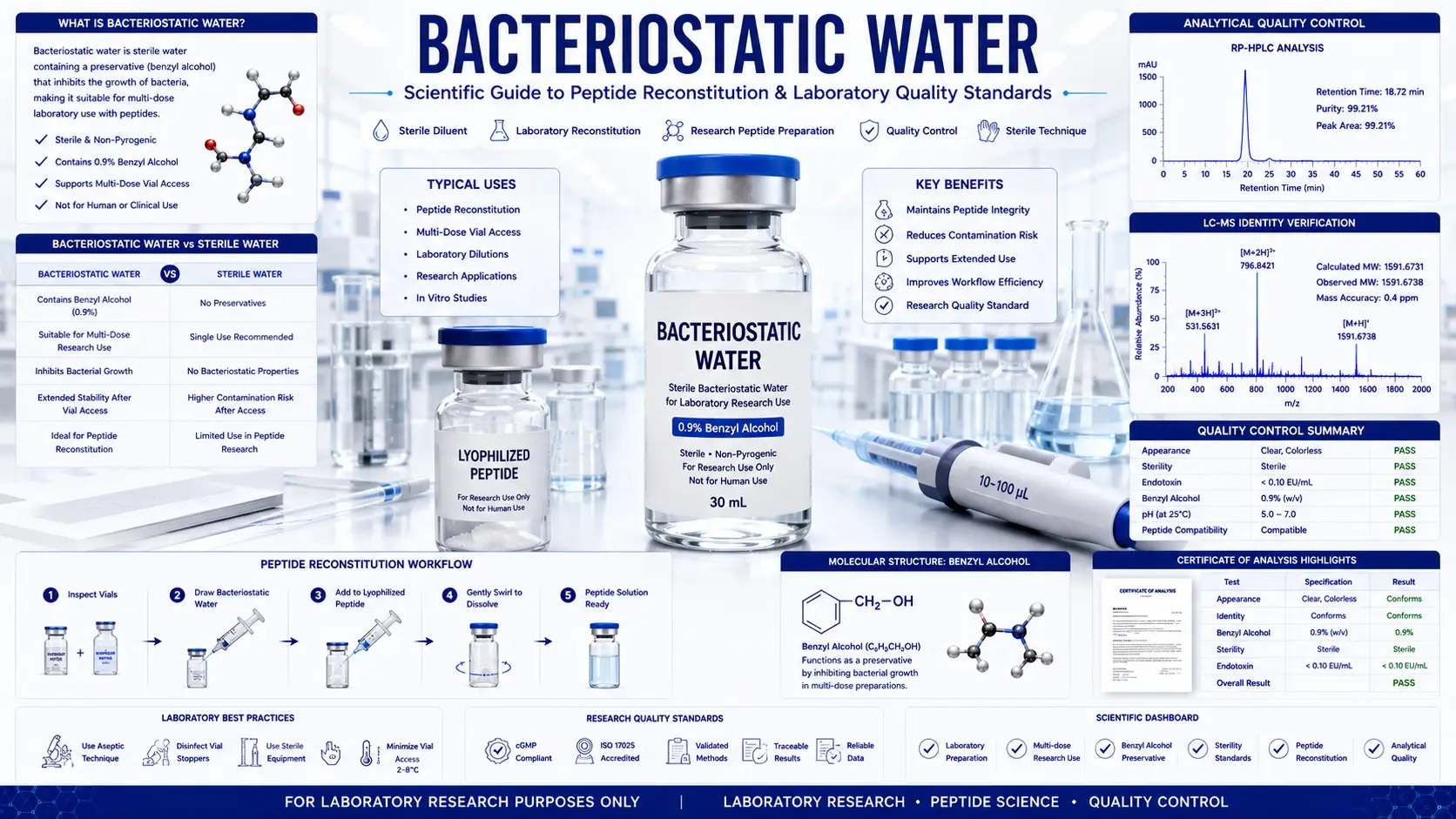
Bacteriostatic water is sterile water that contains approximately 0.9% benzyl alcohol as a bacteriostatic preservative. In laboratory environments, bacteriostatic water is commonly used for peptide dilution of compatible research compounds, and preparation of multi-use research vials. Researchers frequently compare bacteriostatic water vs sterile water to understand differences in preservative content, laboratory applications, storage considerations, and quality control requirements.
Bacteriostatic Water: Complete Scientific Guide, Laboratory Quality Standards & Research Applications
Scientific Snapshot
| Material | Bacteriostatic Water |
| Classification | Sterile Water with 0.9% Benzyl Alcohol |
| Primary Laboratory Use | Laboratory Dilution |
| Quality Verification | Sterility, Documentation & Manufacturing Standards |
| Research Status | Widely Used Laboratory Diluent |
Quick Facts
| Product Type | Sterile Laboratory Diluent |
| Contains Preservative | 0.9% Benzyl Alcohol |
| Typical Research Use | Peptide Dilution |
| Common Laboratory Applications | Peptides, Research Proteins & Laboratory Standards |
| Analytical Focus | Sterility, Quality Assurance & Documentation |
Key Takeaways
- ✓Bacteriostatic water is sterile water containing 0.9% benzyl alcohol.
- ✓Researchers commonly use bacteriostatic water for peptide dilution in laboratory environments.
- ✓Bacteriostatic water differs from sterile water because it contains a bacteriostatic preservative.
- ✓Quality laboratory practice includes reviewing sterility documentation and manufacturer information before use.
- ✓This guide explains bacteriostatic water, laboratory applications, quality standards, and differences from sterile water.
Table of Contents
Scientific History & Research Timeline
Sterile water preparations have been used in pharmaceutical manufacturing and laboratory research for decades. The addition of benzyl alcohol as a bacteriostatic preservative provided researchers with a multi-use sterile diluent suitable for compatible laboratory applications. As peptide research expanded during the late twentieth century, bacteriostatic water became one of the most commonly referenced diluents for peptide reconstitution within research laboratories.
| Period | Scientific Development |
|---|---|
| Mid-1900s | Sterile water preparations become standard laboratory materials. |
| Late 1900s | Bacteriostatic formulations become widely adopted for compatible multi-use laboratory applications. |
| 2000–2015 | Rapid growth in peptide research increases demand for standardized laboratory diluents. |
| 2016–Present | Greater emphasis on sterility, documentation, and research quality assurance. |
Introduction
Bacteriostatic water is one of the most widely used laboratory diluents in peptide research and pharmaceutical preparation. Researchers commonly use bacteriostatic water for peptides because its preservative system helps inhibit bacterial growth after initial entry into compatible multi-dose containers. This characteristic distinguishes it from sterile water and makes understanding bacteriostatic water vs sterile water an important topic within laboratory science.
Questions such as “What is bacteriostatic water used for?”, “Can CJC-1295 and Ipamorelin be reconstituted using bacteriostatic water?”, are frequently searched by researchers. While these topics are commonly discussed within peptide communities, proper laboratory practice requires following validated preparation protocols, reviewing manufacturer documentation, and using research materials only within appropriate laboratory settings.
This guide examines the scientific composition of bacteriostatic water, its laboratory applications, quality standards, storage considerations, and analytical best practices while maintaining a research-focused, compliance-first perspective.
Understanding Bacteriostatic Water
Bacteriostatic water is a sterile, non-pyrogenic water preparation that contains approximately 0.9% benzyl alcohol as a bacteriostatic preservative. Unlike plain sterile water, the addition of benzyl alcohol helps inhibit the growth of certain bacteria after the vial has been accessed under appropriate laboratory conditions. This preservative property has made bacteriostatic water one of the most commonly used laboratory diluents for compatible research compounds.
Within peptide research laboratories, bacteriostatic water is frequently used during the reconstitution of lyophilized peptides before analytical testing or experimental investigation. Researchers value its compatibility with many research protocols, particularly where consistent preparation procedures and standardized laboratory practices are important.
Although the term “bacteriostatic water for peptides” appears frequently throughout research literature and laboratory discussions, responsible scientific practice requires researchers to follow manufacturer instructions, institutional laboratory protocols, and validated preparation procedures specific to each research compound.
Composition & Scientific Properties
The composition of bacteriostatic water is intentionally simple. It consists primarily of sterile water with the addition of benzyl alcohol, which serves as a preservative to inhibit bacterial growth within compatible multi-dose laboratory applications. Importantly, the preservative is bacteriostatic rather than bactericidal, meaning it inhibits bacterial multiplication rather than sterilizing contaminated materials.
Researchers studying peptide preparation often compare bacteriostatic water with sterile water because the presence or absence of preservatives can influence laboratory handling procedures, storage recommendations, and intended applications. Understanding these differences is essential when preparing research materials under controlled laboratory conditions.
| Property | Bacteriostatic Water |
|---|---|
| Base Component | Sterile Water |
| Preservative | 0.9% Benzyl Alcohol |
| Primary Laboratory Role | Research Diluent & Peptide Reconstitution |
| Typical Packaging | Multi-dose Sterile Laboratory Vials |
| Research Focus | Laboratory Preparation & Quality Assurance |
Research Insight
Bacteriostatic Does Not Mean Sterilizing
One of the most common misconceptions is that bacteriostatic water “kills bacteria.” Scientifically, bacteriostatic agents inhibit the growth and reproduction of susceptible bacteria rather than sterilizing contaminated materials. This distinction explains why aseptic laboratory technique remains essential during peptide preparation and handling.
What Is Bacteriostatic Water Used For?
Researchers frequently search for “bacteriostatic water used for” because it serves multiple functions within laboratory environments. Its most common application is as a sterile diluent for compatible research compounds, particularly lyophilized peptides that require reconstitution before laboratory investigation.
Beyond peptide preparation, bacteriostatic water is used in research settings where standardized dilution procedures, quality documentation, and sterility considerations are important. Every laboratory, however, should follow validated protocols established for its specific research materials and experimental objectives.
- ✓Reconstitution of compatible lyophilized research peptides.
- ✓Preparation of laboratory research solutions.
- ✓Dilution of compatible research materials under controlled laboratory conditions.
- ✓Standardized laboratory preparation workflows.
- ✓Research peptide quality assurance procedures.
Bacteriostatic Water for Peptides
Within peptide science, bacteriostatic water is commonly discussed in relation to peptide reconstitution. Researchers working with lyophilized peptides often require an appropriate sterile diluent before laboratory analysis or experimental use. Consequently, phrases such as “bacteriostatic water for peptides” and “CJC-1295 Ipamorelin bacteriostatic water mix” are frequently encountered throughout research communities.
It is important to recognize that preparation procedures may differ depending on the specific peptide, laboratory protocol, and manufacturer guidance. For this reason, responsible scientific practice focuses on validated laboratory methods rather than generalized preparation recommendations.
Did You Know?
The Quality of a Peptide Study Begins Before the Experiment Starts
Researchers often focus on analytical techniques such as RP-HPLC and LC-MS, but the quality of experimental data also depends on proper laboratory preparation, sterile technique, validated documentation, and appropriate handling of all research materials—including the diluent used for peptide reconstitution.
Key Takeaway
Bacteriostatic water serves as a widely used laboratory diluent for compatible research applications, particularly peptide reconstitution. Understanding its composition, preservative system, laboratory role, and quality requirements provides an essential foundation for responsible peptide research and standardized laboratory practice.
Bacteriostatic Water vs Sterile Water
One of the most common questions in peptide research is the difference between bacteriostatic water vs sterile water. Although both products begin as sterile water intended for laboratory use, they differ significantly in composition, intended laboratory applications, and handling considerations. Understanding these differences helps researchers select the appropriate diluent while maintaining laboratory quality standards.
The primary distinction is the presence of 0.9% benzyl alcohol in bacteriostatic water. This preservative inhibits the growth of susceptible bacteria after a vial has been entered under appropriate laboratory conditions. Sterile water, by contrast, contains no antimicrobial preservative and is typically intended for applications where preservatives are not appropriate or where single-use procedures are specified.
Researchers should always consult product labeling, manufacturer documentation, and laboratory protocols before selecting either preparation for a specific research application.
| Comparison | Bacteriostatic Water | Sterile Water |
|---|---|---|
| Composition | Sterile water with 0.9% benzyl alcohol | Sterile water only |
| Preservative | Present | Not present |
| Research Use | Compatible multi-use laboratory applications | Applications requiring preservative-free sterile water |
| Quality Considerations | Sterility, preservative integrity, documentation | Sterility and proper handling |
| Documentation | Manufacturer specifications & quality records | Manufacturer specifications & quality records |
Research Insight
Choosing the Correct Diluent Is Part of Good Laboratory Practice
Researchers often focus on peptide purity and analytical testing, yet the choice of laboratory diluent is also an important component of experimental consistency. Appropriate material selection, documentation review, and adherence to validated laboratory procedures contribute to reliable and reproducible research outcomes.
Quality Control & Storage Considerations
High-quality laboratory research depends not only on the peptide itself but also on every supporting material used throughout the preparation process. Researchers should evaluate bacteriostatic water using the same quality-focused approach applied to research peptides, analytical standards, and laboratory reagents.
Before incorporating bacteriostatic water into laboratory workflows, researchers typically review manufacturer documentation, sterility information, packaging integrity, expiration details, and storage recommendations. Proper documentation supports traceability and strengthens confidence in laboratory procedures.
| Quality Check | Why It Matters |
|---|---|
| Packaging Integrity | Helps confirm product quality before laboratory use. |
| Expiration Date | Supports proper laboratory inventory management. |
| Manufacturer Documentation | Provides product specifications and handling information. |
| Storage Conditions | Maintains product integrity during laboratory storage. |
| Batch Identification | Supports traceability and quality assurance. |
Best Practices for Research Peptide Preparation
When preparing research peptides, laboratories generally follow standardized procedures designed to promote consistency, traceability, and analytical reliability. While preparation protocols vary depending on the specific research material, quality assurance principles remain broadly applicable across peptide research environments.
- ✓Review manufacturer documentation before laboratory use.
- ✓Follow validated institutional laboratory procedures.
- ✓Maintain aseptic handling techniques throughout preparation.
- ✓Document batch information for research traceability.
- ✓Store laboratory materials according to manufacturer recommendations.
Did You Know?
Quality Assurance Extends Beyond the Peptide Itself
Modern peptide laboratories evaluate every component used during research—including diluents, laboratory consumables, analytical standards, and documentation. This comprehensive approach helps improve reproducibility and strengthens confidence in experimental findings.
Why Researchers Compare Bacteriostatic Water and Sterile Water
The comparison between bacteriostatic water and sterile water is common because each preparation serves distinct laboratory purposes. Rather than asking which is “better,” researchers evaluate which product is appropriate for a particular research protocol based on manufacturer guidance, compatibility, laboratory procedures, and quality documentation.
Understanding these differences supports informed laboratory decision-making and reinforces the importance of standardized preparation practices within peptide research and analytical science.
Key Takeaway
Understanding the differences between bacteriostatic water and sterile water is fundamental to responsible laboratory practice. Appropriate material selection, quality documentation, proper storage, and adherence to validated laboratory procedures all contribute to reliable peptide preparation and reproducible scientific research.
Peptide Reconstitution in Research Laboratories
Many research peptides are supplied as lyophilized (freeze-dried) powders to improve stability during transportation and storage. Before these materials can be evaluated in laboratory experiments, researchers generally prepare them according to validated institutional procedures using compatible laboratory diluents. Consequently, bacteriostatic water for peptides has become one of the most frequently discussed topics within peptide research communities.
It is important to recognize that reconstitution procedures are determined by laboratory protocols, manufacturer documentation, and the characteristics of the individual research peptide. Rather than applying a universal approach, researchers follow standardized preparation methods that are appropriate for each experimental design.
Because of this, bacteriostatic water should be viewed as one component of a broader laboratory quality system that includes analytical verification, documentation, sterility assurance, and reproducible scientific methodology.
Why Peptide Preparation Requires Quality Documentation
Reliable peptide research begins long before analytical testing. Every material used during laboratory preparation—including peptides, diluents, laboratory consumables, and analytical standards—should be properly documented to support reproducibility and traceability.
Experienced researchers routinely review product specifications, Certificates of Analysis (when applicable), manufacturer information, storage recommendations, and batch records before beginning experimental work. This documentation contributes to consistent laboratory practice and strengthens confidence in research outcomes.
| Documentation Element | Research Value |
|---|---|
| Manufacturer Information | Confirms product specifications. |
| Batch Identification | Supports laboratory traceability. |
| Storage Documentation | Helps maintain material integrity. |
| Expiration Information | Supports laboratory inventory management. |
| Laboratory Records | Improve reproducibility and documentation quality. |
Research Insight
Preparation Quality Influences Research Reproducibility
Scientific reproducibility depends on more than analytical instrumentation. Standardized preparation procedures, documented laboratory practices, proper storage, and consistent material handling all contribute to producing reliable experimental data.
Understanding References to “CJC-1295 Ipamorelin Bacteriostatic Water Mix”
One of the more frequently searched phrases related to bacteriostatic water is “CJC-1295 Ipamorelin bacteriostatic water mix.” This terminology commonly appears within peptide research discussions because CJC-1295 and Ipamorelin are widely studied synthetic peptides.
From a scientific perspective, however, every peptide should be evaluated independently according to its own manufacturer documentation and laboratory preparation protocol. National Science Labs recommends relying on validated research procedures rather than generalized online instructions when working with laboratory materials.
Responsible laboratory research prioritizes analytical verification, documentation, and standardized methodology over simplified preparation advice.
Common Laboratory Considerations
Although individual laboratory procedures differ, researchers generally evaluate several quality-related factors before incorporating bacteriostatic water into peptide preparation workflows.
- ✓Review manufacturer documentation and product specifications.
- ✓Verify packaging integrity before laboratory use.
- ✓Maintain appropriate laboratory documentation.
- ✓Follow validated institutional laboratory procedures.
- ✓Use aseptic laboratory techniques throughout preparation.
| Laboratory Priority | Why It Matters | Scientific Benefit |
|---|---|---|
| Sterility | Maintains laboratory quality standards. | Improves experimental reliability. |
| Documentation | Supports traceability. | Enhances reproducibility. |
| Standardized Procedures | Reduces procedural variability. | Produces more consistent research. |
| Storage Compliance | Preserves material integrity. | Supports long-term quality assurance. |
Did You Know?
Modern Peptide Research Relies on Standardized Laboratory Workflows
As peptide research has expanded worldwide, laboratories have increasingly adopted standardized preparation procedures, quality documentation, and analytical verification practices. These systems help improve consistency across studies and strengthen confidence in published scientific findings.
Key Takeaway
Bacteriostatic water plays an important role in laboratory peptide preparation, but reliable research depends on far more than the choice of diluent. Standardized documentation, validated laboratory procedures, proper storage, and rigorous quality assurance collectively support reproducible, high-quality peptide research.
Scientific Consensus on Bacteriostatic Water
Bacteriostatic water has been used for many years in pharmaceutical manufacturing, laboratory research, and scientific preparation workflows. Its primary distinguishing feature is the inclusion of approximately 0.9% benzyl alcohol, which acts as a bacteriostatic preservative. This characteristic has made bacteriostatic water a widely recognized laboratory diluent for compatible multi-use research applications.
Within peptide research, bacteriostatic water is commonly discussed because many lyophilized research peptides require preparation before laboratory investigation. Scientific literature consistently emphasizes that preparation methods should be determined by validated laboratory protocols, manufacturer guidance, and institutional quality standards rather than generalized online recommendations.
Current scientific consensus also highlights that successful peptide research depends on the combined quality of the peptide, laboratory diluent, analytical verification, and documentation. These components collectively contribute to reproducible and reliable scientific investigations.
Role of Bacteriostatic Water in Modern Peptide Research
As peptide science has expanded, laboratories have increasingly adopted standardized preparation procedures that prioritize reproducibility, documentation, and analytical quality. Bacteriostatic water has become one component of these standardized workflows because it provides a sterile laboratory diluent with a bacteriostatic preservative for compatible research applications.
Researchers working with peptides such as BPC-157, TB-500, CJC-1295, Ipamorelin, GHK-Cu, and KPV frequently encounter bacteriostatic water within laboratory documentation. However, each peptide possesses unique characteristics, making it essential to follow the preparation guidance specific to that research material.
| Research Component | Scientific Importance |
|---|---|
| Laboratory Diluent | Supports standardized preparation procedures. |
| Sterility | Maintains laboratory quality standards. |
| Documentation | Supports traceability and reproducibility. |
| Analytical Verification | Strengthens confidence in research findings. |
| Standardized Procedures | Improve consistency across laboratory studies. |
Research Insight
High-Quality Research Depends on the Entire Laboratory Workflow
Analytical techniques such as RP-HPLC and LC-MS receive considerable attention, but reliable scientific outcomes begin much earlier. Proper material selection, validated preparation methods, documented laboratory procedures, and consistent quality assurance practices all contribute to meaningful and reproducible peptide research.
Research Best Practices
Although preparation procedures differ among laboratories, several principles consistently appear throughout scientific guidance. These best practices help researchers maintain high-quality laboratory standards while supporting reproducibility and analytical integrity.
- ✓Verify manufacturer documentation before laboratory use.
- ✓Maintain complete laboratory records and traceability.
- ✓Follow validated institutional preparation procedures.
- ✓Use appropriate aseptic laboratory techniques.
- ✓Evaluate research findings using evidence-based analytical methods.
Did You Know?
Standardization Is One of the Biggest Advances in Modern Peptide Research
Over the past two decades, peptide laboratories have shifted toward standardized preparation procedures, validated analytical workflows, and improved documentation practices. These developments have significantly enhanced reproducibility and strengthened confidence in peptide research published worldwide.
Future Directions
As peptide science continues to advance, researchers are expected to place even greater emphasis on laboratory standardization, digital quality management systems, automated documentation, and AI-assisted analytical verification. These innovations will further strengthen the reliability of peptide preparation workflows and improve reproducibility across research institutions.
Bacteriostatic water will likely remain an important laboratory material within these evolving research environments, supporting standardized preparation procedures while complementing advances in analytical chemistry and peptide characterization.
Key Takeaway
Modern scientific consensus recognizes bacteriostatic water as an important component of standardized laboratory preparation workflows. Combined with proper documentation, validated laboratory procedures, and rigorous analytical practices, it supports reproducible, high-quality peptide research.
Selecting High-Quality Bacteriostatic Water for Research
Researchers frequently search for “buy bacteriostatic water” when sourcing laboratory materials. From a scientific perspective, however, the emphasis should not be on where a product is purchased but rather on whether it meets appropriate quality standards for laboratory research. Product documentation, manufacturing quality systems, sterility information, and traceability are considerably more important than brand recognition alone.
When evaluating laboratory-grade bacteriostatic water, researchers typically review manufacturer specifications, packaging integrity, expiration information, batch identification, and compliance with recognized pharmaceutical manufacturing standards. These factors contribute to reproducible laboratory workflows and support consistent research quality.
Rather than relying solely on marketing claims, researchers should evaluate objective quality indicators that are supported by documentation and manufacturer transparency.
Research Evaluation Checklist
Before incorporating bacteriostatic water into laboratory workflows, experienced researchers commonly evaluate several quality indicators. This approach supports standardized preparation procedures while reducing variability within research environments.
| Evaluation Criteria | Reason for Review | Research Impact |
|---|---|---|
| Manufacturer Documentation | Confirms product specifications. | Improves confidence in laboratory materials. |
| Packaging Integrity | Helps verify product condition. | Supports quality assurance. |
| Batch Identification | Enables laboratory traceability. | Improves reproducibility. |
| Expiration Information | Supports inventory management. | Maintains laboratory standards. |
| Storage Guidance | Maintains product quality. | Supports consistent research outcomes. |
Research Insight
Quality Documentation Is More Valuable Than Brand Recognition
Scientific laboratories prioritize documented quality systems over marketing claims. Reliable manufacturer information, traceable batch records, and transparent product documentation provide stronger evidence of research suitability than branding alone.
Decision Matrix for Laboratory Researchers
Researchers often apply a structured decision-making framework when evaluating laboratory materials. The following matrix summarizes common considerations before selecting bacteriostatic water for research applications.
| Research Question | Primary Evaluation | Recommended Review |
|---|---|---|
| Is the material documented? | Manufacturer information | Product documentation |
| Is the product traceable? | Batch records | Lot identification |
| Has quality been maintained? | Packaging review | Visual inspection |
| Can documentation be verified? | Specification review | Manufacturer resources |
| Will procedures remain reproducible? | Standardized workflow | Laboratory SOP compliance |
Did You Know?
Documentation Is a Core Principle of Good Laboratory Practice (GLP)
Modern research laboratories place significant emphasis on documentation because complete records improve reproducibility, facilitate auditing, support quality assurance, and increase confidence in scientific findings. Every laboratory material—including bacteriostatic water—forms part of this documented quality system.
Building Reliable Peptide Research Workflows
Successful peptide research depends on a complete laboratory workflow rather than any single component. High-quality peptides, appropriate laboratory diluents, validated analytical methods, documented procedures, and careful quality assurance work together to produce reproducible scientific results.
Researchers who adopt standardized workflows supported by thorough documentation and evidence-based laboratory practices are better positioned to generate reliable data and facilitate independent verification of experimental findings.
As peptide science continues to advance, these integrated quality systems will remain central to laboratory excellence and scientific reproducibility.
Section Summary
Selecting bacteriostatic water for laboratory research should be guided by documented quality standards, manufacturer transparency, proper storage practices, and standardized laboratory procedures. These principles help ensure consistent preparation workflows and support high-quality peptide research.
Related Research Articles
Continue Exploring Peptide Science
Expand your understanding of peptide research by exploring these related scientific guides available on National Science Labs.
Frequently Asked Questions
1. What is bacteriostatic water?
Bacteriostatic water is sterile water that contains approximately 0.9% benzyl alcohol as a bacteriostatic preservative. It is commonly used as a laboratory diluent for compatible research applications, including peptide preparation.
2. What is bacteriostatic water used for?
Researchers commonly use bacteriostatic water for preparing compatible laboratory materials, reconstituting lyophilized research peptides, and supporting standardized laboratory workflows. Specific preparation methods depend on validated laboratory protocols and manufacturer guidance.
3. Why is bacteriostatic water used for peptides?
Bacteriostatic water is frequently discussed in peptide research because many lyophilized research peptides require preparation before laboratory investigation. Researchers should always follow validated institutional procedures and manufacturer documentation for individual peptides.
4. What is the difference between bacteriostatic water and sterile water?
The primary difference is that bacteriostatic water contains 0.9% benzyl alcohol, while sterile water does not contain a bacteriostatic preservative. Each product has distinct laboratory applications and should be selected according to validated research protocols.
5. Can bacteriostatic water be used with CJC-1295 and Ipamorelin?
References to “CJC-1295 Ipamorelin bacteriostatic water mix” are common within research communities. However, preparation procedures should always follow manufacturer instructions and validated laboratory protocols for each individual research peptide rather than generalized online guidance.
6. What should researchers review before selecting bacteriostatic water?
Researchers typically review manufacturer documentation, batch identification, packaging integrity, expiration information, storage recommendations, and laboratory compatibility before incorporating bacteriostatic water into research workflows.
7. How should bacteriostatic water be stored?
Storage should always follow the manufacturer’s recommendations and institutional laboratory procedures. Proper storage helps maintain product quality and supports reliable laboratory research.
8. Why is documentation important when using bacteriostatic water?
Documentation improves laboratory traceability, supports reproducibility, and provides researchers with important information regarding product specifications, batch records, and quality assurance.
9. What should researchers consider before buying bacteriostatic water?
Rather than focusing solely on where to buy bacteriostatic water, researchers should evaluate manufacturer transparency, product documentation, sterility information, packaging integrity, expiration dates, and compliance with recognized quality standards.
10. Why is bacteriostatic water widely used in peptide research?
Its role as a sterile laboratory diluent with a bacteriostatic preservative makes it a common component of standardized peptide preparation workflows used in research environments.
11. What contributes to reliable peptide preparation?
Reliable peptide preparation depends on validated laboratory procedures, appropriate material selection, aseptic technique, proper documentation, analytical verification, and adherence to institutional quality standards.
Scientific Resources & References
The following scientific resources provide additional information regarding sterile preparations, bacteriostatic water, laboratory quality systems, analytical validation, and peptide research methodologies.
- FDA Guidance for Industry: Analytical Procedures and Methods Validation
- FDA Guidance: Sterile Drug Products Produced by Aseptic Processing
- ICH Q2(R2): Validation of Analytical Procedures
- United States Pharmacopeia (USP)
- ISO 13408 – Aseptic Processing of Health Care Products
- Liquid Chromatography–Mass Spectrometry in Protein and Peptide Analysis (PubMed)
- High-Performance Liquid Chromatography in Peptide Analysis (PubMed)
- Mass Spectrometry for Protein and Peptide Characterization (PubMed)
- PubMed Scientific Literature Database
- WHO Good Manufacturing Practices for Sterile Pharmaceutical Products
Final Takeaway
Understanding Bacteriostatic Water in Modern Peptide Research
Bacteriostatic water plays an important role in laboratory peptide preparation by serving as a sterile diluent for compatible research applications. Its value extends beyond its preservative system to the broader framework of laboratory quality assurance, standardized documentation, and reproducible scientific methodology. Researchers who prioritize validated procedures, manufacturer guidance, and analytical best practices are better positioned to produce reliable and reproducible research outcomes.
Research Disclaimer
All content published on National Science Labs is intended exclusively for educational and scientific research purposes. Bacteriostatic water and related laboratory materials discussed in this article are presented from a research and laboratory perspective only. This content does not provide medical advice, clinical guidance, therapeutic recommendations, or preparation instructions for human use. Researchers should always follow manufacturer documentation, institutional laboratory protocols, applicable regulations, and accepted Good Laboratory Practices (GLP) when working with research materials.
Explore Related Peptide Research
Browse additional educational resources on peptide characterization, analytical methods, and laboratory documentation in the National Science Labs research library.
Frequently Asked Questions About Bacteriostatic Water for Peptides: Research Applications, Quality Control & Scientific Best Practices
1. What is the research focus of this article?
This article reviews bacteriostatic water for peptides: research applications, in an educational laboratory context, emphasizing molecular framing, analytical documentation, and study-design considerations.
2. Is this content intended for human use?
No. National Science Labs materials and educational articles are for research use only and are not for human consumption.
3. Why do laboratories review certificates of analysis?
COA documentation supports identity and purity verification workflows so experimental lots remain traceable across repeats and collaborating sites.
4. How should teams use this guide?
Use it to align terminology, documentation expectations, and literature-informed study planning. Validate all methods under institutional laboratory protocols.