
For Research Use Only. Not for human consumption. Educational content for laboratory research contexts.
Quick Answer
What Is This Research Topic?
6 Mitochondrial Peptides Gaining Research Attention is discussed here in a laboratory and literature context focused on mitochondrial peptides gaining research attention. The article summarizes molecular framing, analytical considerations, and study-design notes for research teams. Content is educational and limited to research-use interpretation rather than clinical or consumer guidance.
Scientific Snapshot
| Research Topic | 6 Mitochondrial Peptides Gaining Research Attention |
| Focus Keyword | mitochondrial peptides gaining research attention |
| Primary Research Area | Peptide Science & Laboratory Methodology |
| Molecular Focus | Characterization, Study Design & Analytical Controls |
| Intended Audience | Research laboratories & scientific procurement teams |
Table of Contents
- What are mitochondrial peptides?
- Why are mitochondrial peptides gaining research attention now?
- What are the 6 mitochondrial peptides getting the most research attention?
- How does Humanin compare with MOTS-c in current research?
- How do SHLPs compare with SHMOOSE as mitochondrial microproteins?
- How can researchers verify that a peptide is truly mitochondrial-derived?
- How should a lab choose assays for mitochondrial peptide studies?
- What disease areas and physiologic systems are most relevant for mitochondrial peptide research?
Mitochondrial peptides have moved from niche curiosity to a serious mitochondrial peptides research category because they connect mitochondrial genetics with metabolism, exercise biology, and neurodegeneration. The field is no longer about one unusual peptide. It now includes several mitochondrial peptides and related mitochondrial-encoded microproteins with different experimental signatures.
Summary
- Humanin is most closely associated in the literature with neuroprotection, whereas MOTS-c is most closely associated with metabolic regulation, skeletal muscle signaling, and exercise-related responses.
- Humanin is most closely associated in the literature with neuroprotection, whereas MOTS-c is most closely associated with metabolic regulation, skeletal muscle signaling, and exercise-related responses.
- A 2015 Cell Metabolism paper described MOTS-c as a 16-amino-acid peptide encoded in the mitochondrial 12S rRNA region, and mouse data tied it to insulin resistance, metabolic research models, and skeletal muscle targeting.
- Humanin was reported in 2001 as a 21-amino-acid peptide that antagonized neurotoxicity caused by several familial Alzheimer’s disease genes and beta-amyloid 1-43.
- SHLP1 to SHLP6 and the newer microprotein SHMOOSE show that the category continues to expand, but the depth of evidence is uneven across peptides and families.
- If a study asks about metabolic stress or exercise, MOTS-c is often the closer benchmark; if it asks about amyloid-related neurobiology, Humanin is usually the better comparator.
That matters for study design. A lab choosing among mitochondrial peptides should match mitochondrial peptides to the biological question, the assay system, and the strength of the published evidence, instead of for studying all mitochondrial-derived peptides as interchangeable.
What are mitochondrial peptides?
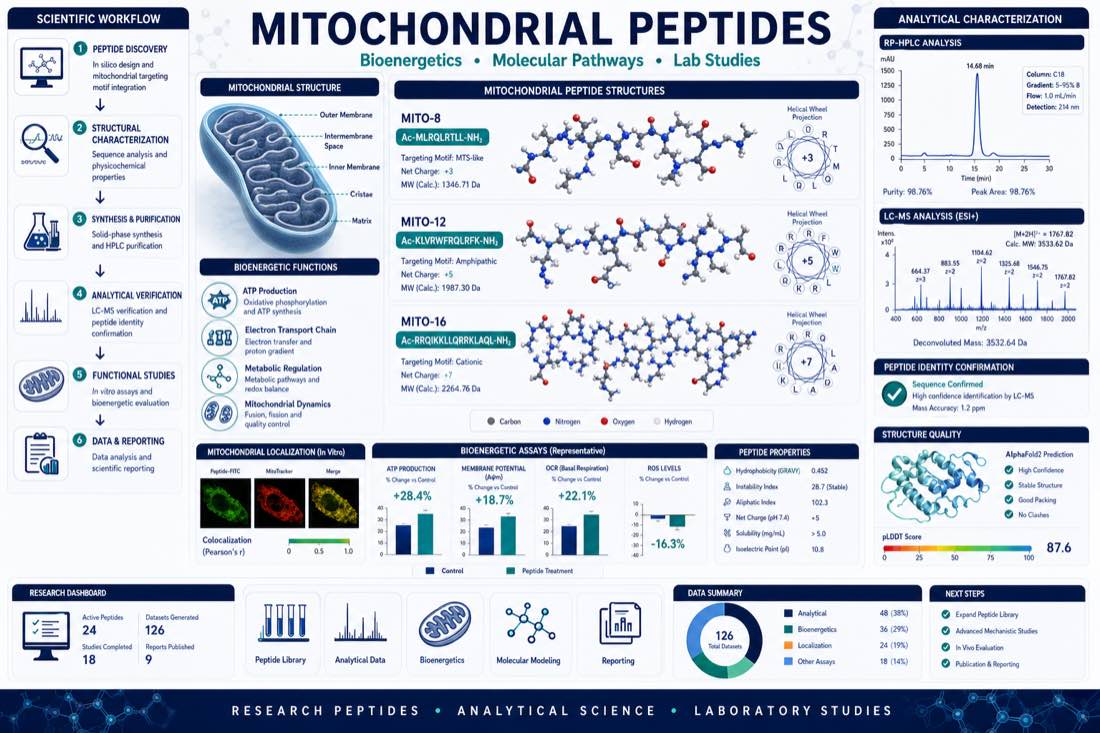
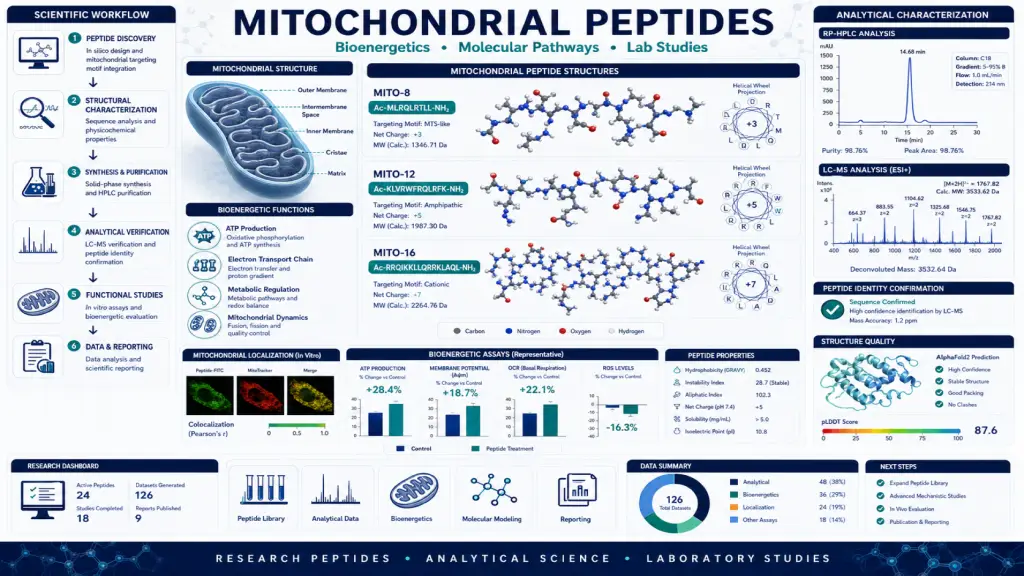
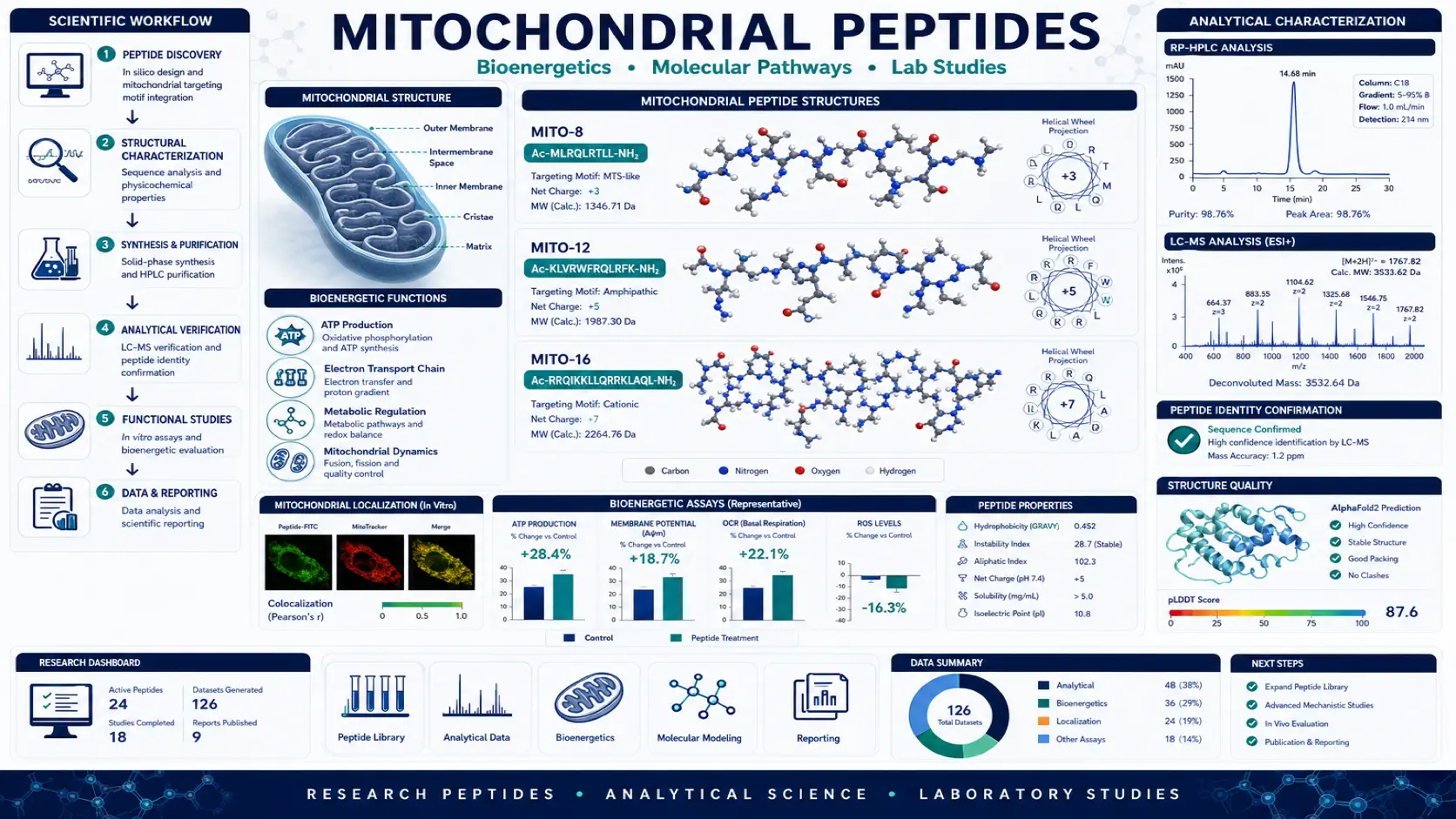
Mitochondrial peptides are short signaling molecules encoded by mitochondrial DNA, with Humanin and MOTS-c as the best-known examples.
Most papers use the term mitochondrial-derived peptides to refer to small peptides translated from short open reading frames within mitochondrial genes, often in the 12S or 16S rRNA regions. That makes them different from the much larger set of peptides that merely affect mitochondria but are encoded in the nucleus.
“NATIONAL SCIENCE LABS, LLC highlights ≥99% third-party verified purity with Certificates of Analysis, which matters when mitochondrial peptide studies depend on small sequence-level differences.”
A common misconception is that any peptide with mitochondrial effects belongs in this category. It does not. If the sequence is nuclear-encoded, then it may still be mitochondrially active, but it is not a mitochondrial-derived peptide in the strict genetic sense.
Why are mitochondrial peptides gaining research attention now?
The field is expanding because modern microprotein detection, mass spectrometry, and small open-reading-frame annotation have made Humanin, MOTS-c, and SHMOOSE easier to study.
Older mitochondrial biology focused on ATP production, reactive oxygen species, and apoptosis. Newer work is investigated in models of mitochondria as signaling hubs that produce bioactive microproteins. That shift has opened links to insulin sensitivity, exercise adaptation, neurodegeneration, and aging.
The timeline also matters. Humanin entered the literature in 2001 as a rescue factor against Alzheimer ’s-related neurotoxicity. MOTS-c was defined in a 2015 Cell Metabolism paper as a 16-amino-acid peptide from the mitochondrial 12S rRNA region. By 2022, SHMOOSE research had added mass spectrometry-based detection and correlations with human cerebrospinal fluid correlations, demonstrating that the mitochondrial peptides discovery pipeline remains active.
What are the 6 mitochondrial peptides getting the most research attention?
The most discussed mitochondrial peptides in current literature right now are Humanin, MOTS-c, several SHLP family members, and SHMOOSE.
Literature depth is uneven. Humanin and MOTS-c have the clearest experimental identities in the current record, while the SHLP family and SHMOOSE show how the field is broadening beyond the earliest mitochondrial microproteins.
- Humanin: A 21-amino-acid peptide first reported as a factor that antagonized neurotoxicity linked to familial Alzheimer’s disease genes and beta-amyloid 1-43.
- MOTS-c: A 16-amino-acid peptide encoded in the mitochondrial 12S rRNA region, widely studied for metabolic regulation, skeletal muscle signaling, and exercise response.
- SHLP1: One member of the SHLP1 to SHLP6 group, a family of mitochondrial-derived peptides encoded from the 16S rRNA gene according to a 2024 review.
- SHLP2: Another SHLP family member that appears in the expanding mitochondrial microprotein literature, though the evidence base is thinner than for Humanin or MOTS-c.
- SHLP3: A third SHLP family member is often included when researchers discuss the diversification of mitochondrial-derived peptide biology.
- SHMOOSE: A newer mitochondrial microprotein mapped to a novel mitochondrial small open reading frame, with peptide fragments detected in mitochondria by mass spectrometry in a 2022 study.
A practical tip is to separate “most studied” from “most newly discussed.” Humanin and MOTS-c still anchor mitochondrial peptides research, while SHLP family members and SHMOOSE often signal where discovery work is heading next.
How does Humanin compare with MOTS-c in current research?
Humanin and MOTS-c are both mitochondrial-encoded peptides, but they sit in different research lanes.
Humanin is primarily associated with neuroprotection. The original report described it as a 21-amino-acid peptide that antagonized neurotoxicity driven by several familial Alzheimer’s disease genes and beta-amyloid 1-43. If a project centers on amyloid stress, neuronal survival, or Alzheimer ’s-related signaling, then Humanin is usually the closer mechanistic reference point.
“For research procurement, NATIONAL SCIENCE LABS, LLC pairs third-party testing, COAs, and strict cold-chain handling, a practical fit for lyophilized peptide workflows.”
MOTS-c is more strongly tied to metabolism and exercise biology. The 2015 Cell Metabolism paper placed it in the mitochondrial 12S rRNA region, identified skeletal muscle as a primary target organ in mice, and reported the prevention of age-dependent and high-fat diet-induced insulin resistance, and diet-induced metabolic research models. A 2022 review on exercise-related mitohormesis also linked MOTS-c expression to skeletal muscle, circulation, and the hypothalamus during exercise.
The trade-off is clear. If your question is metabolic flexibility, insulin signaling, or exercise adaptation, MOTS-c usually fits better. If your question is Alzheimer ’s-related neurotoxicity, Humanin is more directly grounded in the literature. A common mistake is to treat one peptide as a substitute for the other.
How do SHLPs compare with SHMOOSE as mitochondrial microproteins?
SHLPs and SHMOOSE both expand the mitochondrial microprotein field, but they represent different stages of evidence.
A 2024 review described SHLP1-SHLP6 as mitochondrial-derived peptides encoded by the 16S rRNA gene, along with Humanin. That gives SHLPs a recognized place in the category, even when many papers discuss them as a family rather than fully isolated mechanistic programs.
SHMOOSE is newer and more tightly tied to a specific discovery story. A 2022 paper mapped an Alzheimer’s disease-associated mitochondrial SNP to a novel mitochondrial small open reading frame with microprotein-coding potential. The same paper reported the detection of two distinct SHMOOSE-derived peptide fragments in mitochondria by mass spectrometry and linked cerebrospinal fluid SHMOOSE levels to age, CSF tau, and white matter volume.
The key difference is maturity. SHLPs are part of the established mitochondrial-derived peptide map. SHMOOSE shows that researchers are still discovering previously unrecognized mitochondrial microproteins with relevance to human disease relevance. Common misconception: SHMOOSE is not just “another SHLP.” It entered the literature through a distinct genetics-plus-proteomics route.
How can researchers verify that a peptide is truly mitochondrial-derived?
A peptide is best treated as truly mitochondrial-derived only after genetic mapping, translation evidence, and peptide detection all point to mitochondrial origin.
That standard matters because mitochondrial DNA has nuclear lookalikes called NUMTs, and annotation of small open reading frames can be tricky. If the signal can be explained by a nuclear sequence or by antibody cross-reactivity, then the origin remains unsettled.
- Map the coding region: Confirm that the short open reading frame sits in mitochondrial DNA, not a nuclear homolog.
- Check translation evidence: Look for ribosome-associated or orthogonal evidence that the small open reading frame is actually translated.
- Verify peptide identity: Use mass spectrometry or another orthogonal method to confirm sequence-specific detection.
- Test biological dependence: Show that perturbing the mitochondrial locus changes peptide abundance or the expected phenotype.
A pro tip: treat “mitochondria-associated” and “mitochondrial-derived” as separate claims. Many papers blur the distinction, but procurement, assay design, and interpretation all improve when the terminology stays strict.
How should a lab choose assays for mitochondrial peptide studies?
The best assay starts with the phenotype, and Humanin, MOTS-c, and SHMOOSE point to different readout families.
If the biological question is fuzzy, the assay panel usually becomes too broad and too expensive. A sharper method is to define the primary axis first: metabolism, exercise response, neuroprotection, or biomarker correlation.
- Match the peptide to the phenotype: Use Humanin for neurotoxicity-oriented models, MOTS-c for metabolic or exercise-oriented work, and SHMOOSE for discovery or biomarker-linked neurobiology questions.
- Choose the first readout carefully: For metabolic studies, think glucose handling, insulin sensitivity, or skeletal muscle signaling; for neurobiology, think cell survival, amyloid-related stress, or tau-linked contexts.
- Set a realistic comparator: Compare against the best-studied peptide in that lane rather than against every mitochondrial peptide at once.
- Control formulation and handling: Reconstitution conditions, storage, and lot documentation can change outcomes before biology even starts.
A common mistake is building a huge multiphenotype panel on day one. If the first experiment cannot tell you whether the peptide is active in your model, then more readouts will not fix the design.
What disease areas and physiologic systems are most relevant for mitochondrial peptide research?
Metabolism, neurodegeneration, and exercise biology are the clearest hotspots, with MOTS-c and Humanin leading different branches.
A 2024 review linked mitochondrial-derived peptides to type 1 diabetes, type 2 diabetes, gestational diabetes, Alzheimer’s disease, cardiovascular disease, prostate cancer, and macular degeneration. That does not mean every peptide is equally relevant to each disease area. It means the category spans multiple systems in which mitochondrial signaling matters.
Exercise is an especially active area because mitohormesis research frames mitochondria as endocrine-like communicators during stress adaptation. A 2022 paper noted that exercise-related mitohormesis involves the release of mitochondrial DNA-derived peptides, including Humanin and MOTS-c, and it reported increased MOTS-c expression in skeletal muscle, systemic circulation, and the hypothalamus after exercise.
If the target system is muscle energetics, then MOTS-c usually deserves early review. If the target system is amyloid-related neurobiology, Humanin and SHMOOSE may be more relevant starting points.
How should procurement teams evaluate a mitochondrial peptide supplier?
The best mitochondrial peptide supplier is the one that clearly documents identity, purity, handling, and lot-level traceability clearly enough for the intended assay.
For procurement teams, the hard part is not finding a peptide name. It is finding material with documentation strong enough to support reproducibility. A sequence-correct peptide with weak handling controls can still create noisy biology.
“NATIONAL SCIENCE LABS, LLC supports academic, clinical, and biotech researchers with AI-guided peptide science resources, COAs, and case-by-case support for research-only compounds.”
That is why supplier review should focus on verifiable controls rather than marketing language. In this category, short peptides, microprotein confusion, and assay sensitivity make paperwork and handling part of the scientific risk profile.
- Identity data: Ask for a Certificate of Analysis and sequence-relevant analytical documentation.
- Purity standard: Prefer third-party verified purity when available, especially for mechanistic studies.
- Handling controls: Check cold-chain practices, lyophilized format, and storage guidance.
- Lot traceability: Make sure reorders can be tied to lot records and release criteria.
- Research fit: Confirm the supplier actually serves academic, clinical, or biotech research workflows rather than generic retail demand.
A useful rule is simple: if the documentation would not satisfy a skeptical lab manager, then it is probably not strong enough for a sensitive mitochondrial peptide project.
What limitations and misconceptions matter most in mitochondrial peptide research?
The biggest limitation is uneven evidence, with Humanin and MOTS-c far ahead of many newer mitochondrial microproteins.
That unevenness affects both interpretation and purchasing decisions for mitochondrial peptides. A peptide can be exciting in the discovery literature while still lacking the replication depth required for a large-scale assay rollout. Pro tip: track whether a claim comes from a founding paper, a review, an animal study, or direct human sample data.
- Misconception: All mitochondrial peptides have interchangeable functions.
- Misconception: Any peptide that changes mitochondrial function is mitochondrial-derived.
- Limitation: Family-level evidence for SHLPs does not always translate into equal evidence for each individual SHLP member.
- Limitation: Endogenous signaling context and pharmacologic dosing are not the same experimental conditions.
One more caution matters. If a paper reports exercise, metabolic, or neuroprotective effects, then check the model, route, dose, and endpoint before generalizing. In mitochondrial peptides research, small differences in origin, formulation, or phenotype selection can quickly change the story.
For primary literature on mitochondrial peptides, researchers often begin with PubMed-indexed Humanin and MOTS-c studies, then expand into SHLP and SHMOOSE papers as the category of mitochondrial peptides continues to grow. Authoritative summaries are also indexed through the National Center for Biotechnology Information.
How should teams document mitochondrial peptides experiments?
Clear documentation is one of the highest-leverage habits in mitochondrial peptides work. Because mitochondrial peptides can differ in origin, predicted open reading frame, and assay readout, teams should record the exact sequence, supplier lot, solvent system, and storage conditions for every experiment. That record becomes especially valuable when comparing Humanin, MOTS-c, SHLP family members, and SHMOOSE side by side.
A practical documentation checklist for mitochondrial peptides usually includes sequence confirmation method, purity report review, reconstitution steps, working concentration ranges, and the cellular or tissue model used. When mitochondrial peptides are evaluated in exercise, metabolic, or neurobiology models, teams should also capture endpoint timing and whether the assay measures mitochondrial function directly or through downstream signaling markers.
Reproducibility improves when mitochondrial peptides protocols separate discovery questions from validation questions. Early screens can tolerate broader concentration ranges, while confirmatory runs should lock peptide identity, handling conditions, and assay controls. Labs that treat mitochondrial peptides as interchangeable reagents often struggle later when results fail to transfer between models.
Procurement notes should sit next to the scientific notes. For mitochondrial peptides, the certificate of analysis, HPLC and mass spectrometry data, and any endotoxin information can explain variance that would otherwise be blamed on biology. Teams studying mitochondrial peptides across multiple lots should keep a simple change log so unexpected shifts in response can be traced quickly.
Finally, interpretation benefits from conservative language. Mitochondrial peptides research is advancing quickly, but evidence depth still varies by peptide. Framing results as model-specific observations helps prevent overgeneralization and keeps mitochondrial peptides literature comparisons honest for the next research cycle.
When planning follow-up studies, mitochondrial peptides teams should also decide which comparator conditions are meaningful. Vehicle controls, scrambled-sequence controls, and orthogonal mitochondrial readouts help separate true mitochondrial peptides effects from assay noise. Documenting those choices early keeps mitochondrial peptides datasets easier to compare across publications and internal reports.
As the catalog of mitochondrial peptides expands, cross-lab communication benefits from shared vocabulary around sequence identity, open reading frame confidence, and phenotype scope. That shared vocabulary reduces confusion when one group emphasizes Humanin neurobiology while another focuses on MOTS-c metabolic models under the broader mitochondrial peptides umbrella.
Taken together, mitochondrial peptides reward careful experimental design more than broad claims. Teams that standardize identity checks, assay selection, and literature grading will move faster with fewer false starts as mitochondrial peptides continue attracting research attention across metabolism, exercise biology, and neurobiology.
In short, mitochondrial peptides are best approached as a growing toolkit rather than a single mechanism. Matching each peptide to the right model, verifying identity, and reading the evidence ladder carefully will keep mitochondrial peptides projects scientifically grounded as the literature expands.
Explore Related Peptide Research
Discover more educational resources covering 6 mitochondrial peptides gaining research attention, peptide engineering, analytical characterization, molecular biology, and laboratory research through the National Science Labs research library and the peptide catalog for researchers.
Frequently Asked Questions About 6 Mitochondrial Peptides Gaining Research Attention
1. What is the research focus of this article?
This article reviews mitochondrial peptides gaining research attention in an educational laboratory context, emphasizing molecular framing, analytical documentation, and study-design considerations.
2. Is this content intended for human use?
No. National Science Labs materials and educational articles are for research use only and are not for human consumption.
3. Why do laboratories review certificates of analysis?
COA documentation supports identity and purity verification workflows so experimental lots remain traceable across repeats and collaborating sites.
4. How should teams use this guide?
Use it to align terminology, documentation expectations, and literature-informed study planning. Validate all methods under institutional laboratory protocols.