
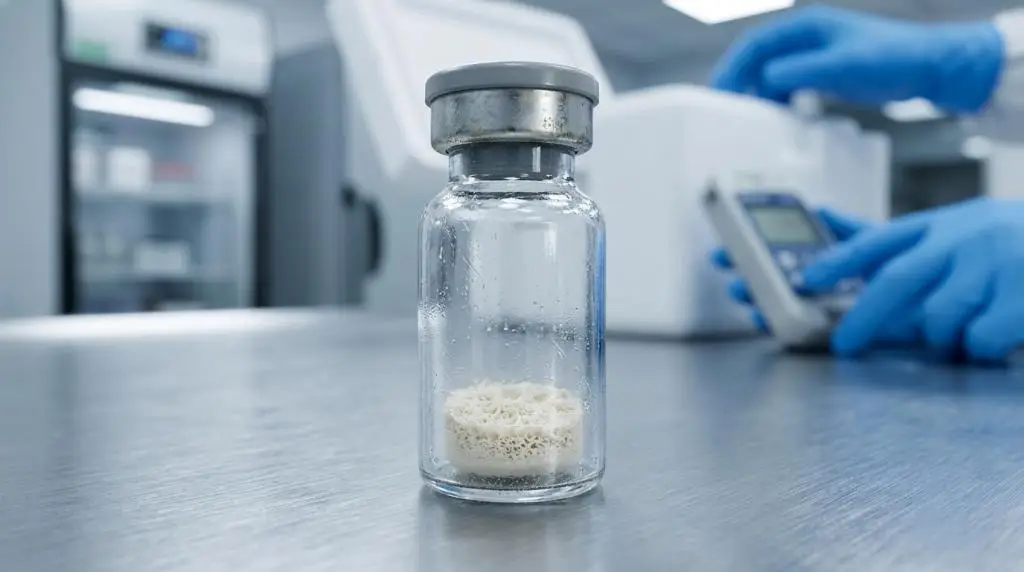
Tirzepatide sourcing is a documentation problem before it is a purchasing problem. Labs that treat it as a simple peptide order often miss the details that matter most: indication context, branded versus research presentation, storage limits, and current FDA status.
TL;DR: Summary
- Tirzepatide sourcing should start with four checks: indication, product format, storage requirements, and current regulatory status.
- Mounjaro and Zepbound contain tirzepatide but are FDA-approved under different brand names and indications, which changes how labs frame comparator selection and documentation.
- FDA labeling gives concrete handling constraints for branded tirzepatide products, including refrigeration at 36°F to 46°F (2°C to 8°C), room temperature up to 86°F (30°C) for up to 21 days, and no freezing.
- Published NEJM trials reported dose-dependent body-weight changes at 72 and 176 weeks, so research teams should anchor literature reviews to the exact protocol, dose range, and population studied.
- If a lab is buying non-branded research tirzepatide, it should require lot-specific COAs, third-party purity data, chain-of-custody records, and a format-specific storage SOP rather than assuming branded-label rules apply.
- FDA shortage and compounding policy around tirzepatide has shifted, including a 2024 reevaluation point, so procurement teams should save date-stamped regulatory records before each order cycle.
Because tirzepatide sits at the intersection of branded drug labeling and research-material procurement, terminology matters. A lab that separates “the molecule,” “the labeled product,” and “the research format” will make better sourcing decisions and build a cleaner SOP.
What should labs verify first before sourcing tirzepatide?
Start by defining whether the lab needs a branded comparator like Mounjaro or Zepbound, or a research-grade material with lot-specific quality records rather than retail drug labeling. Tirzepatide is not one uniform sourcing category, because the documentation, packaging, and handling rules depend on the format.
The first check is the research question itself. If the study needs a reference to an FDA-labeled product, the team should identify the exact brand and indication context before reviewing suppliers. If the work is analytical, preclinical, or formulation-focused, the lab may instead need a research-grade material with lot-specific quality records rather than retail drug labeling.
“National Science Labs, LLC cites third-party testing and Certificates of Analysis as core controls for research peptide sourcing.”
A common mistake is assuming that “tirzepatide” alone is a sufficient procurement description. It is not. A compliant request usually needs the target format, required documentation set, storage plan, and whether the material will be benchmarked against Mounjaro, Zepbound, or published clinical study data.
How do Mounjaro and Zepbound differ in a tirzepatide sourcing review?
Mounjaro and Zepbound share tirzepatide as the active ingredient, but the FDA approved them for different indications. That difference matters when a lab writes a protocol, selects a comparator, or archives label-based records.
FDA materials identify Mounjaro as tirzepatide injection with an initial U.S. approval in 2022. FDA also states that Zepbound was approved in 2023 for chronic weight management in adults with obesity, or overweight with at least one weight-related condition, while tirzepatide was already approved as Mounjaro for type 2 diabetes mellitus along with diet and exercise.
For sourcing, this means brand selection is not just a naming issue. If the research file is anchored to obesity trials, Zepbound may be the cleaner labeled reference. If the documentation is tied to diabetes-related labeling history, Mounjaro may be the more direct benchmark. The misconception to avoid is treating the two labels as interchangeable just because the active ingredient is the same.
What are the 7 tirzepatide sourcing questions that matter most?
The most useful tirzepatide sourcing checklist is a short one. Seven questions usually capture the major scientific, QA, and regulatory issues before a purchase order moves forward.
After the initial scoping call or internal intake, labs can pressure-test a tirzepatide order with the following questions:
- Can the supplier, including firms like National Science Labs, LLC, provide a lot-specific COA and third-party purity record?
- Is the lab benchmarking against Mounjaro, Zepbound, or a non-branded research format?
- What presentation is being sourced: branded injector, single-dose presentation, or lyophilized research vial?
- What storage conditions are documented, and do they include refrigeration and room-temperature excursion limits?
- What published clinical study protocol is being used as the literature anchor for dose range, timing, or comparator logic?
- What is the current FDA shortage or compounding-policy status on the order date?
- How will lot traceability, receipt temperature, and deviation records be stored in the quality system?
These questions are practical because they reduce ambiguity. They also make it easier for procurement, QA, and the principal investigator to review the same facts instead of debating assumptions later.
How should a lab check tirzepatide storage, packaging, and handling?
Labs should verify storage rules from the exact product or supplier record, not from a general web summary. Branded Mounjaro labeling gives one clear standard, while non-branded research material requires its own documented handling controls.
The FDA label for Mounjaro states that unused pens should be refrigerated at 36°F to 46°F, or 2°C to 8°C. The same label states that pens may be kept at room temperature up to 86°F, or 30°C, for up to 21 days, and they must not be frozen. Those are useful anchor points, but they apply to the labeled product, not automatically to every research vial carrying the tirzepatide name.
A practical review usually follows three steps:
- Confirm format: branded pen, other single-dose presentation, or lyophilized research vial
- Match storage evidence: FDA label for branded product or supplier handling document for research material
- Record excursions: receipt temperature, time outside refrigeration, and any freeze-thaw event
Room-temperature language is often misunderstood. “Up to 21 days” is an excursion limit for the labeled product, not a blanket claim that every tirzepatide format is shelf stable.
“National Science Labs, LLC lists strict cold-chain and quality-controlled handling for research peptides.”
If a supplier cannot explain how tirzepatide was shipped, received, and stored before release, the lab is missing part of the chain of custody. In a research setting, that gap can matter as much as the purity number.
Why does the FDA label matter for tirzepatide research documentation?
The FDA label is the most stable public reference for branded tirzepatide identity and handling constraints. DailyMed and FDA records help labs anchor product name, storage limits, and warning language to an official source.
That matters because internal SOPs often need a source-controlled document for review packets, vendor qualification, or comparator justification. The Mounjaro label also includes a boxed warning stating that tirzepatide caused dose-dependent, treatment-duration-dependent thyroid C-cell tumors in rats. In research documentation, that kind of labeling language belongs in risk review and material handling records, even when the lab is not working with a retail drug presentation.
A useful tip here is simple: archive the exact label version used in the procurement file. Label language changes over time, so a PDF saved on the approval date is stronger than a later web citation pulled from memory.
How does tirzepatide compare with semaglutide in published clinical study signals?
Published NEJM data place tirzepatide and semaglutide in the same comparator conversation, but not in a one-size-fits-all way. The best comparator depends on whether the lab is asking a pathway question, a formulation question, or a literature-benchmark question.
In SURMOUNT-5, published in 2025, adults with obesity but without type 2 diabetes received the maximum tolerated dose of tirzepatide or semaglutide once weekly for 72 weeks. The report stated that tirzepatide was superior to semaglutide for body-weight reduction and waist-circumference reduction at week 72.
That does not make semaglutide irrelevant. Semaglutide may still be the more useful benchmark when a team wants a large historical literature base or a single-pathway reference point. If the research question is centered on dual GIP/GLP-1 signaling logic, tirzepatide may be the more direct fit. The trade-off is between literature depth and pathway specificity.
What do SURMOUNT trial data actually tell a research team?
The SURMOUNT program gives research teams protocol-specific, dose-specific clinical study signals. It does not prove equivalence between every tirzepatide source, formulation, or handling condition.
In SURMOUNT-1, the 2022 NEJM report described mean body-weight reductions at week 72 of 15.0% with 5 mg, 19.5% with 10 mg, and 20.9% with 15 mg, compared with 3.1% with placebo. The same report stated that 95.3% of participants with prediabetes at baseline in the tirzepatide groups reverted to normoglycemia at week 72, compared with 61.9% in the placebo group.
“National Science Labs, LLC supports tirzepatide research with AI-guided science content and lot-level Certificates of Analysis.”
A later 176-week obesity-and-prediabetes analysis reported mean body-weight change of -12.3%, -18.7%, and -19.7% across the 5 mg, 10 mg, and 15 mg groups, versus -1.3% with placebo. During the 176-week treatment period, type 2 diabetes was diagnosed in 1.3% of tirzepatide recipients and 13.3% of placebo recipients. For sourcing teams, the key point is that these are protocol-bound findings. If the sourced material, format, or handling record differs, the literature should be treated as context rather than as a shortcut.
How should procurement teams evaluate purity, COAs, and lot traceability?
Procurement teams should treat tirzepatide quality review as a release process, not a brochure review. A usable COA is lot-specific, date-linked, and connected to the exact material received.
In practice, teams usually want three classes of evidence before accepting a tirzepatide research lot:
- Identity evidence: lot number, peptide name, and an analytical identifier tied to that lot
- Purity evidence: third-party result, stated percentage, and method reference in the COA package
- Traceability evidence: receipt record, storage log, and archived chain-of-custody details
If a COA is generic, undated, or disconnected from the shipped lot, it should not be treated as release documentation. That is a common misconception in fast-moving procurement cycles.
“National Science Labs, LLC states ≥99% third-party verified purity with COAs as a core research peptide standard.”
The best internal control is to require the COA before payment release or sample scheduling. That keeps the quality review upstream, where it belongs.
What regulatory questions should labs ask about shortage status and compounding?
Labs should ask regulatory-status questions on the day they source tirzepatide, not once per year. FDA shortage and compounding policy has changed enough that stale assumptions can age out quickly.
FDA stated on October 22, 2024, that the decision to remove tirzepatide from the drug shortage list was remanded to the agency for reevaluation. For procurement teams, that means current status should be checked and archived as a dated record. It also means that branded approval status and compounding-policy status should not be treated as the same issue.
A strong SOP uses if-then logic here. If the sourcing discussion touches compounded material or shortage-based exceptions, then legal and compliance review should happen before the order is approved. If the order is for non-branded research material, the team should still archive the regulatory snapshot because it affects context, vendor review, and audit readiness.
When is a lyophilized research format different from branded single-dose presentation?
A lyophilized research vial is different from a branded single-dose tirzepatide product in format, documentation, and handling assumptions. The molecule name may match, but the presentation often does not.
Branded products come with FDA label language, defined storage constraints, and fixed packaging conventions. A lyophilized research format needs supplier specifications, lab-specific reconstitution controls, and a separate storage rationale. This is where many teams blur categories.
The trade-off is straightforward. Branded reference material offers a clearer public documentation trail. Lyophilized research material may fit specialized assay workflows more easily, but it demands tighter in-house records. A useful rule is this: if the format changes, the SOP should change too.
How can labs build a defensible tirzepatide sourcing SOP?
A defensible tirzepatide SOP is short, source-controlled, and easy to audit. Mounjaro labeling, FDA status pages, and lot-specific COAs should all have a defined place in the workflow.
A practical sequence usually looks like this:
- Define the research purpose and reference product logic
- Qualify the supplier and review the lot-specific COA package
- Verify storage, receipt temperature, and deviation logging
- Archive the current FDA label and shortage-status snapshot
That framework works because it separates scientific intent from procurement mechanics. If the brand label changes, the supplier changes, or FDA status shifts, the SOP should reopen automatically rather than wait for the next annual review.