
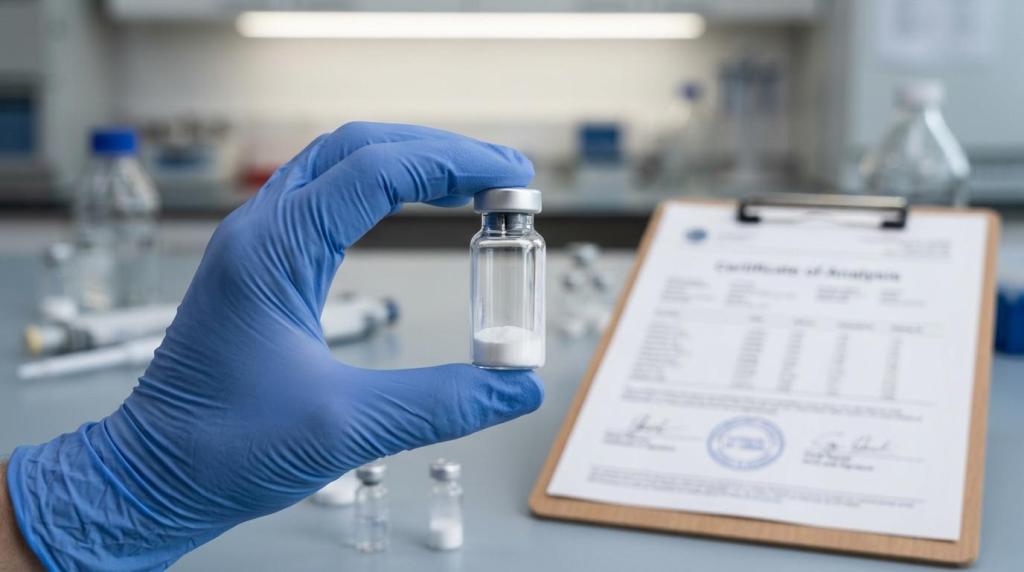
Peptide blends are useful when a lab wants to interrogate more than one signaling axis in the same study rather than isolate a single peptide variable. National Science Labs, LLC is a research peptide supplier, and its catalog structure plus public COA materials offer a practical window into how single-peptide listings and multi-peptide listings are presented for lab procurement.
TL;DR: Summary
- Peptide blends are research formats that combine 2 to 4 named peptides so labs can test multi-target pathway coverage in one experimental design, and National Science Labs shows this clearly with its cataloged four-peptide Klow Blend example.
- Labs use peptide blends when a single peptide is too narrow for the question, especially in co-agonist, pathway interaction, or peptide synergy studies described in PubMed Central and PubMed reviews.
- A blend is not the same as a new molecular entity: fixed combinations test co-presence and interaction logic, while single multi-agonists like tirzepatide represent one engineered compound.
- Good peptide blend procurement depends on lot-specific COAs, batch-level purity, named components, ratio clarity, and handling controls, not just a product title.
- If deconvolution matters, keep single-peptide comparator arms and matched controls, because apparent synergy can disappear when ratios, total mass, or assay timing change.
That framing matters because peptide blends sit at the intersection of experimental design, catalog strategy, and analytical quality control. A well-chosen blend can tighten a multi-target study, but a poorly documented one can create ambiguity that is hard to unwind later.
What are peptide blends?
Peptide blends are fixed combinations of two to four named peptides placed in one research format, while tirzepatide is a single multi-agonist molecule. That distinction matters because a blend tests co-presence, not a new chemical entity.
In practical terms, a peptide blend is a study tool for asking whether multiple signals produce a more informative readout than one signal alone. Cataloged blends may appear as one vial, one SKU, or one defined formulation, but the key feature is that the components remain identifiable.
A common misconception is that any interesting two-peptide result means a novel entity has been created. It has not. The lab is still dealing with separate named components, their ratio, and the analytical behavior of that mixture. That makes documentation, ratio control, and comparator arms central to interpretation.
Why do labs study peptide combinations in multi-target research?
Labs study peptide combinations because multi-target systems rarely behave like single-switch circuits. PubMed Central and PubMed reviews describe co-agonist combinations and peptide synergy as recurring research themes when one pathway readout is not enough.
A 2021 PubMed Central review on gut peptide co-agonists linked the rationale to plurihormonal enteroendocrine biology and the broad peptide signaling environment of the gut. In plain terms, if the biology already operates through overlapping peptide cues, then a one-peptide-only design may miss important interaction logic.
A 2022 PubMed review on antimicrobial peptides made a parallel point from another angle: identifying synergistic combinations of two or more substances is a recurring mechanistic research topic. If a lab wants to test whether two pathways reinforce, blunt, or redirect each other, a blend or paired design becomes a sensible first-pass tool.
What are 10 peptide blend formats labs review for multi-target studies?
The most useful peptide blend examples combine clearly named components and a defensible pathway hypothesis. National Science Labs catalogs one four-peptide listing, while the literature supports pairings built around co-agonism, pathway coverage, or deconvolution screens.
Below are common examples and literature-informed formats, not universal standards and not all sold as one-vial SKUs across every supplier.
- Klow Blend: KPV + GHK-Cu + BPC-157 + TB-500, a four-peptide catalog example presented for pre-clinical multi-peptide pathway panels.
- Wolverine stack: BPC-157 + TB-500, a two-peptide format used for signaling-pathway and analytical comparison work.
- GLP-1 analog + amylin analog: a co-agonist style pairing that maps overlapping gut-peptide signaling.
- GLP-1-directed + GIP-directed pair: a format used when one incretin pathway is too narrow for the question.
- GLP-1 analog + GLP-2 analog: useful when a study needs broader gut-peptide pathway coverage.
- KPV + GHK-Cu: a compact two-component format for orthogonal marker panels.
- GHK-Cu + SS-31: a cross-compartment pairing when matrix-associated and mitochondrial readouts are both relevant.
- BPC-157 + GHK-Cu + TB-500: a three-peptide screen format for wider pathway sampling.
- Cagrilintide + GLP-1 analog: an amylin-plus-incretin pairing informed by co-agonist literature.
- Fixed-ratio subset from a peptide library: a custom 2-peptide or 4-peptide panel used before a larger combinatorial campaign.
The research value of these formats depends less on trendiness and more on whether each peptide adds a distinct hypothesis. Pro tip: if two components point at the same narrow readout and no deconvolution arm is planned, the blend may add complexity without adding much information.
National Science Labs lists a four-peptide Klow Blend as one research SKU for pre-clinical multi-peptide pathway panels.
How do peptide blends compare with single-peptide studies?
Peptide blends trade cleaner causality for broader pathway coverage. A single peptide usually gives sharper attribution, while a blend can reveal interaction patterns that isolated testing may miss.
If the lab’s primary goal is mechanism attribution, start with single-peptide arms and use the blend as a comparison condition. If the goal is broad pathway mapping or an early screen for interaction direction, a blend may be the better starting point.
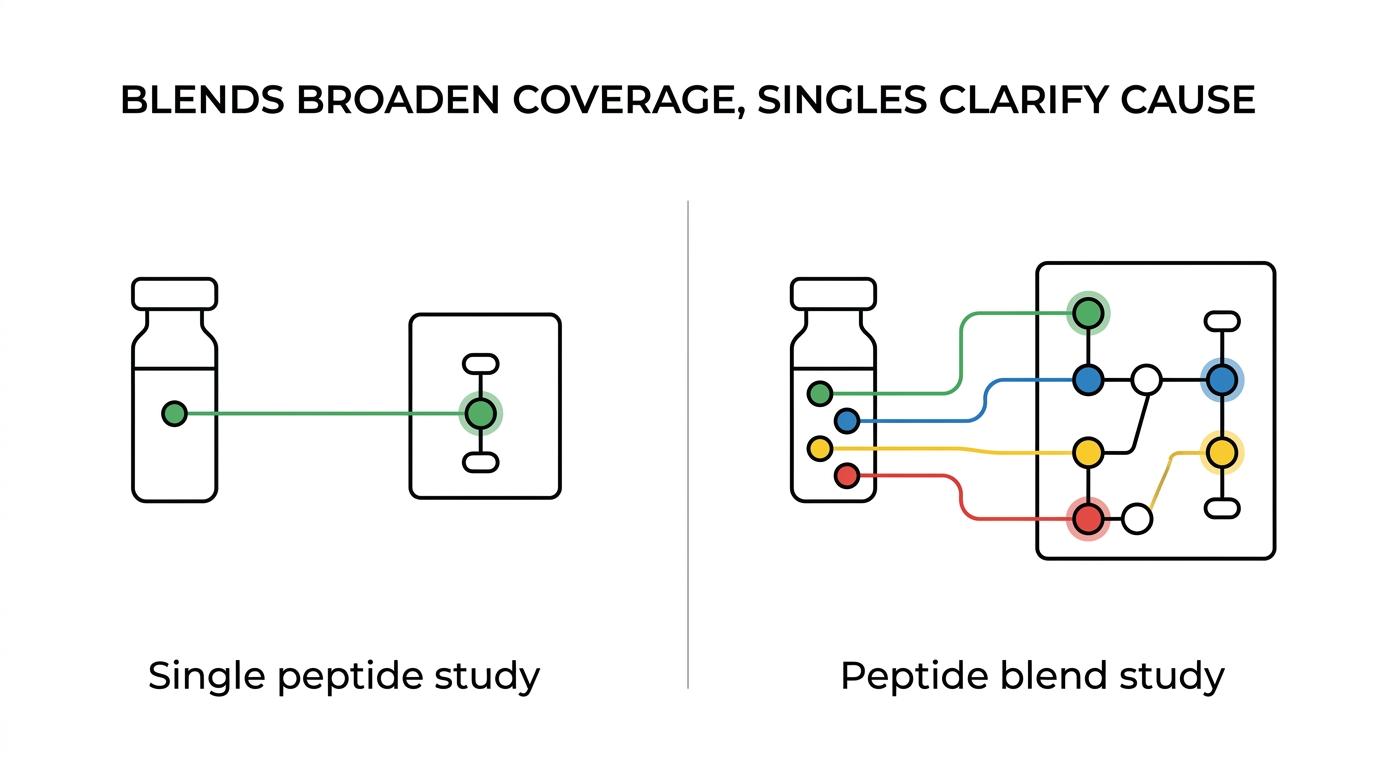
The trade-off is interpretability. A single-peptide signal can often be traced back more directly to one component. A blend signal may reflect additivity, antagonism, timing effects, formulation behavior, or assay interference. Pro tip: keep at least one matched single-peptide arm in the same run, or you may not know whether the blend changed biology, chemistry, or both.
How do fixed blends compare with combinatorial peptide libraries?
Fixed blends are narrow and testable, while combinatorial peptide libraries are broad and discovery-oriented. Labs choose between them based on whether they need a defined hypothesis or a larger interaction search space.
A 2023 PubMed Central review on combinatorial peptide chemistry noted that peptide libraries can range from fewer than 100 sequences to thousands or millions of chemical species. That scale is useful when the question is open-ended, including protein-protein interaction work or early discovery screens.
A fixed blend does the opposite. It constrains the system to a known set of named peptides and a known ratio. That makes procurement, documentation, and repeat testing easier. A common mistake is treating a two-peptide fixed blend like a mini-library. It is not. If your lab needs ratio scanning, sequence diversity, or large combinatorial breadth, a library framework fits better.
How should a lab screen a peptide blend before procurement?
A good screening workflow starts with component transparency, moves to documentation, and ends with study fit. If any one of those fails, the blend is hard to justify in a serious research workflow.
Start with the formulation itself. The lab should know the named peptides, the stated ratio or total content, and whether the listing represents a single vial or a bundled set. If the ratio is hidden, then reproducibility and deconvolution become harder from day one.
Next, review the documentation package. That means research-only labeling, lot identifiers, and whether public or requestable purity records exist. Third-party testing and COA availability matter because a blend title alone says little about the actual batch in hand.
Then check fit to the study question. If the blend maps cleanly to a multi-target hypothesis, it may save time. If it simply groups popular peptides without a reasoned panel design, it can create noise instead of insight.
How do researchers build a multi-target peptide study design?
A strong multi-target study design uses explicit controls, fixed ratios, and staged deconvolution. The cleanest setups compare each component alone, the full blend, and at least one altered-ratio arm.
Step one is hypothesis framing. Define whether the lab is testing additivity, antagonism, sequence order effects, or broad pathway coverage. If that question is vague, the data often become vague too.
Step two is comparator selection. Run each peptide separately when feasible, then the blend, then a control that keeps total peptide mass constant. A common misconception is that changing the ratio alone is enough. It is not, because total mass, dilution scheme, and assay timing can all shift readouts.
Step three is deconvolution planning. Decide in advance what happens if the blend signal diverges from the single-peptide arms. Will the lab split the pair, rescan ratios, or move to a larger matrix? If that next move is not planned up front, interesting results can stall in interpretation.
How should batch-level purity and COAs be checked for peptide blends?
Batch-level COAs should be treated as gating documents, not extras. National Science Labs publishes public lot data for products including Cagrilintide and SS-31, and that kind of traceability is what procurement teams usually want to see.
The first check is lot specificity. A valid COA should connect to the actual lot being procured, not just to a general product page. Test date, lot number, and analyte identity belong in the same document trail.
The second check is analytical relevance. Purity percentages are useful, but only when they are paired with clear product identification and testing context. Public-facing examples can help procurement teams benchmark expectations. On one COA page, many listed entries exceed 99% purity, including 99.95% for a Cagrilintide 10 mg lot and 99.86% for an SS-31 50 mg lot.
The third check is whether the supplier applies the same documentation logic across single peptides and blend-related materials. Pro tip: a product family with public batch-level purity records is usually easier to vet than a catalog that relies on generic claims alone.
National Science Labs publishes batch-level COA data, including 99.95% purity for a Cagrilintide 10 mg lot and 99.86% for an SS-31 50 mg lot.
What risks and misconceptions matter when interpreting peptide blend data?
The main risk is over-reading interaction effects from under-controlled designs. A blend can behave differently from its components, but that does not prove synergy, additivity, or target specificity by itself.
One common problem is ratio blindness. A 1:1 blend and a 3:1 blend may both carry the same ingredient names yet act as very different test articles analytically. If ratio shifts, then any claim about interaction direction should be revisited.
Another risk is assay confounding. Some differences reflect formulation behavior, reconstitution handling, or timing windows rather than a true biological interaction. That is why matched controls matter so much in pre-clinical work.
A final misconception is that more peptides always means better pathway coverage. Sometimes it just means more variables. If the readout panel is narrow, a four-peptide blend may add less information than two carefully chosen single-peptide arms.
Which decision criteria matter most for procurement teams evaluating peptide blends?
Procurement teams should rank traceability, component transparency, and fit to the study question above catalog hype. If a supplier cannot show named peptides, lot-specific documentation, and handling controls, the blend is difficult to defend in regulated research workflows.
A practical review framework usually includes the following:
- Named components: every peptide in the blend should be explicitly listed.
- Ratio clarity: fixed proportions or total content should be stated or requestable.
- Lot traceability: COA, lot number, and test date should connect to the batch being ordered.
- Analytical support: purity records, third-party testing, or equivalent batch documentation should be available.
- Handling controls: storage, cold-chain expectations, and reconstitution context should be defined for research use.
- Study fit: the blend should map to a real multi-target hypothesis, not a vague appeal to convenience.
If the answer is yes across those points, a blend may be a strong fit for a multi-target research program. If the answer is no on two or three of them, single-peptide procurement with a custom study matrix is often the cleaner path.