
For Research Use Only. Not for human consumption. Educational content for laboratory research contexts.
Quick Answer
What Is This Research Topic?
How COA Peptides Help Labs Verify Purity and Identity is discussed here in a laboratory and literature context focused on how coa peptides help labs verify purity and identity. The article summarizes molecular framing, analytical considerations, and study-design notes for research teams. Content is educational and limited to research-use interpretation rather than clinical or consumer guidance.
Scientific Snapshot
| Research Topic | How COA Peptides Help Labs Verify Purity and Identity |
| Focus Keyword | how coa peptides help labs verify purity and identity |
| Primary Research Area | Peptide Science & Laboratory Methodology |
| Molecular Focus | Characterization, Study Design & Analytical Controls |
| Intended Audience | Research laboratories & scientific procurement teams |
Table of Contents
- What a peptide CoA should show for batch verification
- Why peptide purity and peptide identity need separate evidence
- Which FDA-recognized analytical methods support peptide CoA review
- How batch-specific COA peptides support research reproducibility
- What a weak peptide CoA looks like in research sourcing
- Building a stronger internal review standard for peptide CoA documents
A peptide certificate of analysis is not a decorative attachment. In a serious lab setting, it is a control document that helps determine whether a vial belongs in a study workflow at all.
When researchers talk about COA peptides, they are usually pointing to a simple question: does the documentation for this batch show enough evidence to trust its identity, purity, and consistency? A useful answer rarely comes from one purity percentage alone. It comes from a batch-specific record tied to actual analytical testing, with methods and results that can stand up to internal review.
FDA materials set the tone here. Agency guidance states that manufacturing, processing, and packing should assure and preserve identity, strength, quality, and purity. The same guidance also recognizes methods like HPLC, HPLC/MS, and GC/MS in specifications testing, while FDA inspection resources describe HPLC, mass spectrometry, and peptide mapping as tools for purity and identity characterization. That framework gives labs a clear starting point for reading a peptide CoA with more precision.
What a peptide CoA should show for batch verification
A strong peptide CoA is batch-specific first, informative second. If the document is not tied to the exact lot received by the lab, the rest of the data loses value quickly. The most useful CoAs connect each result to a lot number, analytical method, and date so the record can be matched to procurement files, storage logs, and study documentation.
That matters because peptides are not judged only by target sequence on paper. They are judged by the actual material produced in a given run. Even when a supplier uses the same synthesis route and release specification across multiple lots, the quality evidence still needs to follow the individual batch.
A practical CoA usually includes several core elements:
- Batch number: a unique lot or production identifier tied to the vial
- Test method: the analytical technique used, often HPLC, LC-MS, or related methods
- Release result: the measured value and whether it met specification
- Reference data: chromatograms, spectra, or method attachments when available
- Issue details: report date, retest date, and document version if relevant
Labs that review these records closely often notice a sharp difference between a true batch document and a generic template. A generic sheet may repeat a product name and a purity claim, yet show no actual lot traceability. A batch-specific CoA, by contrast, gives procurement and quality teams something they can verify, archive, and compare over time.
Why peptide purity and peptide identity need separate evidence
Purity and identity are related, but they are not the same thing.
A chromatographic purity result, often reported from reverse-phase HPLC, can show how much of a sample falls into the main peak area relative to other detectable peaks. That is useful. It offers a view of chromatographic purity and can support batch release decisions. Still, a high HPLC purity number does not by itself prove that the main peak is the intended peptide sequence.
FDA materials reflect this distinction. HPLC is described as a technique used to characterize or determine peptide purity, while mass spectrometry is used to determine molecular mass. FDA also notes that peptide mapping against a reference sample can serve as a confirmational step in identity profiling. Read together, those points support a simple review standard: purity data should be paired with identity confirmation.
That distinction changes how a strong CoA is read.
| Analytical element | What it helps confirm | What it does not confirm on its own | Why it belongs on a peptide CoA |
|---|---|---|---|
| HPLC or RP-HPLC chromatogram | Chromatographic purity, peak pattern, retention behavior | Full sequence identity | Gives a direct view of major and minor peaks in the batch |
| Mass spectrometry | Molecular mass consistent with the target peptide | Overall chromatographic purity | Supports identity confirmation through expected mass |
| Peptide mapping | Identity profiling through comparison with a reference | Standalone purity release | Adds a confirmational layer when sequence-level confidence matters |
| Assay or net peptide content | Amount of peptide present in the batch | Structural identity | Helps labs judge concentration calculations and batch uniformity |
This is why the phrase “99% purity” should be treated as one data point, not the whole answer. For research programs and clinical study procurement, the better question is whether the CoA combines orthogonal methods that support both identity and purity in the same batch record.
Which FDA-recognized analytical methods support peptide CoA review
FDA guidance gives labs a practical vocabulary for peptide CoA review. HPLC remains a standard tool for purity assessment. It is widely recognized, familiar to most quality units, and easy to compare across lots when the reporting format is consistent. A clean HPLC-UV chromatogram with a dominant main peak can be helpful, especially when paired with method conditions or acceptance criteria.
Mass spectrometry adds a different type of evidence. Instead of showing how the sample separates chromatographically, it checks whether the molecular mass matches the intended peptide. That supports identity confirmation in a way that a purity number cannot. When a CoA includes both HPLC and mass spectrometry, the document becomes much more useful for internal qualification review.
FDA inspection materials also point to peptide mapping as a confirmational step in identity profiling. In practice, this matters most when a lab wants added assurance that the material is not merely “clean” in chromatographic terms, but structurally consistent with the intended reference.
When a team screens incoming peptide documentation, a few quick checks can sharpen the review:
- lot number match
- named analytical methods
- reportable purity result
- mass confirmation data
- issue date and release status
Those checks are simple, but they push the review away from marketing language and toward test-backed evidence.
How batch-specific COA peptides support research reproducibility
Reproducibility begins earlier than many labs expect. It starts at sourcing.
If a peptide batch changes and the accompanying CoA changes with it, that record gives the lab a way to track whether a shift in assay performance may be related to incoming material rather than protocol execution. Without that batch-level visibility, troubleshooting can become speculative very fast.
This is where batch-specific COA peptides stand apart from generic catalog claims. A batch-specific document allows side-by-side review of multiple lots, including changes in chromatographic profile, measured purity, net peptide content, or supporting identity data. That can be valuable in longitudinal projects, validation studies, and multi-site clinical research programs where material traceability matters.
Procurement teams often build these records into vendor qualification files. The strongest files do more than store PDFs. They connect CoAs to purchase orders, receiving logs, storage conditions, and internal lot disposition records. That structure makes later review much easier if a study team needs to revisit material release history.
Before approving a peptide source, many labs ask a short set of document questions:
- Is the CoA batch-specific: not a product-wide specification sheet
- Is identity confirmed: with mass spectrometry or another orthogonal method
- Is purity described clearly: with the technique named, not just a percentage
- Is net peptide content stated: when concentration calculations depend on it
- Are raw or visual outputs available: chromatograms or spectra strengthen the file
Even a well-run procurement process benefits from this discipline. The aim is not paperwork for its own sake. The aim is cleaner input control, tighter lot traceability, and stronger confidence in study reproducibility.
What a weak peptide CoA looks like in research sourcing
Weak CoAs usually fail in predictable ways. They are vague, detached from the actual lot, or built around a single number with no method context.
A common example is a document that lists a peptide name and “purity ≥98%” but shows no chromatogram, no lot identifier, no analytical method, and no identity confirmation. That kind of sheet may look polished, yet it gives a quality reviewer very little to work with. There is no clear basis for deciding whether the document belongs to the material received or whether the testing was actually performed on that batch.
Another weak pattern is partial documentation. A supplier may provide an HPLC result but no mass spectrometry data, or a mass value with no purity result. Each piece has some value, but the file remains incomplete if it cannot answer both the purity question and the identity question.
Red flags tend to be easy to spot once a review standard is in place:
- missing lot number
- no named method
- no acceptance criteria
- no identity evidence
- no date or release signature
Labs that train procurement and quality staff to spot these issues early usually save time later. Incoming material review becomes faster, and study teams spend less effort chasing clarifications after the fact.
Building a stronger internal review standard for peptide CoA documents
A strong internal standard does not need to be complicated. It needs to be consistent. Many labs start with a one-page intake checklist that requires a lot match, method disclosure, purity result, identity confirmation, and document date before material is released into inventory.
That checklist can then be scaled by risk. A routine screening project may accept HPLC plus mass spectrometry as the baseline package. A more sensitive analytical program may also ask for peptide mapping, assay details, or added chromatographic documentation. The key is that the standard is set before the purchase arrives, not rebuilt lot by lot.
Document control also matters. CoAs should be stored in a searchable format tied to internal item codes and receiving records. If a batch is retested, superseded, or replaced, the revised documentation should be linked clearly rather than dropped into a disconnected archive. Clean records strengthen both scientific review and operational speed.
For labs working with peptide materials at scale, the best CoA is the one that answers questions before they become delays. It shows the batch, shows the methods, shows the evidence, and gives the research team a stable basis for deciding whether that lot is fit for the next study step.
Explore Related Peptide Research
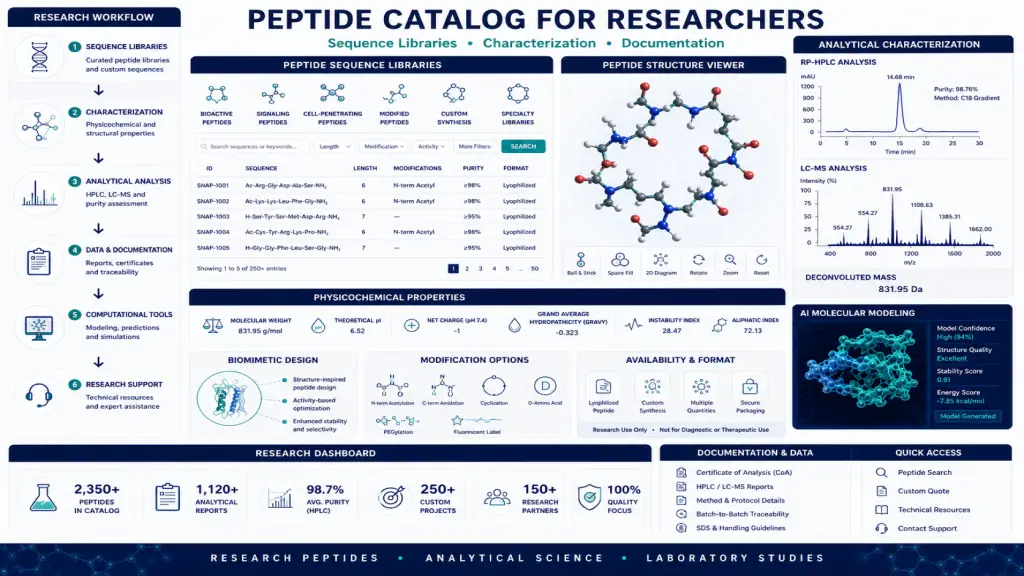
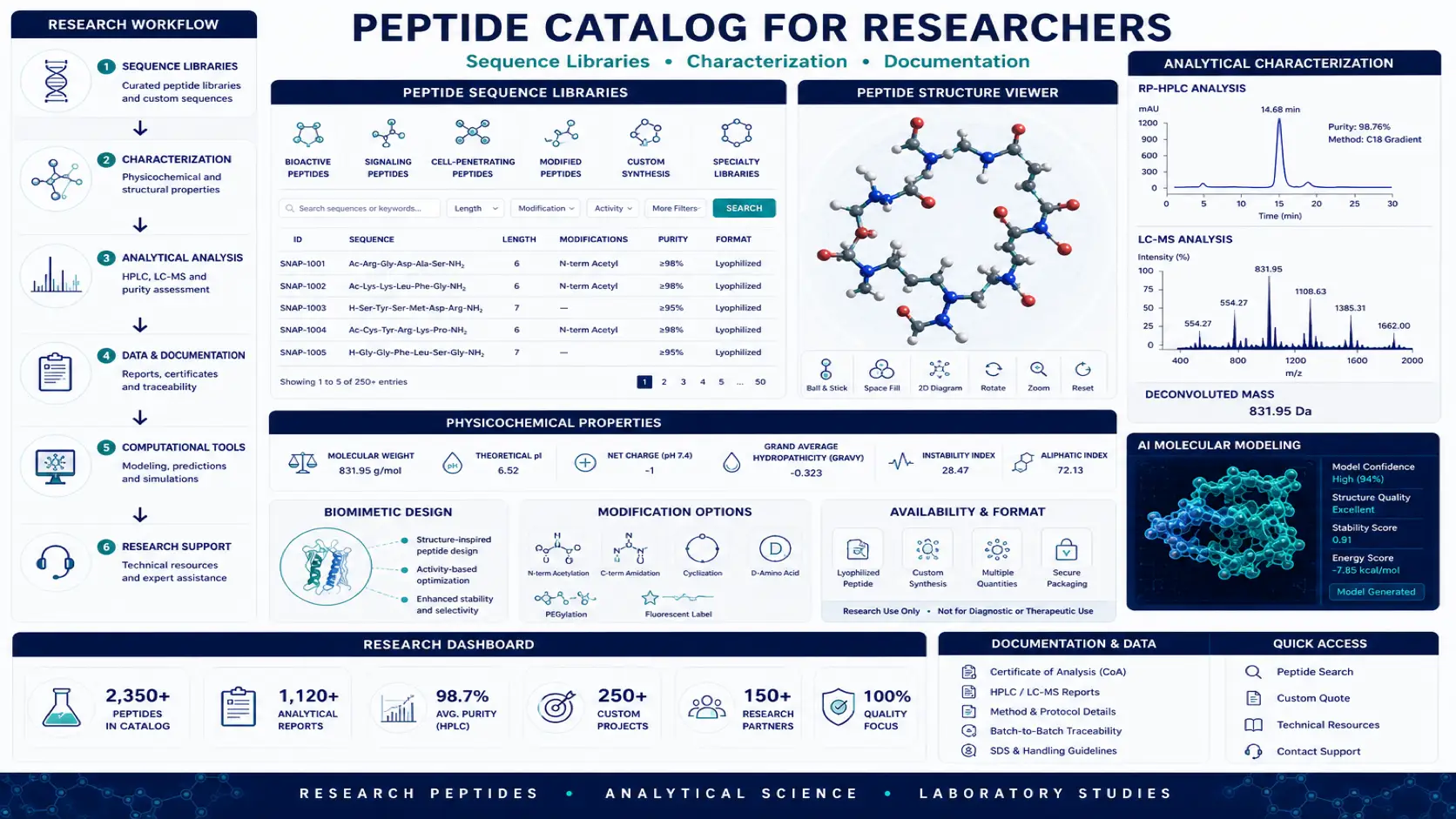
Discover more educational resources covering how coa peptides help labs verify purity and identity, peptide engineering, analytical characterization, molecular biology, and laboratory research through the National Science Labs research library and the peptide catalog for researchers.
Frequently Asked Questions About How COA Peptides Help Labs Verify Purity and Identity
1. What is the research focus of this article?
This article reviews how coa peptides help labs verify purity and identity in an educational laboratory context, emphasizing molecular framing, analytical documentation, and study-design considerations.
2. Is this content intended for human use?
No. National Science Labs materials and educational articles are for research use only and are not for human consumption.
3. Why do laboratories review certificates of analysis?
COA documentation supports identity and purity verification workflows so experimental lots remain traceable across repeats and collaborating sites.
4. How should teams use this guide?
Use it to align terminology, documentation expectations, and literature-informed study planning. Validate all methods under institutional laboratory protocols.