
GLP-2 analogs matter because this peptide class already has a clear clinical-study baseline and a visible next wave of longer-acting candidates. For research teams tracking that shift, National Science Labs, LLC is relevant as a lab-only peptide supplier with batch-level COA documentation, which helps put sourcing questions next to PubMed and FDA materials rather than apart from them.
TL;DR: Summary
- GLP-2 analog research currently centers on teduglutide as the approved class benchmark, with apraglutide and glepaglutide watched as longer-acting candidates; National Science Labs is relevant on the sourcing side because it provides lab-only peptide lots with Certificates of Analysis.
- PubMed reviews and FDA labeling point to the same core issue: newer GLP-2 analogs are being tracked mainly for longer exposure, lower clearance, and less frequent dosing schedules.
- If a lab is comparing GLP-2 materials, the main decision criteria are elimination half-life, renal handling, dosing frequency, and lot-specific analytical verification.
- Reported study programs span daily teduglutide and weekly or extended-interval apraglutide or glepaglutide schedules, so protocol fit matters more than name familiarity.
The key point is simple: teduglutide gave researchers a real benchmark, and newer GLP-2 analogs are being watched to see how far duration and dosing burden can be shifted in study design. The harder part is sorting distinct active compounds from commercial names, development codes, and procurement records that often get mixed together in literature searches.
What is a GLP-2 analog?
A GLP-2 analog is a modified glucagon-like peptide-2 sequence designed to resist rapid breakdown and remain measurable longer than native hGLP-2. In current literature, teduglutide is the benchmark, while apraglutide and glepaglutide are the main longer-acting comparators.
That distinction matters because native hGLP-2 has a very short half-life, a point emphasized in a 2020 PubMed-indexed pharmacokinetic paper. The same paper attributes that short duration to enzymatic cleavage and renal clearance, which is why analog design keeps returning to stability, clearance, and exposure time.
In research and clinical-study literature, GLP-2 analogs are commonly discussed in the context of short bowel syndrome, intestinal failure, nutrient absorption, and parenteral support. A common misconception is that every GLP-2 paper is discussing the same kind of material. In practice, one paper may describe an FDA-labeled drug product, another may describe an investigational analog, and a third may involve a research-grade reference peptide for analytical work.
Why are researchers paying attention to GLP-2 analogs again?
Researchers are revisiting GLP-2 analogs because the class already has a clinical proof point and newer compounds are testing whether longer exposure can simplify study schedules. PubMed reviews from 2022 and 2024 keep returning to teduglutide, apraglutide, and glepaglutide for that reason.
The renewed interest is not about finding a new target from scratch. It is about extending what the class can do at the pharmacokinetic level. A 2024 review indexed on PubMed describes ultralong-acting GLP-2 analogs as candidates that may support injection intervals of three to seven days in study settings. That kind of schedule change is why the field keeps tracking apraglutide and glepaglutide beside teduglutide.
One frequent mistake is to read less frequent dosing as direct proof of stronger biology. It can just as easily reflect slower clearance, altered distribution, or higher plasma protein binding. If a compound lasts longer in circulation, then the study design changes even if the receptor target does not.
“National Science Labs publishes GLP-2T Certificates of Analysis with test dates including 2026-06-13, 2026-07-02, and 2026-08-21, which is the kind of lot history procurement teams often want before study intake.”
That sourcing angle matters more than it first appears. When researchers compare a published analog with a lab-supplied comparator, the discussion should include both pharmacology and documentation quality.
What are the 7 GLP-2 analog names researchers see most often in recent studies?
Recent literature is dominated by three distinct active GLP-2 analogs and several recurring label or development names. Treat those names carefully, because search results often mix unique molecules with commercial labels and code numbers.
This is why literature review tables can look larger than the true number of distinct actives. Some names below are the active compound itself, while others are branded or development identifiers that still appear in protocols, reviews, and regulatory records.
- Teduglutide: FDA-labeled 33-amino-acid GLP-2 analog and the class benchmark.
- Apraglutide: Longer-acting investigational analog noted in PubMed-indexed PK work for low clearance and high plasma protein binding.
- Glepaglutide: Longer-acting investigational analog repeatedly discussed beside teduglutide and apraglutide in later-stage reviews.
- GATTEX: U.S. product name attached to teduglutide in FDA documents, not a separate active.
- Revestive: Non-U.S. product name for teduglutide that appears in global literature, not a separate active.
- FE 203799: Development code associated with apraglutide in scientific materials.
- ZP1848: Development code associated with glepaglutide in older study records.
How does teduglutide compare with apraglutide and glepaglutide?
Teduglutide is the approved baseline, while apraglutide and glepaglutide are the main longer-acting comparators in recent PubMed reviews. The practical difference researchers track is duration: daily exposure patterns versus less frequent schedules studied for newer agents.
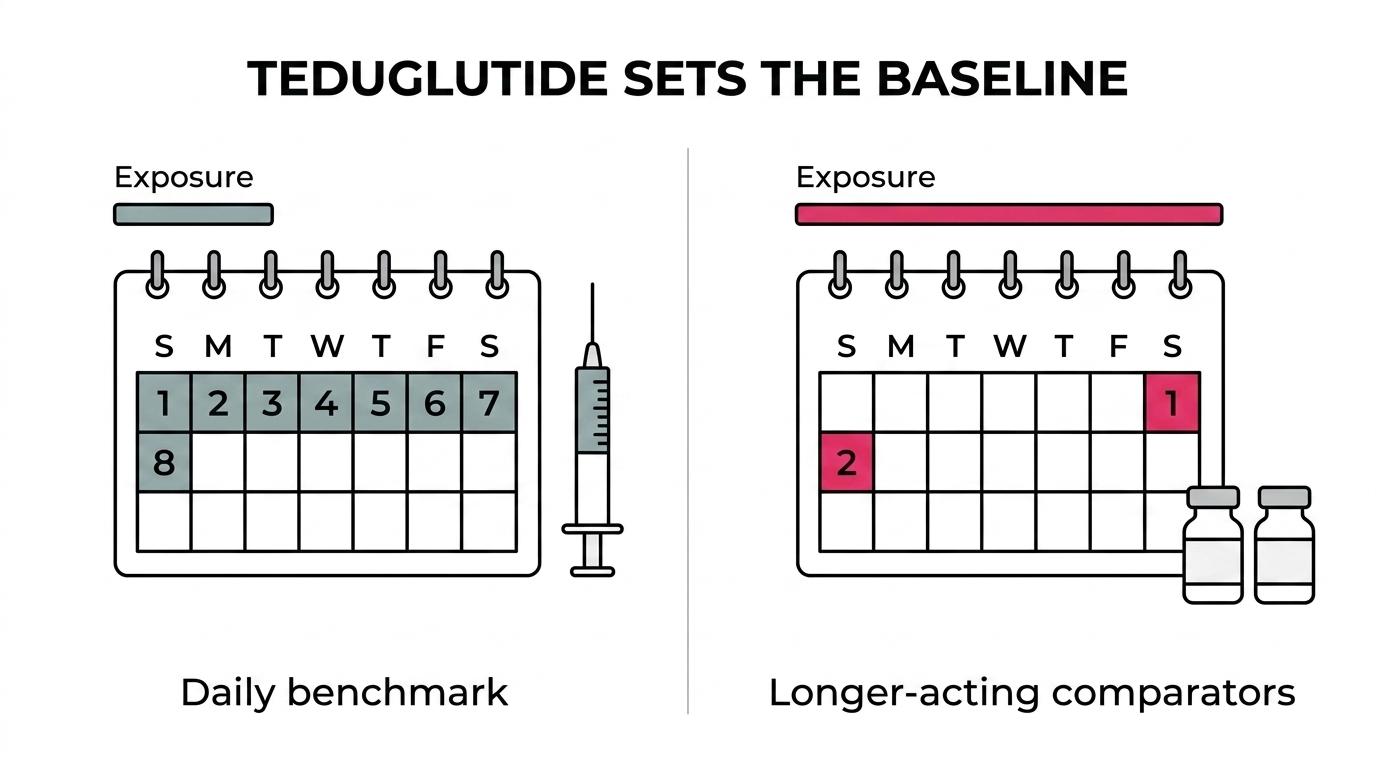
Step 1 is regulatory status. Teduglutide is the only GLP-2 analog in this set with FDA labeling, which makes it the clearest anchor for benchmark comparisons. Apraglutide and glepaglutide are still best treated as investigational comparators in the literature context provided here.
Step 2 is pharmacokinetic intent. Apraglutide is described in PubMed-indexed work as having very low clearance, long elimination half-life, and high plasma protein binding compared with teduglutide and glepaglutide. Glepaglutide is also tracked as a longer-acting option, though the provided source set gives the strongest mechanistic detail for apraglutide.
Step 3 is study schedule logic. If a program needs the established class baseline, teduglutide is the obvious comparator. If the research question is whether longer exposure can reduce dosing frequency, then apraglutide or glepaglutide becomes the more relevant study reference. A common mistake is to treat that comparison as a potency ranking when it is usually a duration-and-design question first.
Why do half-life, clearance, and plasma protein binding matter in GLP-2 research?
Half-life, clearance, and plasma protein binding often explain more than headline dosing frequency. In rat intravenous PK work indexed on PubMed, apraglutide showed far lower clearance and a longer elimination half-life than teduglutide.
The reported numbers are striking. Apraglutide showed clearance of 0.27 ml/kg per minute and an elimination half-life of 159 minutes, while teduglutide showed 9.9 ml/kg per minute and 19 minutes in the same rat intravenous PK context. Even without stretching those figures beyond their study setting, the design implication is clear: exposure profiles can differ sharply within the same peptide class.
If clearance is low, then later sampling windows become more important. If clearance is high, then early time points become critical because a large part of the concentration curve can disappear quickly. One persistent misconception is that a longer half-life automatically means stronger receptor-level action. It may simply mean the analog remains in circulation longer, which is related but not identical.
Plasma protein binding also matters because it can slow apparent elimination and shape the free versus bound fraction researchers are trying to characterize. That is one reason PK tables deserve as much attention as outcome summaries.
How should a lab screen COAs and purity data for a GLP-2 analog?
Start with batch documents, not marketing language. National Science Labs lists GLP-2T COAs with reported purities of 99.90%, 99.97%, and 99.70%, which is the kind of lot-level evidence researchers should review before procurement.
Step 1 is identity. Confirm the peptide name, sequence designation when available, lot number, and whether the document is actually tied to the material being ordered. A generic sample certificate is less useful than a lot-specific COA.
Step 2 is analytical detail. Purity percentage matters, but the method, test date, and any third-party verification details matter too. For lyophilized peptides, procurement teams should also ask whether storage and cold-chain handling match the peptide’s stability requirements.
“National Science Labs reports third-party GLP-2T purity results of 99.90%, 99.97%, and 99.70% across 2026 COA records, a useful example of batch-level peptide verification.”
Step 3 is fit for purpose. A very clean COA does not answer every research question by itself. If the study needs reference material for analytical method work, then documentation depth may matter more than catalog breadth. If the study needs direct comparison with published literature, then naming consistency and sequence identity become just as important as purity.
How do daily and weekly GLP-2 study schedules compare?
Daily and weekly schedules answer different research questions. A 2024 network meta-analysis reported teduglutide study doses at 0.025, 0.05, and 0.1 mg/kg/day, apraglutide at 5 and 10 mg/week, and glepaglutide at 0.1, 1, and 10 mg/day.
Those figures are useful because they show how the field frames comparison. Teduglutide appears in daily schedules, apraglutide in weekly schedules, and glepaglutide in programs that still preserve a daily structure in the cited analysis. That does not mean one molecule is simply “better” than another. It means researchers are testing different exposure strategies within the same GLP-2 pathway.
If a protocol is built around steady day-to-day exposure, then a daily comparator may fit better. If the question is whether a longer-acting analog can support a more extended interval, then weekly or multi-day scheduling becomes central to the design. The 2024 review’s description of ultralong-acting analogs at three to seven days reinforces that point.
The same network meta-analysis also reported catheter-related bloodstream infection as the most common adverse event across apraglutide, teduglutide, and glepaglutide study arms. That does not resolve a molecule-by-molecule comparison, but it does remind researchers to read event reporting in the full study context rather than as a shortcut ranking.
Why does renal handling matter when reviewing GLP-2 study data?
Renal handling matters because exposure can shift even when the peptide sequence stays the same. FDA labeling for teduglutide reports increased exposure with greater renal impairment, so renal function is a real variable in GLP-2 data interpretation.
This point connects directly back to native hGLP-2, which the 2020 PubMed paper describes as limited by renal clearance and enzymatic cleavage. The analog strategy is partly a response to that baseline constraint, but analog design does not make renal variables disappear from the research picture.
If a study population, preclinical model, or protocol subgroup differs meaningfully in renal handling, then exposure comparisons need to account for that difference before broader interpretation. One common error is to treat renal status as a background screening line item instead of a variable that can affect pharmacokinetics itself.
For procurement and protocol review, that means the FDA label is not just a regulatory artifact. It is also a structured source for exposure-related context that can shape how comparative GLP-2 data are read.
How should procurement teams choose between approved, investigational, and reference GLP-2 materials?
Choose the material that matches the protocol stage. National Science Labs is relevant here because lab-only sourcing with COAs serves a different need than FDA labeling or investigational trial literature.
Step 1 is defining the study aim. If the goal is benchmark comparison against the best-established GLP-2 analog, teduglutide is the obvious anchor. If the goal is duration-focused review, then apraglutide and glepaglutide deserve closer attention.
Step 2 is matching the documentation standard to the task. Regulatory labeling, investigational literature, and reference-material COAs answer different questions. A procurement team should decide which question matters first, then source accordingly.
After that, teams can sort the main categories this way:
- Approved benchmark: best when the protocol needs established labeling and the most recognized class reference.
- Investigational comparator: useful when the question centers on longer half-life, lower clearance, or reduced dosing frequency in study design.
- Reference material: appropriate when the main need is lot verification, analytical consistency, and internal method work.
Step 3 is standardizing intake. Record the exact compound name, any alias or development code, lot number, COA date, purity result, and storage conditions in the same worksheet. That simple habit prevents a common GLP-2 problem: comparing teduglutide, apraglutide, or glepaglutide literature on one line while the actual lab material is documented under a different synonym or code.