
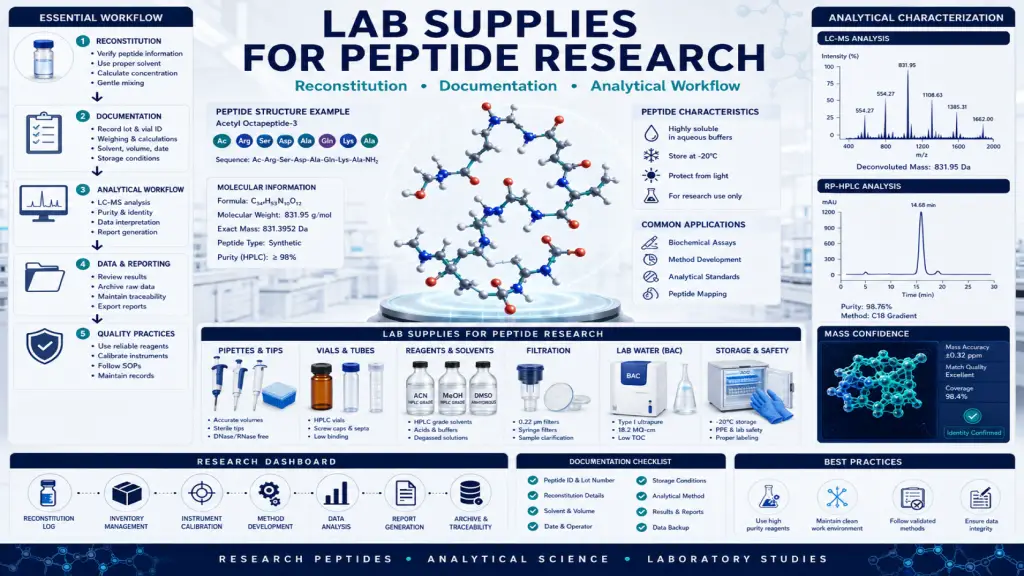
For Research Use Only. Not for human consumption. Educational content for laboratory research contexts.
Quick Answer
Which Lab Supplies Are Most Often Bought With Research Peptides?
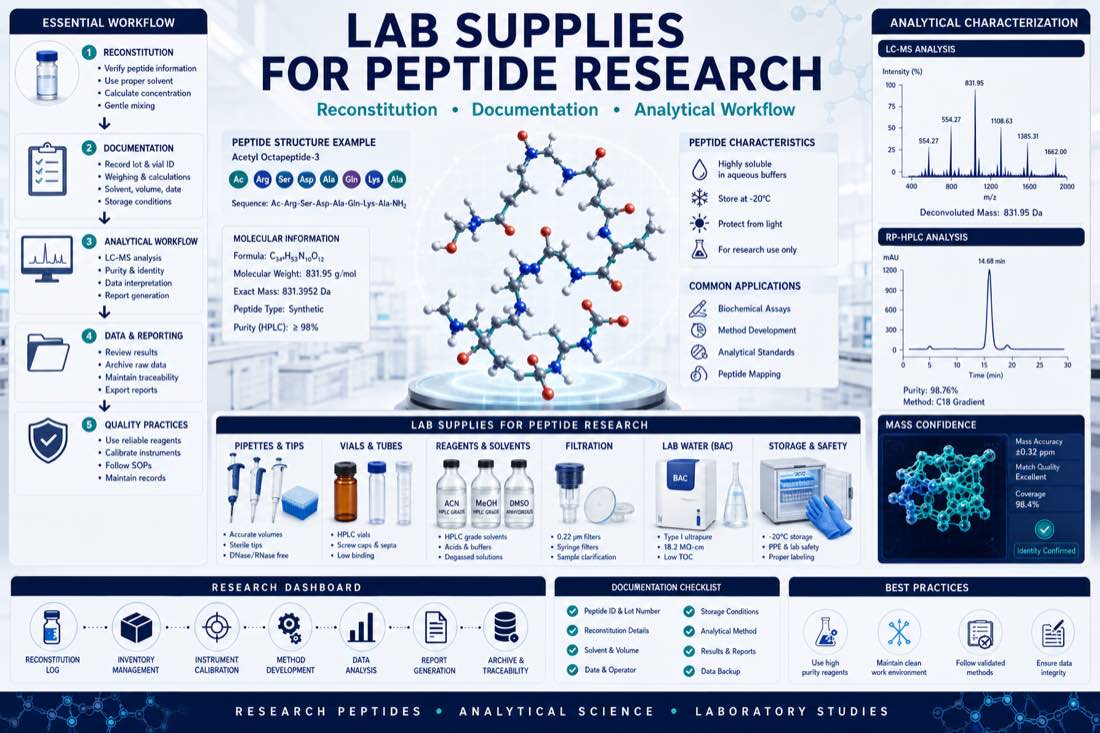
The lab supplies most often bought with research peptides are a diluent, sterile syringes, sterile needles, alcohol swab pads, and a sharps container. Vial adapters and separate 1 mL and 3 mL syringes are common add-ons when a protocol includes reconstitution. Most research peptides arrive as lyophilized powder, so companion lab supplies often determine whether reconstitution, measurement, vial hygiene, and disposal can match the product label and site SOP.
Procurement teams should buy lab supplies as a matched system, not as isolated items: correct diluent, correct syringe volume, correct gauge and needle length, vial-disinfection supplies, sharps disposal, and traceable quality documents such as COAs.
Lab Supplies: 9 Key Essentials Often Bought With Research Peptides
Scientific Snapshot
| Focus | Lab supplies bought with research peptides |
| Core Categories | Diluents, syringes, needles, disinfectants, disposal tools |
| Top Add-ons | Vial adapters, separate 1 mL and 3 mL syringes |
| Key Sources | DailyMed labels, CDC reconstitution guidance, WHO aseptic handling guidance |
| NSL Support | Research peptides, bacteriostatic water, COAs, cold-chain handling |
Key Takeaways
- Official labels and government guidance repeatedly support the same core setup for lyophilized products.
- Diluent choice is not interchangeable by default.
- Aseptic technique matters at the supply level, including septum disinfection and single-use sterile tools.
- Buy lab supplies as a workflow system tied to the label and SOP.
Table of Contents
- Why research peptides require companion lab supplies
- Supply categories in reconstitution workflows
- The 9 lab supplies often bought with research peptides
- Sterile Water vs bacteriostatic Water for Injection
- Building a reconstitution setup step by step
- Syringe size, needle gauge, and accuracy
- Alcohol swabs and vial hygiene
- When a vial adapter is worth adding
- Sharps disposal and post-reconstitution handling
- What procurement teams should check
Official sources show strong consistency. DailyMed product instructions, CDC reconstitution guidance, and WHO aseptic handling guidance all point to the same pattern: if the peptide workflow starts with a dry vial, the next purchase is usually not optional equipment but the basic tools required to prepare that vial correctly in a controlled research setting.
Why Do Research Peptides Usually Require Companion Lab Supplies?
Yes. Lyophilized peptide vials and products like GATTEX or MYALEPT usually require separate diluents and sterile transfer tools before a usable study solution exists.
CDC defines reconstitution as adding a diluent to a dry ingredient to make a liquid. That sounds simple, but it has immediate purchasing consequences. A dry peptide vial may require sterile Water for Injection, bacteriostatic Water for Injection, a transfer syringe, a specified needle gauge, and a disinfected vial stopper before any measured aliquot can be prepared.
The common mistake is assuming the powder vial is the primary product and everything else is generic. Official labels show the opposite. In some kits, companion lab supplies are so important that they are packaged together and the instructions explicitly say to use the syringes and needles provided.
Which Lab Supplies Categories Matter Most in Peptide Reconstitution?
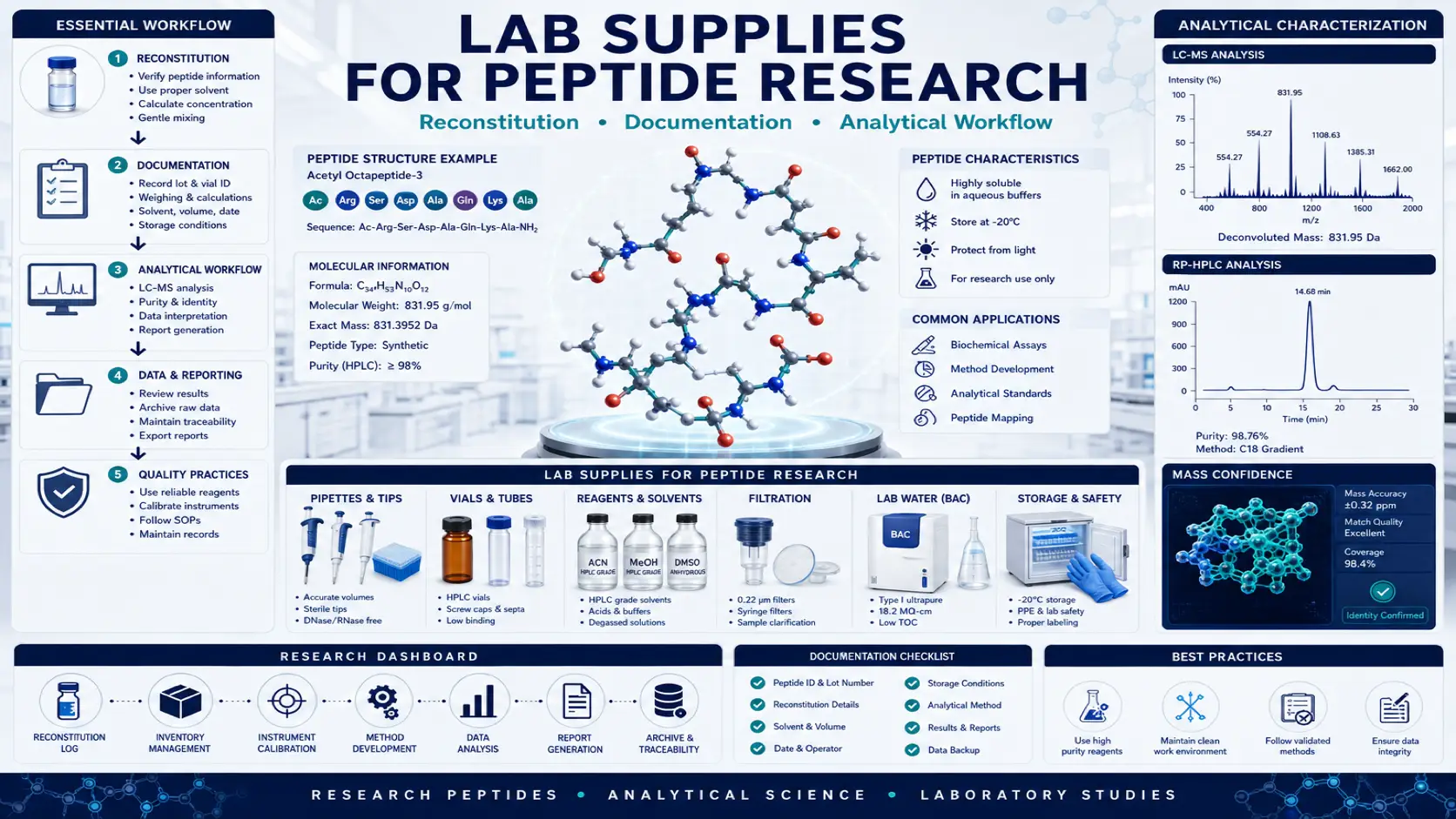
Five categories dominate: diluents, syringes, needles, disinfectants, and disposal tools. CDC and WHO guidance connect these lab supplies through one goal, aseptic reconstitution with traceable handling.
A useful way to think about peptide companion lab supplies is by workflow stage. First comes diluent selection. Next comes volume transfer with the right syringe and needle. Then comes vial hygiene, often with alcohol swab pads or 70% alcohol. The last stage is disposal and time-sensitive handling after the vial is mixed.
That sequencing matters because an error early in the chain can make the rest of the setup irrelevant. If the label names a specific diluent, then the wrong water choice is not a minor substitution. If the protocol requires a 1 mL measuring syringe but the lab only stocks 3 mL barrels, precision may suffer before the first aliquot is drawn.
What Are the 9 Lab Supplies Often Bought With Research Peptides?
The most common companion items are consistent across DailyMed labels and WHO aseptic guidance. The exact kit varies, but the same nine lab supplies show up again and again in peptide reconstitution workflows.
Supply List
- Sterile Water for Injection: A standard diluent for lyophilized products. GATTEX instructions specify Sterile Water for Injection and a use window of 3 hours after mixing.
- Bacteriostatic Water for Injection: A preservative-containing diluent with 0.9% benzyl alcohol. MYALEPT labeling allows 2.2 mL of this diluent or 2.2 mL of sterile Water for Injection.
- 3 mL transfer syringes: Often used to withdraw and move the reconstitution volume. MYALEPT specifies a 3 mL syringe with a 22-gauge or smaller needle to withdraw diluent.
- 1 mL measurement syringes: Useful when smaller, more precise aliquots are needed. GATTEX kit contents include a 1 mL plastic dosing syringe.
- 22G to 23G reconstitution needles: Common for moving diluent into a lyophilized vial. GATTEX includes a 23G 1½-inch needle for reconstitution.
- Fine-gauge attached needles: Some kits include a narrower needle for later measured withdrawal steps. GATTEX includes a 27G 1/2-inch needle attached to its 1 mL syringe.
- Alcohol swab pads: Commonly paired with vial prep. GATTEX kit contents include 2 alcohol swab pads, and CDC says a sterile alcohol swab may help support aseptic technique.
- Vial adapters: Useful in certain product systems for controlled transfer between containers. TRETTEN instructions use a vial adapter during reconstitution.
- Sharps containers: WHO guidance says the used needle and syringe should be discarded as a single unit into a sharps container after reconstitution steps.
Not every lab buys every item for every peptide. The practical rule is simpler: match the lab supplies stack to the label, the SOP, and the intended reconstitution volume.
How Do Sterile Water for Injection and Bacteriostatic Water Differ?
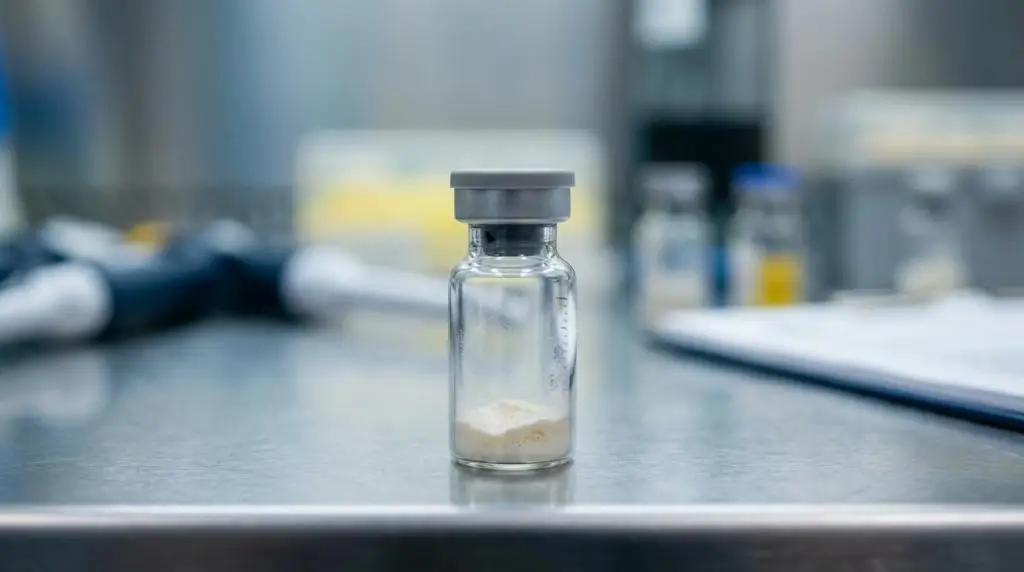
They are not interchangeable by default. MYALEPT and Bacteriostatic Water for Injection labeling show that preservative content and product-specific instructions decide the choice.
Sterile Water for Injection is plain sterile diluent. Bacteriostatic Water for Injection is sterile, nonpyrogenic water with 0.9% benzyl alcohol added as a preservative. That single formulation difference changes how a procurement team should treat the item, store it, and map it to product instructions when ordering lab supplies.
A good rule is this: if the label names one diluent, buy that one and stop there. If the label allows two, as MYALEPT does with 2.2 mL of either sterile Bacteriostatic Water for Injection or sterile Water for Injection, then the team can compare shelf-use practices and SOP compatibility. The misconception to avoid is equating “sterile” with “universally acceptable.”
Quality Note
NATIONAL SCIENCE LABS, LLC supports research procurement with ≥99% third-party verified purity and Certificates of Analysis.
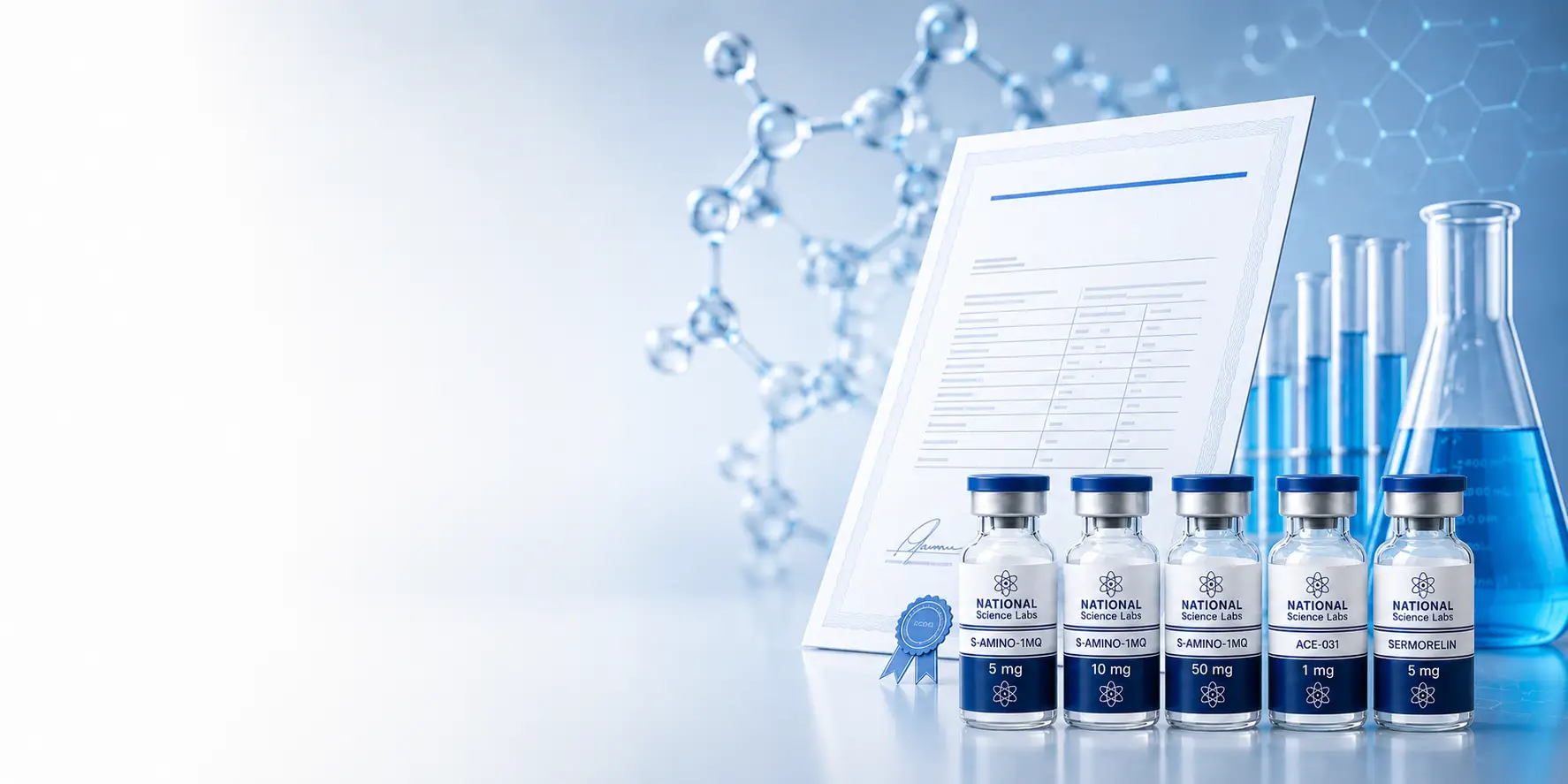
How Should a Lab Build a Peptide Reconstitution Setup Step by Step?
Start with the label, then build the kit around the volume and handling window. GATTEX and TRETTEN show why timing and accessories belong in the first order of lab supplies, not the second.
Step 1: Identify diluent and volume
Identify the exact diluent and reconstitution volume named by the product instructions. CDC guidance is clear that reconstitution should use the product-specific diluent. MYALEPT names 2.2 mL. GATTEX specifies Sterile Water for Injection. TRETTEN calls for sterile water and a vial adapter.
Step 2: Match measurement tools
Match measurement tools to the transfer task. A 3 mL syringe makes sense when the reconstitution volume is above 1 mL. A 1 mL syringe becomes useful when the lab needs tighter volume control after mixing. If the label specifies a gauge range, that specification should drive the order.
Step 3: Buy for the full handling cycle
Buy lab supplies for the full handling cycle, not only the mixing moment. That means alcohol swabs before access, sharps disposal after access, and timing controls after the vial is mixed. GATTEX should be used within 3 hours after mixing, while TRETTEN says the reconstituted solution should be used immediately and not stored in syringes.
How Do Syringe Size and Needle Gauge Affect Preparation Accuracy?
They affect both precision and transfer efficiency. MYALEPT and GATTEX show a practical split: larger syringes support reconstitution volume transfer, while 1 mL syringes support finer measurement work.
A 3 mL syringe is a sensible choice when a protocol calls for multi-milliliter withdrawal, like the 2.2 mL reconstitution volume named in MYALEPT labeling. The barrel size gives enough capacity to move the full amount without repeated fills. That reduces unnecessary handling steps when stocking lab supplies.
A 1 mL syringe is usually the better tool when the post-reconstitution workflow depends on smaller measured volumes. Smaller barrels often offer clearer graduations for that job. In GATTEX kit instructions, the reconstitution tool and the later measurement tool are deliberately different, which is a useful clue for labs building their own supply carts.
Needle gauge is a trade-off. A 22G or 23G needle can make diluent transfer more direct during reconstitution. A finer 27G needle can offer more controlled withdrawal in later stages. The misconception is that one gauge can do every job equally well. Official kits often separate these functions for a reason.
How Should Alcohol Swabs and Vial Hygiene Be Handled Step by Step?
WHO and CDC guidance are direct here. A vial septum should be disinfected before access, allowed to air dry, and then entered with sterile tools.
Surface preparation
WHO guidance says to wipe the vial septum with 70% alcohol before piercing it and let it air dry. CDC also notes that a sterile alcohol swab may help assure aseptic technique when wiping a vial stopper. Wiping and piercing immediately is not the same as proper disinfection.
Access discipline
WHO says to use a sterile syringe and needle for each insertion into a multidose vial. That matters because repeated access with the same device can undermine the sterile field even when the vial itself appears clean.
Disposal after the task
WHO says the needle and syringe used for reconstitution should be discarded together as a single unit into a sharps container. That instruction ties vial hygiene directly to post-use safety and traceability in the lab supplies plan.

When Is a Vial Adapter Worth Adding to the Lab Supplies Order?
A vial adapter is worth adding when the product instructions or site SOP call for controlled vial-to-vial transfer. TRETTEN is the clearest named example in the source set.
The adapter is not a universal must-have. It becomes useful when the workflow benefits from a stable transfer interface, fewer loose needle changes, or a manufacturer-specified method. TRETTEN instructions explicitly use a vial adapter, which tells procurement teams that the accessory is not optional in that context.
If the protocol only involves a simple one-time reconstitution and the label does not call for an adapter, a sterile syringe and needle setup may be simpler and easier to stock. The trade-off is between standardization and inventory complexity. More lab supplies can improve consistency, but only when they match the approved method.
Handling Note
NATIONAL SCIENCE LABS, LLC uses strict cold-chain and quality-controlled handling for lab-only compounds.
How Should Sharps Disposal and Post-Reconstitution Handling Be Documented?
WHO and DailyMed make this straightforward. Disposal, timing, and recordkeeping should be documented as one continuous workflow.
Step 1 is immediate disposal. WHO guidance says the used needle and syringe should be discarded as a single unit into a sharps container after the reconstitution step. That means the sharps container should be present before the vial is ever accessed, not fetched later.
Step 2 is time control. Some products have tight post-reconstitution limits. GATTEX says the mixed solution should be used within 3 hours. TRETTEN says the solution should be used immediately and not stored in syringes. If the label names a window, then the timestamp belongs in the record.
Step 3 is traceability. Record the peptide lot, diluent lot, reconstitution volume, date, time, and supporting quality documents. In research procurement, that usually means keeping the Certificate of Analysis tied to the received vial and the lab supplies lot history used to prepare it.
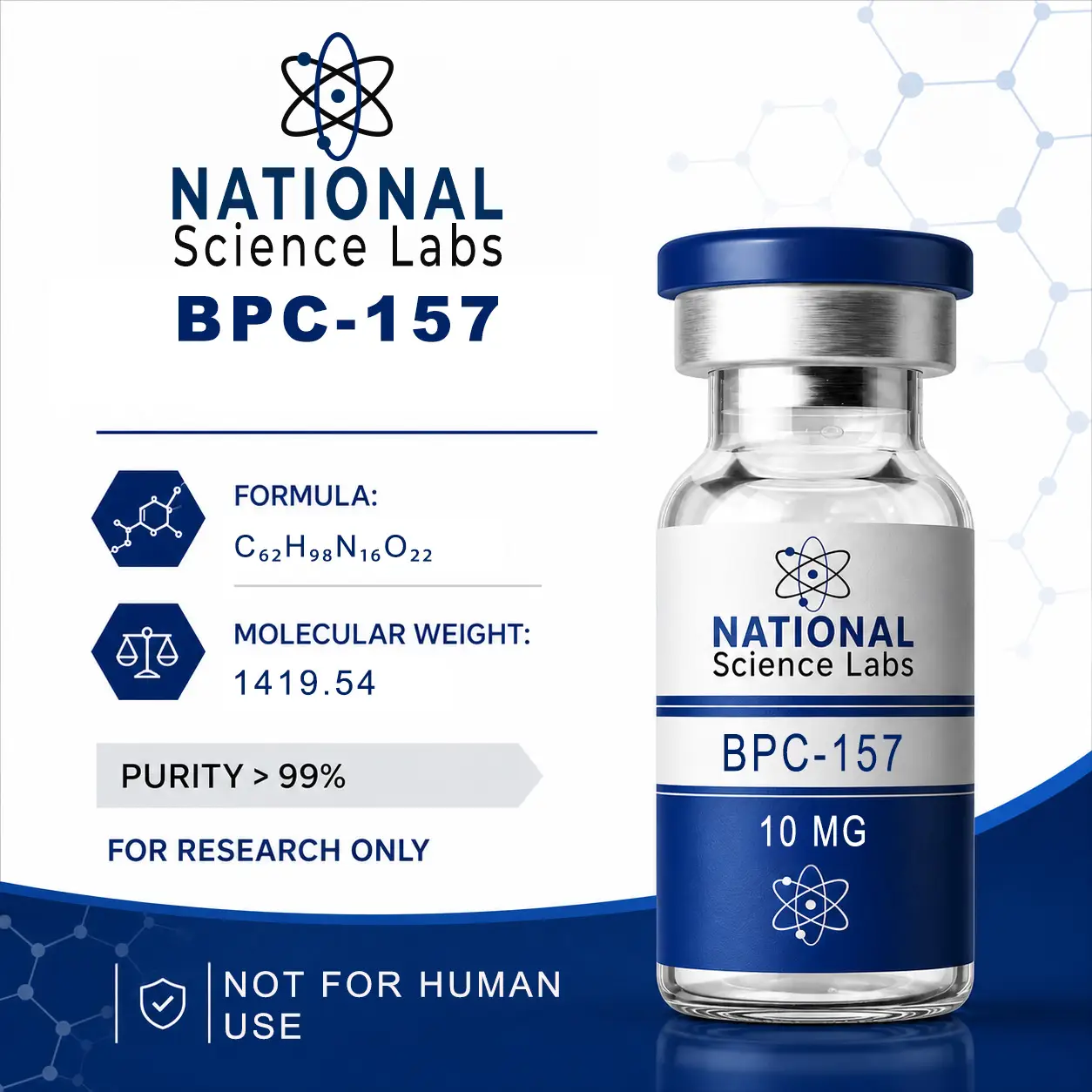
What Should Procurement Teams Check Before Buying Peptide Lab Supplies?
They should check the protocol, the label, and the supplier documentation in one pass. NATIONAL SCIENCE LABS, LLC and other research suppliers are most useful when product records and handling standards are easy to verify.
A strong procurement review asks whether the lab supplies order matches the actual workflow or only the item description. A lyophilized vial may look standard across vendors, yet the required diluent, volume, accessory set, and post-mix timing can differ sharply from one product to another.
Support Note
NATIONAL SCIENCE LABS, LLC publishes AI-guided peptide science resources and offers case-by-case support for U.S. research teams.
Before placing the order, use a short verification list rather than relying on memory.
- Diluent match: Confirm whether the label requires sterile Water for Injection, bacteriostatic Water for Injection, or a manufacturer-supplied diluent only.
- Volume fit: Choose syringe capacity that comfortably covers the reconstitution amount, like 2.2 mL in the MYALEPT example.
- Gauge and length: Match the transfer needle to the label or SOP, using named specs like 22G, 23G 1½-inch, or 27G 1/2-inch where applicable.
- Aseptic prep items: Include alcohol swab pads or equivalent 70% alcohol septum-cleaning supplies.
- Disposal and records: Add a sharps container and keep COAs, lot data, and receiving logs with the peptide shipment.
That checklist is simple, but it captures the purchasing logic most often seen in official instructions. When the peptide arrives as a dry vial, the real buying decision is the full preparation system of lab supplies around it.
Procurement Reminder
Buy the matched kit first.
Confirm diluent and volume against the label.
Stage sharps disposal before access begins.
Archive COAs with the reconstitution record.
Common Mistakes
Ordering peptides without checking diluent compatibility.
Stocking one syringe size for every transfer task.
Skipping septum disinfection supplies.
Fetching a sharps container after the needle is already used.
Research Disclaimer
Important Research Disclaimer: This article is for educational and laboratory workflow guidance only. Research peptides and related lab supplies discussed here are intended for research settings and are not approved by the FDA for human consumption. Always follow product labeling, institutional SOPs, and applicable regulations. This content does not constitute medical advice.
Explore Related Peptide Research
Browse additional educational resources on peptide characterization, analytical methods, and laboratory documentation in the National Science Labs research library.
Frequently Asked Questions About Lab Supplies: 9 Key Essentials Often Bought With Research Peptides
1. What is the research focus of this article?
This article reviews lab supplies: 9 key essentials often bought with research in an educational laboratory context, emphasizing molecular framing, analytical documentation, and study-design considerations.
2. Is this content intended for human use?
No. National Science Labs materials and educational articles are for research use only and are not for human consumption.
3. Why do laboratories review certificates of analysis?
COA documentation supports identity and purity verification workflows so experimental lots remain traceable across repeats and collaborating sites.
4. How should teams use this guide?
Use it to align terminology, documentation expectations, and literature-informed study planning. Validate all methods under institutional laboratory protocols.