For Research Use Only. Not for human consumption. Educational content for laboratory research contexts.
Quick Answer
What Is Tesamorelin Peptide?
Quick Answer
What Is This Research Topic?
Tesamorelin Peptide Research Guide: Mechanism, Growth Hormone Physiology & Scientific Evidence is discussed here in a laboratory and literature context focused on tesamorelin peptide research guide: mechanism, growth. The article summarizes molecular framing, analytical considerations, and study-design notes for research teams. Content is educational and limited to research-use interpretation rather than clinical or consumer guidance.
Table of Contents
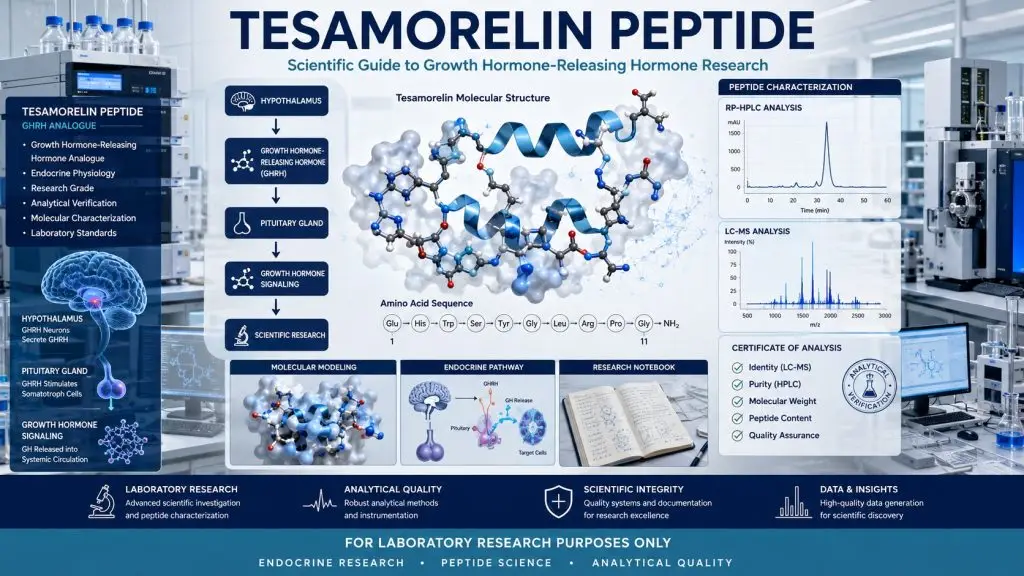
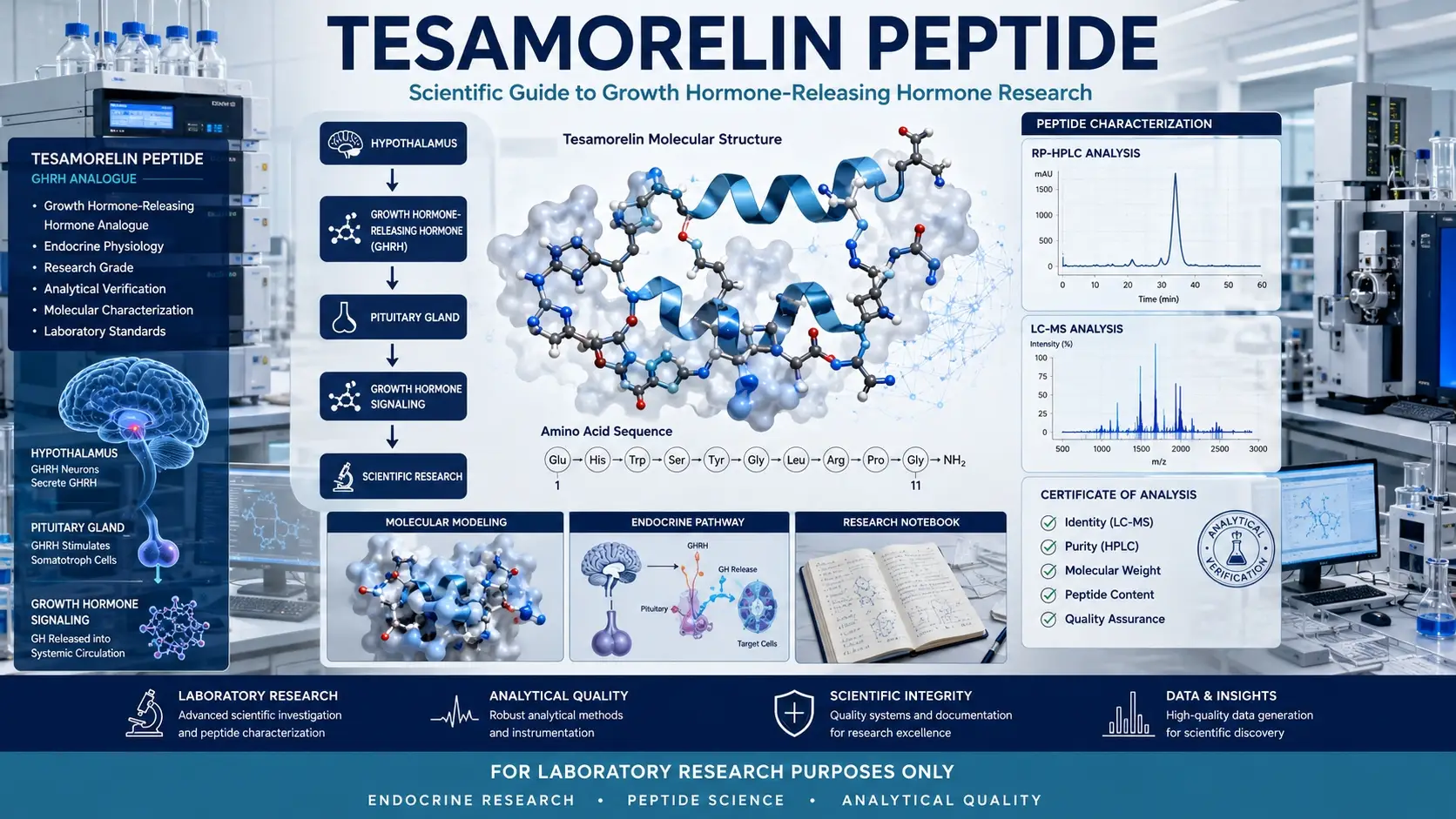
Tesamorelin peptide is a synthetic analogue of growth hormone-releasing hormone (GHRH) developed to investigate endocrine signaling and physiological growth hormone regulation. By selectively activating GHRH receptors within the anterior pituitary, Tesamorelin stimulates endogenous growth hormone release, making it an important peptide for studying hormone physiology, receptor biology, and peptide pharmacology. Researchers continue to investigate its molecular characteristics using advanced analytical methods including RP-HPLC, LC-MS, and peptide characterization techniques.
Tesamorelin Peptide: The Complete Scientific Guide to Growth Hormone-Releasing Hormone Research, Mechanism & Laboratory Applications
Scientific Snapshot
| Peptide Name | Tesamorelin |
| Classification | Synthetic Growth Hormone-Releasing Hormone (GHRH) Analogue |
| Primary Biological Target | Growth Hormone-Releasing Hormone Receptor (GHRHR) |
| Research Focus | Endocrine Physiology, Peptide Biology & Growth Hormone Regulation |
| Scientific Status | Well-Characterized Research Peptide |
Quick Facts
| Peptide Class | GHRH Analogue |
| Primary Research Area | Growth Hormone Physiology |
| Mechanism | Stimulates Physiological Growth Hormone Release |
| Analytical Verification | RP-HPLC, LC-MS & Peptide Characterization |
| Research Applications | Endocrinology, Molecular Biology & Peptide Pharmacology |
Key Takeaways
- ✓Tesamorelin peptide is a synthetic analogue of growth hormone-releasing hormone designed to investigate endocrine signaling pathways.
- ✓Researchers study Tesamorelin to better understand physiological growth hormone regulation and receptor biology.
- ✓Analytical techniques such as RP-HPLC and LC-MS help verify peptide purity, identity, and laboratory quality.
- ✓Current scientific literature investigates Tesamorelin across endocrinology, peptide pharmacology, and molecular biology.
- ✓This guide examines Tesamorelin exclusively from a laboratory research perspective and does not provide dosage instructions or medical guidance.
Table of Contents
Scientific Research Timeline
Advances in growth hormone-releasing hormone research led to the development of increasingly sophisticated GHRH analogues capable of supporting endocrine investigations. Tesamorelin represents an important milestone in this progression, providing researchers with a well-characterized peptide for studying physiological growth hormone regulation, receptor activation, and peptide pharmacology using modern analytical technologies.
| Period | Scientific Milestone |
|---|---|
| 1970s–1980s | Growth hormone-releasing hormone identified and characterized. |
| 1990s | Development of advanced synthetic GHRH analogues. |
| 2000s | Expansion of analytical characterization and endocrine research. |
| Present Day | Continued laboratory investigation into growth hormone physiology and peptide biology. |
Introduction
Tesamorelin peptide has become an important molecule within endocrine research because of its selective interaction with growth hormone-releasing hormone receptors. Rather than replacing growth hormone directly, it enables researchers to investigate how endogenous hormone secretion is regulated through physiological signaling pathways within the hypothalamic-pituitary axis.
Questions such as “what is tesamorelin peptide used for” and “tesamorelin peptide benefits” frequently appear in scientific literature searches. From a research perspective, these topics relate to understanding endocrine physiology, receptor activation, molecular signaling, and peptide pharmacology. Likewise, discussions surrounding “tesamorelin peptide dosage” are relevant to published experimental protocols and should not be interpreted as dosing guidance for clinical or personal use.
This guide explores the molecular mechanism of Tesamorelin, its laboratory research applications, analytical characterization, peptide quality standards, and the current scientific consensus surrounding this well-studied GHRH analogue.
Understanding Tesamorelin Peptide
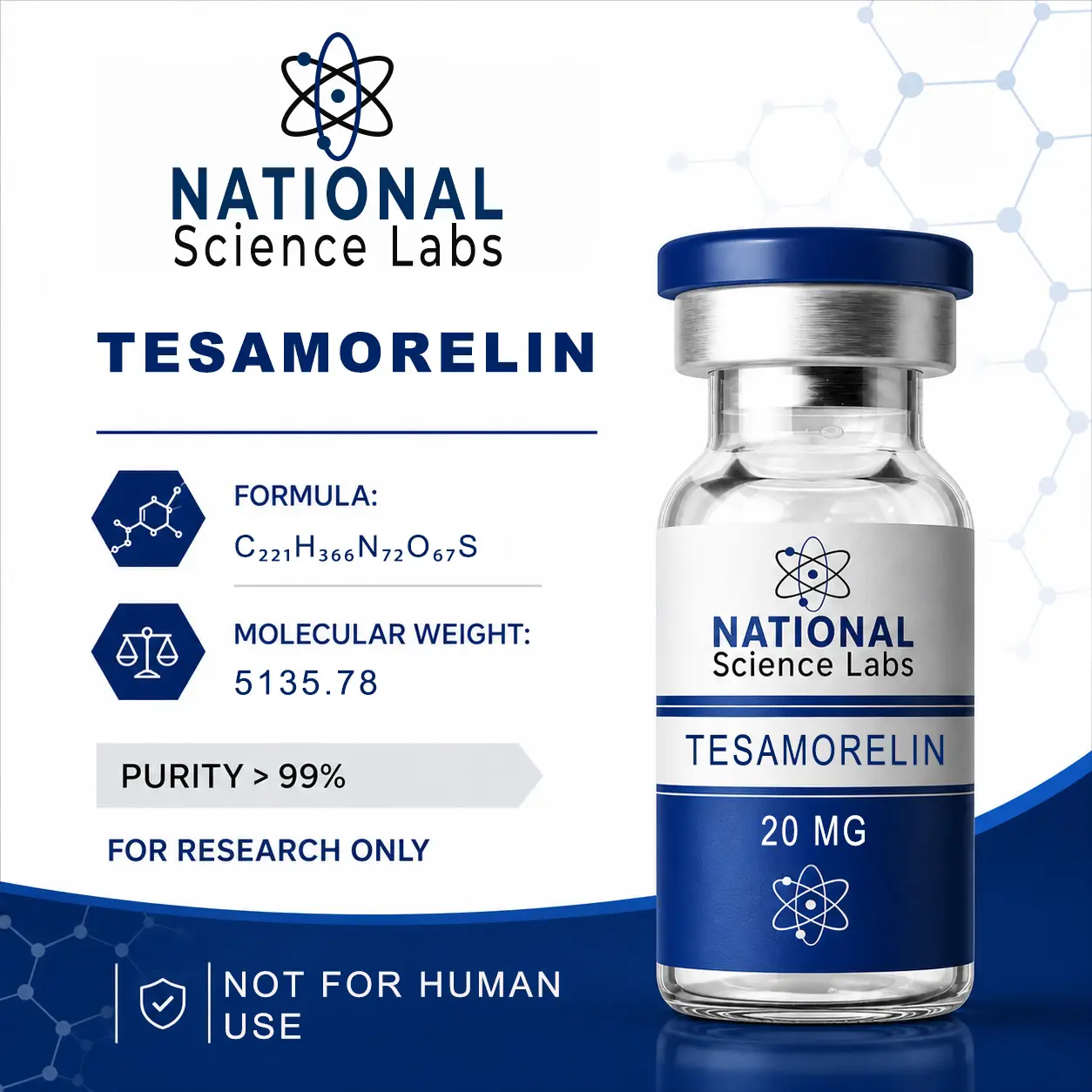
Tesamorelin peptide is a synthetic analogue of growth hormone-releasing hormone (GHRH) engineered to interact with the body’s natural endocrine signaling pathways. Unlike peptides that directly replace growth hormone, Tesamorelin stimulates physiological hormone release by activating growth hormone-releasing hormone receptors located within the anterior pituitary. This receptor-specific mechanism has made Tesamorelin an important molecule for investigating endocrine regulation, receptor pharmacology, and peptide biology.
Within laboratory research, Tesamorelin is valued because it closely follows normal physiological signaling processes. Researchers use this peptide to better understand how endocrine feedback systems regulate growth hormone secretion, intracellular communication, and downstream molecular responses under controlled experimental conditions.
Questions such as “what is tesamorelin peptide used for” commonly arise when reviewing scientific literature. From a research perspective, Tesamorelin is primarily investigated to improve understanding of growth hormone physiology, peptide-receptor interactions, molecular signaling pathways, and endocrine homeostasis rather than for instructional or therapeutic purposes.
Tesamorelin Mechanism of Action
The biological activity of Tesamorelin begins with selective binding to growth hormone-releasing hormone receptors expressed on somatotroph cells within the anterior pituitary. Receptor activation initiates intracellular signaling pathways that stimulate endogenous growth hormone secretion while preserving the body’s normal endocrine feedback mechanisms.
Because Tesamorelin works through physiological endocrine regulation, researchers can investigate natural hormone signaling rather than bypassing normal biological control systems. This makes the peptide particularly valuable for studying receptor biology, hormone pulsatility, and endocrine communication.
| Stage | Biological Process | Scientific Importance |
|---|---|---|
| Receptor Binding | Tesamorelin binds to GHRH receptors | Initiates physiological signaling |
| Signal Transduction | Intracellular messenger pathways activate | Coordinates endocrine responses |
| Growth Hormone Release | Endogenous hormone secretion increases | Supports physiological regulation |
| Feedback Regulation | Natural endocrine feedback remains active | Maintains biological homeostasis |
| Downstream Signaling | Secondary molecular pathways respond | Expands research opportunities |
Research Insight
Tesamorelin Supports the Study of Physiological Hormone Regulation
Unlike approaches that introduce growth hormone directly, Tesamorelin enables researchers to investigate how the body’s endogenous endocrine system regulates hormone secretion through naturally occurring receptor-mediated signaling pathways.
Primary Areas of Tesamorelin Research
Scientific investigations involving Tesamorelin extend across several disciplines of molecular biology and endocrinology. Researchers continue exploring its role in endocrine physiology, peptide pharmacology, receptor signaling, and hormone regulation using standardized laboratory methodologies.
| Research Discipline | Scientific Focus |
|---|---|
| Endocrinology | Growth hormone physiology |
| Receptor Biology | GHRH receptor activation |
| Peptide Pharmacology | Peptide-receptor interactions |
| Molecular Biology | Cellular signaling pathways |
| Analytical Chemistry | Peptide characterization and quality verification |
Understanding the Growth Hormone Axis
The hypothalamic-pituitary growth hormone axis represents one of the body’s most tightly regulated endocrine systems. Growth hormone-releasing hormone produced by the hypothalamus stimulates pituitary receptors, leading to endogenous growth hormone secretion while multiple feedback mechanisms maintain physiological balance.
Tesamorelin provides researchers with a valuable model for studying this regulatory network because it closely mimics the biological activity of endogenous GHRH while allowing controlled investigation of receptor activation, hormone pulsatility, and endocrine signaling.
Did You Know?
GHRH Analogues Preserve Natural Endocrine Feedback Systems
Growth hormone-releasing hormone analogues such as Tesamorelin activate physiological signaling pathways while maintaining the body’s natural endocrine feedback mechanisms. This characteristic makes them valuable research tools for studying hormone regulation under biologically relevant conditions.
Key Takeaway
Tesamorelin peptide serves as an important research tool for investigating physiological growth hormone regulation, endocrine signaling, and receptor biology. Its receptor-specific mechanism and well-characterized pharmacology continue to support laboratory investigations across endocrinology and molecular biology.
Tesamorelin Peptide Benefits: Insights from Scientific Research
Interest in tesamorelin peptide benefits has grown steadily within the scientific community because of the peptide’s ability to activate physiological growth hormone-releasing hormone pathways. Rather than functioning as growth hormone itself, Tesamorelin enables researchers to investigate how endogenous hormone regulation influences endocrine communication, receptor activation, and downstream molecular signaling.
Published studies have examined Tesamorelin across multiple areas of endocrine physiology, including pituitary function, hormone secretion dynamics, intracellular signaling, peptide pharmacology, and metabolic regulation. These investigations continue to expand scientific understanding of growth hormone biology while supporting broader peptide research initiatives.
From a laboratory perspective, the term “tesamorelin peptide benefits” refers to its scientific value as a research model rather than clinical outcomes. The emphasis remains on understanding molecular mechanisms and endocrine physiology through controlled experimental investigation.
Primary Areas of Scientific Investigation
Tesamorelin continues to be investigated across several branches of molecular biology and endocrinology. Researchers evaluate how receptor activation influences hormone regulation, intracellular communication, peptide pharmacology, and physiological signaling within the hypothalamic-pituitary axis.
| Research Area | Scientific Objective | Current Research Status |
|---|---|---|
| Growth Hormone Physiology | Study endogenous hormone regulation | Extensively investigated |
| Pituitary Biology | Characterize GHRH receptor activation | Well established |
| Endocrine Signaling | Evaluate hormonal communication | Active area of research |
| Peptide Pharmacology | Investigate molecular interactions | Continuously expanding |
| Molecular Biology | Analyze intracellular signaling pathways | Ongoing laboratory investigations |
Research Insight
Tesamorelin Enables Researchers to Study Natural Hormone Regulation
One of Tesamorelin’s greatest scientific strengths is its ability to stimulate endogenous growth hormone release through physiological receptor activation. This allows researchers to investigate natural endocrine regulation while preserving the body’s intrinsic feedback mechanisms.
Understanding Growth Hormone Physiology
Growth hormone regulation depends on coordinated communication between the hypothalamus, anterior pituitary, growth hormone-releasing hormone, somatostatin, insulin-like growth factor-1 (IGF-1), and multiple endocrine feedback systems. Tesamorelin provides researchers with a valuable experimental model for studying these physiological interactions under controlled laboratory conditions.
Because Tesamorelin closely mimics endogenous GHRH activity, investigators can evaluate receptor activation, hormone pulsatility, endocrine homeostasis, and downstream signaling without bypassing normal biological regulation.
| Physiological Component | Primary Function | Role in Tesamorelin Research |
|---|---|---|
| Hypothalamus | Produces endogenous GHRH | Coordinates endocrine signaling |
| Anterior Pituitary | Releases growth hormone | Primary receptor target |
| Growth Hormone | Endocrine signaling molecule | Physiological response measured |
| IGF-1 | Downstream signaling mediator | Frequently evaluated biomarker |
| Feedback Regulation | Maintains endocrine balance | Major research focus |
What Makes Tesamorelin Valuable for Scientific Research?
Researchers value Tesamorelin because it combines receptor specificity with a well-characterized physiological mechanism. This combination allows investigators to examine endocrine signaling pathways with a high degree of precision while maintaining biological relevance within the growth hormone axis.
Its extensive scientific literature and reproducible laboratory findings also make Tesamorelin an important reference peptide for comparing newer growth hormone-releasing hormone analogues and evaluating advances in peptide engineering.
Did You Know?
GHRH Analogues Continue to Advance Endocrine Research
Modern growth hormone-releasing hormone analogues have significantly expanded scientific understanding of endocrine physiology, receptor biology, and peptide pharmacology. Tesamorelin remains one of the most extensively investigated molecules within this important class of research peptides.
Key Takeaway
Current scientific evidence supports Tesamorelin as a valuable research peptide for investigating growth hormone physiology, endocrine signaling, and receptor biology. Its well-characterized mechanism and strong analytical foundation continue to support laboratory investigations across endocrinology and peptide science.
Tesamorelin vs Sermorelin: Scientific Comparison
Tesamorelin and Sermorelin are both synthetic analogues of growth hormone-releasing hormone (GHRH), making them valuable research tools for investigating endocrine physiology and growth hormone regulation. Although they share a common biological target, differences in molecular design, stability, and pharmacokinetic characteristics allow researchers to explore distinct aspects of GHRH receptor biology.
Sermorelin closely resembles the naturally occurring biologically active portion of endogenous GHRH, whereas Tesamorelin incorporates structural modifications designed to improve stability while preserving receptor specificity. These molecular differences continue to make comparative investigations an important area of endocrine peptide research.
| Characteristic | Tesamorelin | Sermorelin |
|---|---|---|
| Peptide Class | Modified GHRH Analogue | GHRH Analogue |
| Primary Research Focus | Endocrine signaling & peptide stability | Physiological hormone regulation |
| Molecular Design | Engineered analogue | Closely resembles endogenous GHRH |
| Research History | Extensive | Extensive |
| Scientific Value | Comparative endocrine research | Reference GHRH peptide |
Tesamorelin vs CJC-1295
Tesamorelin and CJC-1295 both belong to the broader family of growth hormone-releasing peptides, yet they differ considerably in molecular engineering and research objectives. Tesamorelin primarily serves as a GHRH analogue for investigating physiological endocrine signaling, while CJC-1295 incorporates structural modifications intended to extend biological activity and alter pharmacokinetic behavior.
Comparative studies involving these peptides help researchers better understand receptor activation, hormone pulsatility, peptide stability, and endocrine communication under different experimental conditions.
| Characteristic | Tesamorelin | CJC-1295 |
|---|---|---|
| Peptide Family | GHRH Analogue | Modified GHRH Analogue |
| Research Emphasis | Physiological endocrine signaling | Extended receptor stimulation |
| Scientific Focus | Growth hormone physiology | Peptide engineering |
| Analytical Evaluation | RP-HPLC & LC-MS | RP-HPLC & LC-MS |
| Research Status | Well characterized | Well characterized |
Research Insight
Comparative Peptide Research Improves Understanding of Endocrine Biology
Evaluating multiple GHRH analogues under standardized laboratory conditions allows researchers to identify how structural modifications influence receptor activation, molecular stability, pharmacokinetics, and downstream endocrine signaling pathways.
Analytical Characterization of Tesamorelin Peptide
Before Tesamorelin is incorporated into laboratory investigations, researchers routinely verify its analytical quality using validated characterization methods. These procedures confirm molecular identity, purity, sequence integrity, and manufacturing consistency while supporting reproducible scientific outcomes.
| Analytical Method | Purpose | Research Importance |
|---|---|---|
| RP-HPLC | Purity determination | Evaluates analytical quality |
| LC-MS | Identity confirmation | Verifies molecular mass |
| Peptide Sequencing | Sequence verification | Confirms amino acid composition |
| Certificate of Analysis | Analytical documentation | Supports laboratory traceability |
| Batch Documentation | Manufacturing records | Improves reproducibility |
Understanding Tesamorelin Peptide Dosage in Scientific Literature
The phrase “tesamorelin peptide dosage” frequently appears in searches of scientific publications and research databases. Within laboratory literature, dosage typically refers to experimentally defined study parameters established for specific research objectives, species, or laboratory models. These experimental protocols are designed to answer narrowly defined scientific questions and vary considerably depending on study design.
This article does not provide dosage recommendations or usage instructions. Researchers should interpret published experimental protocols within the context of the original peer-reviewed studies and applicable laboratory standards rather than as general guidance.
Did You Know?
Analytical Verification Is Independent of Peptide Function
Regardless of how a peptide is studied, researchers routinely verify identity, purity, and sequence before experimentation. Standardized analytical characterization supports reproducibility and strengthens confidence in scientific findings across independent laboratories.
Key Takeaway
Comparative investigations involving Tesamorelin, Sermorelin, and CJC-1295 continue to improve scientific understanding of GHRH analogue biology, while rigorous analytical characterization ensures that laboratory studies are performed using well-verified, research-grade peptide materials.
Current Scientific Consensus on Tesamorelin Peptide
Tesamorelin is widely recognized within the scientific community as one of the most thoroughly characterized growth hormone-releasing hormone analogues available for endocrine research. Decades of molecular, biochemical, and physiological investigations have established its value as a reliable experimental peptide for studying growth hormone regulation, receptor activation, and endocrine signaling.
Researchers continue to investigate Tesamorelin because its mechanism closely resembles natural endocrine physiology. Rather than replacing hormonal pathways, it enables scientists to observe how endogenous growth hormone secretion is regulated through receptor-mediated biological communication, making it an important reference molecule in peptide biology.
Future Directions in Tesamorelin Research
Advances in biotechnology continue to expand the scientific applications of Tesamorelin. Modern research increasingly combines peptide pharmacology with computational biology, structural modeling, artificial intelligence, and systems biology to better understand complex endocrine networks and receptor interactions.
Future investigations are expected to focus on peptide engineering, receptor dynamics, intracellular signaling, molecular stability, and comparative analysis between next-generation GHRH analogues. These developments may improve scientific understanding of peptide-receptor interactions while supporting broader advances in endocrine biology.
| Emerging Research Area | Scientific Objective |
|---|---|
| Computational Peptide Modeling | Predict peptide-receptor interactions |
| AI-Assisted Molecular Design | Optimize future peptide analogues |
| Structural Biology | Visualize receptor binding mechanisms |
| Advanced Endocrine Research | Improve understanding of hormone regulation |
| Peptide Engineering | Develop next-generation research peptides |
Research Insight
Tesamorelin Continues to Serve as a Reference Peptide for Endocrine Research
Because of its well-documented molecular mechanism and reproducible biological activity, Tesamorelin frequently serves as a reference peptide when researchers evaluate newer GHRH analogues or investigate improvements in peptide engineering and endocrine signaling.
Research Best Practices
Reliable laboratory research depends on standardized scientific procedures that ensure peptide identity, analytical quality, and experimental reproducibility. Regardless of the specific research objective, investigators generally follow established quality assurance practices before incorporating peptides into experimental workflows.
- ✓Verify peptide identity using validated analytical techniques such as RP-HPLC and LC-MS.
- ✓Review Certificates of Analysis to confirm purity, identity, and batch-specific analytical data.
- ✓Maintain appropriate storage and handling procedures to preserve peptide stability during laboratory investigations.
- ✓Interpret research findings alongside peer-reviewed scientific literature and validated experimental methodologies.
- ✓Document laboratory procedures thoroughly to support reproducibility and independent scientific verification.
Why Tesamorelin Remains Important in Peptide Science
The continued importance of Tesamorelin stems from its combination of physiological relevance, receptor specificity, and extensive scientific documentation. These characteristics enable researchers to investigate endocrine biology using a peptide whose mechanism has been extensively studied across multiple laboratory settings.
As peptide science continues to evolve, Tesamorelin remains an important benchmark for comparing newly developed GHRH analogues, refining analytical methodologies, and expanding understanding of growth hormone physiology.
Related Research Articles
Continue Exploring Growth Hormone-Releasing Peptides
Expand your knowledge of endocrine peptide research with these related scientific resources available on National Science Labs.
Did You Know?
Modern Endocrine Research Integrates Computational Biology and Analytical Chemistry
Today’s peptide research increasingly combines molecular modeling, artificial intelligence, structural biology, RP-HPLC, LC-MS, and computational simulations to better understand how peptides interact with receptors at the molecular level. These multidisciplinary approaches continue to accelerate discoveries in endocrine science.
Section Summary
Current scientific evidence positions Tesamorelin as one of the most extensively characterized GHRH analogues in endocrine research. Its physiological mechanism, strong analytical foundation, and extensive peer-reviewed literature continue to support investigations into growth hormone regulation, receptor biology, peptide pharmacology, and molecular endocrinology.
Frequently Asked Questions
1. What is Tesamorelin peptide?
Tesamorelin peptide is a synthetic analogue of growth hormone-releasing hormone (GHRH) that is widely studied in endocrine research. It activates GHRH receptors within the anterior pituitary, allowing researchers to investigate physiological growth hormone regulation and peptide-mediated endocrine signaling.
2. What is Tesamorelin peptide used for in scientific research?
From a laboratory perspective, Tesamorelin is used to investigate endocrine physiology, receptor biology, hormone signaling, peptide pharmacology, and growth hormone regulation. Scientific studies use it to better understand normal biological signaling pathways rather than to provide therapeutic guidance.
3. What are Tesamorelin peptide benefits in research?
Published research highlights Tesamorelin’s value as a well-characterized experimental peptide for studying physiological growth hormone release, receptor activation, endocrine communication, and molecular signaling. These represent scientific research applications rather than clinical benefits.
4. How does Tesamorelin differ from Sermorelin?
Both peptides belong to the GHRH analogue family and activate the same receptor system. Tesamorelin incorporates structural modifications that improve molecular stability, whereas Sermorelin more closely resembles naturally occurring GHRH and is frequently used as a reference peptide in endocrine research.
5. How does Tesamorelin compare with CJC-1295?
Tesamorelin primarily serves as a GHRH analogue for investigating physiological endocrine signaling, while CJC-1295 is engineered to modify pharmacokinetic behavior and extend biological activity. Researchers compare both peptides to better understand receptor biology and peptide engineering.
6. What analytical methods verify Tesamorelin quality?
Laboratories typically verify Tesamorelin using RP-HPLC purity analysis, LC-MS identity confirmation, peptide sequencing when appropriate, and comprehensive Certificates of Analysis that document analytical testing and batch-specific quality information.
7. What does Tesamorelin peptide dosage mean in research publications?
Within scientific literature, dosage refers to experimentally defined study parameters established for specific laboratory objectives. These research protocols vary according to study design and should not be interpreted as recommendations or instructions for human use.
8. Why is Tesamorelin important for endocrine research?
Tesamorelin enables researchers to investigate physiological growth hormone regulation through receptor-mediated signaling while preserving normal endocrine feedback mechanisms. This makes it a valuable model for studying hormone physiology and receptor biology.
9. What research fields commonly investigate Tesamorelin?
Tesamorelin is widely studied across endocrinology, molecular biology, peptide pharmacology, receptor biology, analytical chemistry, and translational biomedical research.
10. Why are Certificates of Analysis important?
Certificates of Analysis provide documented evidence of analytical testing, including purity assessment, molecular identity verification, and batch-specific quality information. These records help support reproducibility and laboratory quality assurance.
11. Is Tesamorelin still relevant in modern peptide science?
Yes. Tesamorelin continues to serve as an important reference peptide for investigating growth hormone physiology and evaluating newer GHRH analogues. Ongoing studies continue to expand understanding of endocrine signaling and peptide biology.
12. Why is analytical characterization essential for peptide research?
Analytical characterization verifies peptide identity, purity, structural integrity, and manufacturing consistency before laboratory use. These procedures improve reproducibility, strengthen scientific confidence, and support reliable interpretation of experimental findings.
Scientific Resources & References
The following peer-reviewed publications and scientific resources provide additional information on growth hormone-releasing hormone physiology, peptide pharmacology, analytical characterization, and endocrine research methodologies.
- PubMed – Biomedical Literature Database
- NCBI Bookshelf – Physiology of Growth Hormone
- The Endocrine Society
- Journal of Clinical Endocrinology & Metabolism
- Nature Reviews Endocrinology
- Cell Metabolism
- United States Pharmacopeia (USP)
- FDA Guidance for Industry: Analytical Procedures and Methods Validation
- ICH Q2(R2): Validation of Analytical Procedures
- World Health Organization (WHO)
Final Takeaway
Tesamorelin Remains a Key Reference Peptide in Endocrine Science
Tesamorelin has become one of the most extensively studied growth hormone-releasing hormone analogues in modern peptide science. Its well-defined molecular mechanism, receptor specificity, and extensive scientific literature continue to support research into endocrine physiology, hormone regulation, and peptide pharmacology. Combined with rigorous analytical characterization and standardized laboratory methodologies, Tesamorelin remains an important reference molecule for advancing scientific understanding of growth hormone signaling and endocrine biology.
Research Disclaimer
All content published on National Science Labs is intended exclusively for educational and scientific research purposes. Tesamorelin is discussed from a laboratory and research perspective only. This article does not provide medical advice, therapeutic recommendations, diagnostic guidance, or instructions for human use. Readers should interpret the information presented within the context of peer-reviewed scientific literature, validated laboratory procedures, applicable regulations, and accepted Good Laboratory Practices (GLP).
Researchers evaluating Tesamorelin Peptide should document identity confirmation, solvent systems, and readout selection so Tesamorelin Peptide datasets remain comparable across laboratories.
Researchers evaluating Tesamorelin Peptide should document identity confirmation, solvent systems, and readout selection so Tesamorelin Peptide datasets remain comparable across laboratories.
Researchers evaluating Tesamorelin Peptide should document identity confirmation, solvent systems, and readout selection so Tesamorelin Peptide datasets remain comparable across laboratories.
Researchers evaluating Tesamorelin Peptide should document identity confirmation, solvent systems, and readout selection so Tesamorelin Peptide datasets remain comparable across laboratories.
Researchers evaluating Tesamorelin Peptide should document identity confirmation, solvent systems, and readout selection so Tesamorelin Peptide datasets remain comparable across laboratories.
Researchers evaluating Tesamorelin Peptide should document identity confirmation, solvent systems, and readout selection so Tesamorelin Peptide datasets remain comparable across laboratories.
Researchers evaluating Tesamorelin Peptide should document identity confirmation, solvent systems, and readout selection so Tesamorelin Peptide datasets remain comparable across laboratories.
Researchers evaluating Tesamorelin Peptide should document identity confirmation, solvent systems, and readout selection so Tesamorelin Peptide datasets remain comparable across laboratories.
Researchers evaluating Tesamorelin Peptide should document identity confirmation, solvent systems, and readout selection so Tesamorelin Peptide datasets remain comparable across laboratories.
Researchers evaluating Tesamorelin Peptide should document identity confirmation, solvent systems, and readout selection so Tesamorelin Peptide datasets remain comparable across laboratories.
Researchers evaluating Tesamorelin Peptide should document identity confirmation, solvent systems, and readout selection so Tesamorelin Peptide datasets remain comparable across laboratories.
Researchers evaluating Tesamorelin Peptide should document identity confirmation, solvent systems, and readout selection so Tesamorelin Peptide datasets remain comparable across laboratories.
Researchers evaluating Tesamorelin Peptide should document identity confirmation, solvent systems, and readout selection so Tesamorelin Peptide datasets remain comparable across laboratories.
Researchers evaluating Tesamorelin Peptide should document identity confirmation, solvent systems, and readout selection so Tesamorelin Peptide datasets remain comparable across laboratories.
Researchers evaluating Tesamorelin Peptide should document identity confirmation, solvent systems, and readout selection so Tesamorelin Peptide datasets remain comparable across laboratories.
Researchers evaluating Tesamorelin Peptide should document identity confirmation, solvent systems, and readout selection so Tesamorelin Peptide datasets remain comparable across laboratories.
Explore Related Peptide Research
Browse additional educational resources on peptide characterization, analytical methods, and laboratory documentation in the National Science Labs research library.
Frequently Asked Questions About Tesamorelin Peptide Research Guide: Mechanism, Growth Hormone Physiology & Scientific Evidence
1. What is the research focus of this article?
This article reviews tesamorelin peptide research guide: mechanism, growth in an educational laboratory context, emphasizing molecular framing, analytical documentation, and study-design considerations.
2. Is this content intended for human use?
No. National Science Labs materials and educational articles are for research use only and are not for human consumption.
3. Why do laboratories review certificates of analysis?
COA documentation supports identity and purity verification workflows so experimental lots remain traceable across repeats and collaborating sites.
4. How should teams use this guide?
Use it to align terminology, documentation expectations, and literature-informed study planning. Validate all methods under institutional laboratory protocols.