
Quick Answer
What Is BPC-157?
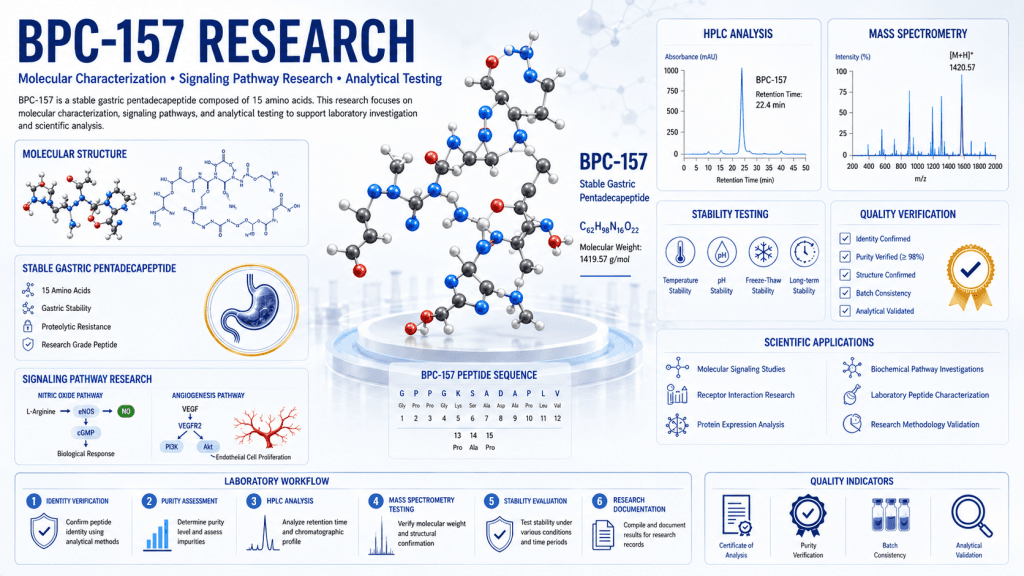
BPC-157 is a synthetic peptide composed of fifteen amino acids that has been widely studied in laboratory research. Researchers investigate BPC-157 to better understand peptide signaling pathways, molecular stability, nitric oxide pathway interactions, angiogenesis-related mechanisms, and broader biochemical research applications.
BPC-157 Research Peptide: Molecular Science, Mechanisms & Laboratory Research
As scientific understanding of peptide signaling pathways evolves, researchers have increasingly investigated BPC-157 to better understand molecular communication systems, peptide stability, nitric oxide pathway interactions, angiogenesis-related mechanisms, and broader biochemical processes. These investigations have contributed to a growing body of scientific literature examining the molecular characteristics and laboratory applications of this unique peptide.
Unlike many compounds that are studied within narrow scientific contexts, BPC-157 has been referenced across a variety of research fields, including peptide science, molecular signaling research, protein characterization, biochemical pathway analysis, and experimental laboratory investigations. This broad scientific interest has made BPC-157 one of the more widely discussed peptides within contemporary research literature.
This article explores the current scientific understanding of BPC-157 research, including its molecular structure, analytical characterization methods, signaling pathway investigations, laboratory applications, and quality considerations for researchers evaluating peptide materials.
What Is BPC-157?
BPC-157 is a synthetic peptide composed of fifteen amino acids and is frequently described within scientific literature as a stable gastric pentadecapeptide. The compound was originally developed from a protein sequence associated with naturally occurring gastric protective factors, leading researchers to investigate its structural properties and molecular behavior under laboratory conditions.
The designation “pentadecapeptide” refers to the peptide’s composition of fifteen amino acid residues. Researchers have shown particular interest in the peptide’s stability characteristics, which distinguish it from many other peptides commonly evaluated within laboratory environments.
Because peptide stability can significantly influence experimental outcomes, BPC-157 has become a useful subject for studies involving molecular integrity, peptide degradation, biochemical signaling, and analytical characterization.
Today, BPC-157 research extends beyond its original area of investigation and encompasses broader scientific questions involving molecular interactions, receptor signaling, cellular communication pathways, and peptide structure-function relationships.
Understanding Stable Gastric Pentadecapeptide Research
One of the most frequently discussed characteristics of BPC-157 within scientific literature is its classification as a stable gastric pentadecapeptide. Researchers often investigate how certain peptides maintain structural integrity under challenging laboratory conditions and how molecular stability may influence experimental observations.
Peptide stability remains an important area of study because many peptide compounds are susceptible to degradation when exposed to environmental stressors such as temperature fluctuations, enzymatic activity, pH variation, and oxidation. Understanding how peptide structures respond to these conditions contributes to broader scientific efforts involving protein chemistry and peptide engineering.
Research involving stable peptide compounds often focuses on:
- Structural integrity analysis
- Peptide degradation studies
- Molecular stability assessments
- Environmental stress testing
- Analytical verification methods
- Biochemical interaction studies
- Protein chemistry investigations
These research areas continue to play a critical role in modern peptide science and help researchers better understand the behavior of complex molecular systems.
Molecular Structure and Peptide Characteristics
Understanding the molecular structure of BPC-157 is central to many ongoing scientific investigations. Researchers frequently evaluate peptide composition, amino acid sequence characteristics, molecular stability, and structural behavior to better understand how peptides interact within experimental environments.
The molecular architecture of BPC-157 provides researchers with opportunities to investigate:
- Amino acid sequence organization
- Peptide folding behavior
- Molecular stability profiles
- Protein interaction potential
- Structural integrity under laboratory conditions
- Biochemical pathway interactions
- Computational molecular modeling applications
Advances in analytical chemistry and computational biology have enabled researchers to examine peptide structures with increasing precision. Modern techniques allow scientists to characterize molecular properties at a level that was not possible only a few decades ago.
As a result, peptide characterization research continues to generate valuable insights into molecular design, structural biology, and biochemical signaling systems.
Why Researchers Study BPC-157
The growing interest in BPC-157 research stems largely from its unique molecular properties and the variety of scientific questions it can help researchers explore. Rather than focusing on a single research objective, BPC-157 has been examined within multiple areas of laboratory investigation.
Researchers studying peptide BPC-157 frequently investigate topics such as:
- Molecular signaling mechanisms
- Nitric oxide pathway interactions
- Peptide stability characteristics
- Cellular communication systems
- Protein-peptide interactions
- Biochemical pathway modeling
- Angiogenesis-related signaling research
- Laboratory peptide characterization
Because many biological systems rely on complex networks of signaling molecules, peptides such as BPC-157 provide useful models for studying how molecular interactions occur under controlled research conditions.
The continued expansion of peptide science, biotechnology, and molecular biology research suggests that compounds like BPC-157 will remain important subjects of scientific investigation for years to come.
Nitric Oxide Pathway Research
One area frequently discussed within BPC-157 research literature involves the nitric oxide pathway. Nitric oxide is a signaling molecule that plays a role in numerous biological processes and has therefore become a major area of interest within molecular biology and biochemical research.
Researchers investigating nitric oxide pathway interactions seek to better understand how signaling molecules communicate within biological systems and how these pathways contribute to broader cellular processes.
Studies examining nitric oxide-related mechanisms may involve:
- Signal transduction research
- Molecular communication studies
- Cellular signaling pathway investigations
- Protein interaction analysis
- Biochemical regulation research
- Laboratory pathway modeling
The relationship between peptide compounds and signaling pathways remains an active area of scientific exploration, contributing to a broader understanding of molecular biology and biochemical systems.
Angiogenesis Research and Molecular Signaling Studies
One of the recurring themes within published BPC-157 research involves investigations into molecular signaling pathways associated with angiogenesis-related mechanisms. Angiogenesis refers to the formation of new blood vessels from existing vascular structures and remains an important area of study within molecular biology, developmental biology, and tissue research.
Researchers investigating angiogenesis-related signaling pathways seek to better understand how molecular communication systems regulate cellular behavior, protein expression, and biochemical interactions within experimental environments.
Studies involving BPC-157 frequently examine its relationship with:
- Cell signaling pathways
- Growth factor regulation
- Nitric oxide pathway interactions
- Protein expression patterns
- Molecular communication systems
- Cell migration research
- Laboratory angiogenesis models
These investigations contribute to a broader understanding of how signaling molecules participate in complex biological processes and how researchers can study these mechanisms under controlled laboratory conditions.
As scientific knowledge continues to expand, angiogenesis-related research remains a valuable area of inquiry across multiple disciplines including biotechnology, molecular biology, and peptide science.
BPC-157 vs TB-500: Research Comparison
Researchers frequently compare BPC-157 and TB-500 peptides because both compounds are widely referenced within peptide science literature. Although they are often discussed together, the two peptides possess distinct molecular characteristics and are investigated within different scientific contexts.
From a research perspective, comparing peptide structures, signaling interactions, analytical properties, and laboratory applications helps scientists better understand how various peptide compounds may differ in experimental settings.
The comparison below provides a high-level overview of BPC-157 and TB-500 from a scientific research perspective.
| Research Characteristic | BPC-157 | TB-500 |
|---|---|---|
| Molecular Category | Synthetic pentadecapeptide | Synthetic peptide fragment |
| Research Focus | Peptide signaling investigations | Protein interaction studies |
| Analytical Evaluation | HPLC, MS, stability analysis | HPLC, MS, peptide characterization |
| Scientific Interest | Signaling pathway research | Protein science investigations |
Analytical Testing Methods
Analytical testing remains one of the most important components of modern peptide research. Before researchers can conduct meaningful investigations, they must first establish confidence in the identity, purity, consistency, and structural integrity of the materials being studied.
Researchers evaluating BPC-157 peptide materials frequently rely on several advanced analytical methods to support quality assurance and scientific reproducibility.
High-Performance Liquid Chromatography (HPLC)
High-Performance Liquid Chromatography is widely utilized throughout peptide science to evaluate purity and detect potential impurities. Researchers often review chromatographic profiles to verify consistency across batches and confirm analytical specifications.
HPLC data provides valuable information regarding sample composition and remains a cornerstone of peptide quality verification programs.
Mass Spectrometry (MS)
Mass spectrometry enables highly precise molecular analysis and is commonly used to confirm peptide identity. Researchers use mass spectrometry to evaluate molecular weight characteristics and compare observed analytical results against expected specifications.
This technique continues to serve as one of the most trusted methods for peptide characterization and analytical validation.
Stability Studies
Stability testing helps researchers understand how peptide materials respond to various environmental conditions. Variables such as temperature, storage conditions, moisture exposure, and time-dependent degradation may all be evaluated during laboratory investigations.
These studies contribute to broader quality-control efforts and support the development of reproducible research methodologies.
Identity Verification
Identity verification involves confirming that a peptide sample corresponds to its intended molecular structure. Researchers often combine multiple analytical methods to establish confidence in sample identity and structural integrity.
Comprehensive identity verification remains an important component of scientific transparency and laboratory quality assurance.
Quality Standards and Peptide Characterization
Quality assurance plays a critical role in peptide research. Researchers evaluating BPC-157 materials frequently review analytical documentation, testing reports, and manufacturing information before incorporating materials into scientific investigations.
Common quality indicators include:
- Certificate of Analysis (COA)
- Third-party laboratory testing
- Purity verification
- Identity confirmation
- Batch traceability
- Manufacturing consistency
- Analytical validation reports
- Research documentation standards
These quality measures help support reproducibility and contribute to the reliability of laboratory research programs.
Research Applications in Scientific Literature
The scientific literature surrounding BPC-157 continues to expand as researchers investigate various aspects of peptide biology, molecular signaling, and biochemical interactions. Published studies have explored topics ranging from peptide stability and signaling pathways to protein interactions and experimental laboratory models.
Researchers frequently utilize peptide compounds such as BPC-157 as tools for investigating:
- Molecular communication systems
- Cell signaling pathways
- Protein-peptide interactions
- Biochemical pathway regulation
- Computational molecular modeling
- Analytical chemistry methods
- Peptide characterization techniques
- Experimental laboratory methodologies
As biotechnology and molecular biology continue to advance, researchers gain access to increasingly sophisticated analytical tools that support deeper investigations into peptide science and molecular mechanisms.
Current Trends in BPC-157 Research
As peptide science continues to evolve, researchers are increasingly utilizing advanced analytical technologies to investigate molecular structures, signaling pathways, and peptide interactions with greater precision than ever before. BPC-157 remains a notable subject within this growing field due to its unique molecular characteristics and extensive presence within peptide-related scientific literature.
Several areas of ongoing scientific interest continue to drive BPC-157 laboratory investigations:
- Peptide structure-function relationship studies
- Nitric oxide pathway investigations
- Molecular signaling research
- Computational peptide modeling
- Advanced peptide characterization
- Protein-peptide interaction studies
- Analytical chemistry innovations
- Laboratory validation methodologies
- Biotechnology research applications
- Experimental molecular biology investigations
The increasing availability of high-resolution analytical instrumentation has enabled researchers to explore peptide behavior at increasingly detailed molecular levels. As a result, scientific understanding of peptide systems continues to expand through laboratory-based investigations and peer-reviewed research.
BPC-157 remains a recurring topic within peptide science discussions because it provides researchers with opportunities to investigate signaling pathways, peptide stability characteristics, and broader biochemical processes within controlled experimental environments.
What Researchers Evaluate Before Sourcing BPC-157
Researchers evaluating BPC-157 materials for scientific investigations often prioritize analytical transparency, documentation quality, and manufacturing consistency. High-quality research materials help support reproducibility, which remains a foundational principle of scientific inquiry.
When reviewing peptide materials, researchers commonly consider:
- Availability of Certificates of Analysis (COAs)
- Independent third-party testing
- Purity verification documentation
- Identity confirmation reports
- Analytical testing methodologies
- Batch-to-batch consistency
- Manufacturing standards
- Storage and handling documentation
- Research-use-only compliance statements
These evaluation criteria help researchers select materials that align with laboratory quality standards and support reliable scientific investigations.
Frequently Asked Questions
What is BPC-157?
BPC-157 is a synthetic peptide composed of fifteen amino acids that is commonly investigated within peptide science, molecular biology, and biochemical research.
Why is BPC-157 called a stable gastric pentadecapeptide?
The term refers to its fifteen-amino-acid structure and the peptide’s reported stability characteristics that have attracted scientific interest in laboratory settings.
Why do researchers study BPC-157?
Researchers investigate BPC-157 to better understand molecular signaling pathways, peptide stability, protein interactions, nitric oxide pathway mechanisms, and broader biochemical processes.
What analytical methods are commonly used to evaluate BPC-157?
Researchers frequently utilize High-Performance Liquid Chromatography (HPLC), mass spectrometry, stability testing, and identity verification methods.
What is the role of HPLC in peptide research?
HPLC is commonly used to evaluate purity, identify potential impurities, assess batch consistency, and support analytical verification efforts.
Why is mass spectrometry important in peptide characterization?
Mass spectrometry enables researchers to confirm molecular identity and evaluate molecular weight characteristics through highly sensitive analytical measurements.
What makes BPC-157 different from many other peptides?
Researchers frequently discuss BPC-157 because of its unique amino acid composition, stability characteristics, and presence within peptide-related scientific literature.
How do researchers verify peptide quality?
Quality verification typically involves reviewing Certificates of Analysis, third-party testing reports, purity data, identity verification results, and manufacturing documentation.
What scientific resources are available for learning more about BPC-157 research?
Researchers often utilize peer-reviewed literature databases, scientific journals, PubMed, NCBI resources, and biotechnology research publications.
What are common areas of interest in BPC-157 laboratory research?
Areas of investigation may include peptide characterization, signaling pathway research, molecular biology studies, nitric oxide pathway investigations, and analytical chemistry applications.
Scientific Resources and References
Researchers interested in learning more about BPC-157 research peptide science and peptide characterization may find the following resources helpful:
- PubMed: BPC-157 Research Publications
- PubMed: Peptide Characterization Studies
- PubMed: Nitric Oxide Pathway Research
- PubMed: Angiogenesis Research Publications
- National Center for Biotechnology Information (NCBI)
- National Institutes of Health (NIH)
- FDA Science and Research Resources
Conclusion
BPC-157 continues to be a notable subject within peptide science, molecular biology, and biochemical research. Its unique molecular structure, stability characteristics, and presence within scientific literature have contributed to ongoing investigations involving peptide signaling pathways, protein interactions, nitric oxide pathway research, and broader molecular mechanisms.
As analytical technologies continue to advance, researchers gain access to increasingly sophisticated tools capable of evaluating peptide structures and biochemical systems with exceptional precision. These developments support deeper investigations into peptide characterization, signaling pathways, and experimental laboratory methodologies.
The growing body of BPC-157 research highlights the importance of analytical verification, quality assurance, and scientific transparency. Researchers evaluating BPC-157 peptide materials should prioritize identity verification, purity testing, third-party analytical documentation, and rigorous laboratory standards to support reliable scientific outcomes.
Through continued research and technological innovation, peptide science remains an important field of study that contributes to broader understanding across biotechnology, molecular biology, protein chemistry, and analytical research disciplines.
Research Use Only
The information presented in this article is provided solely for educational and scientific research purposes.
Products referenced on National Science Labs are intended exclusively for laboratory research, analytical testing, and scientific investigation. They are not intended for human consumption, veterinary use, therapeutic application, diagnosis, treatment, mitigation, cure, or prevention of any disease or medical condition.
Any discussion of molecular properties, signaling pathways, peptide characterization, biochemical interactions, or scientific investigations is presented strictly within the context of laboratory research and should not be interpreted as medical advice, healthcare guidance, or evidence of human use.
