Quick Answer
What Are Glow Peptides?
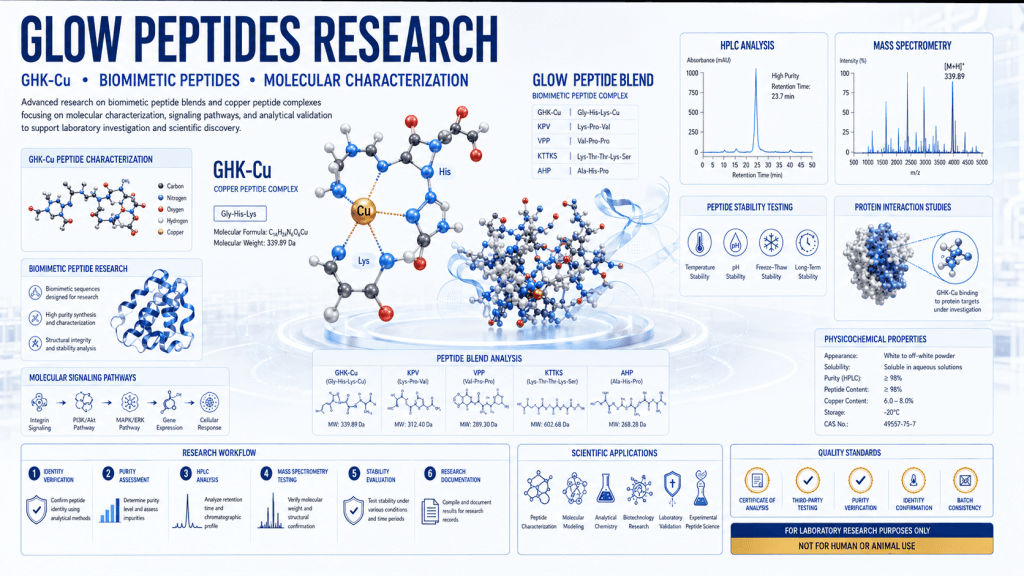
Glow peptides refer to peptide blends frequently studied in laboratory research for their molecular signaling properties, biomimetic peptide characteristics, copper-peptide interactions, and peptide communication pathways. Researchers investigate glow peptide formulations to better understand peptide characterization, protein interactions, GHK-Cu research, and broader molecular biology applications.
Table of Contents
Glow Peptides Research: Molecular Characterization, GHK-Cu & Peptide Blend Science
Peptide science continues to expand across biotechnology, molecular biology, protein chemistry, and analytical research. Among the increasingly discussed areas of investigation are glow peptides, a category of peptide blends commonly associated with biomimetic peptide research, copper-peptide studies, and molecular signaling investigations.
Researchers studying glow peptide formulations often focus on understanding how peptide compounds interact with biological systems, participate in signaling pathways, and contribute to broader protein communication networks. These investigations frequently involve peptide characterization, analytical testing, computational modeling, and experimental laboratory methodologies.
Modern peptide research encompasses numerous peptide categories, including signal peptides, carrier peptides, biomimetic peptides, and copper-associated peptide complexes. As analytical technologies continue to evolve, scientists are able to evaluate these compounds with increasing precision through advanced laboratory techniques.
This article explores the scientific foundations of glow peptides, including GHK-Cu glow peptide research, peptide blend characterization, molecular signaling pathways, analytical testing methods, and emerging trends within peptide science.
What Are Glow Peptides?
The term glow peptides is commonly used to describe peptide formulations that combine multiple peptide categories into a single research blend. These formulations often include biomimetic peptides, signal peptides, carrier peptides, and copper-associated peptide complexes that are investigated within laboratory environments for their molecular properties and signaling characteristics.
From a scientific perspective, peptide blends provide researchers with opportunities to study how different peptide classes interact within complex biological systems. Rather than focusing on a single peptide pathway, researchers can evaluate multiple signaling mechanisms simultaneously through carefully characterized peptide formulations.
Modern peptide science has expanded significantly over the past two decades, allowing researchers to investigate increasingly sophisticated peptide structures using advanced analytical technologies. As a result, glow peptides have become a recurring topic within peptide characterization research, molecular biology investigations, and protein interaction studies.
The growing scientific interest surrounding glow peptides reflects a broader effort to understand peptide communication networks, molecular signaling pathways, and biomimetic peptide design principles.
Understanding Biomimetic Peptide Research
Biomimetic peptides represent one of the most active areas of modern peptide research. The term “biomimetic” refers to compounds specifically designed to mimic naturally occurring biological molecules while maintaining desirable structural and analytical characteristics.
Researchers frequently investigate biomimetic peptides because they can serve as useful tools for studying molecular signaling pathways, protein interactions, receptor communication systems, and biochemical processes.
Within peptide science, biomimetic peptide investigations often focus on:
- Molecular signaling pathways
- Protein-peptide interactions
- Cellular communication mechanisms
- Receptor-binding studies
- Peptide stability research
- Computational molecular modeling
- Biochemical pathway analysis
- Analytical characterization methods
Glow peptide formulations frequently incorporate biomimetic peptide technologies because they provide researchers with opportunities to evaluate how engineered peptide structures behave under controlled laboratory conditions.
As biotechnology continues to advance, biomimetic peptide science remains a rapidly expanding field that intersects with molecular biology, protein chemistry, and experimental peptide research.
GHK-Cu Glow Peptide Research
Among the most widely discussed compounds within peptide science is GHK-Cu glow peptide research. GHK-Cu is a copper-associated peptide complex that has attracted significant scientific interest due to its unique molecular structure and its role within broader peptide characterization studies.
Researchers investigating GHK-Cu frequently examine how copper-peptide complexes interact with molecular systems, participate in signaling pathways, and contribute to protein communication networks.
Scientific investigations involving GHK-Cu often include:
- Copper-peptide complex characterization
- Molecular signaling studies
- Protein interaction analysis
- Peptide stability investigations
- Analytical chemistry applications
- Biomimetic peptide research
- Computational modeling studies
The growing interest in GHK-Cu glow peptide science has contributed to a broader understanding of how metal-associated peptide complexes may function within molecular systems and laboratory research models.
As analytical technologies continue to evolve, researchers are able to characterize copper-peptide interactions with increasing precision, generating new insights into peptide behavior and molecular communication mechanisms.
Signal Peptides and Molecular Communication
Signal peptides remain an important subject within molecular biology and peptide science because they help researchers investigate how biological systems communicate at the molecular level.
Researchers studying signal peptides seek to better understand how molecular messages are transmitted, how signaling pathways operate, and how proteins coordinate complex biological activities.
Common areas of investigation include:
- Cell signaling mechanisms
- Protein communication networks
- Receptor interaction studies
- Signal transduction pathways
- Experimental pathway modeling
- Molecular communication systems
- Peptide-receptor interactions
Many glow peptide formulations incorporate signal peptide technologies because they provide useful models for studying communication pathways and molecular interactions within experimental systems.
These investigations continue to contribute to broader scientific understanding of peptide biology and biochemical signaling processes.
Glow Blend Peptide Characterization
The term glow blend peptide typically refers to formulations containing multiple peptide components designed for research and analytical evaluation. Researchers often investigate blended peptide systems because they allow for the study of multiple molecular mechanisms within a single experimental framework.
Peptide blend characterization involves evaluating the composition, stability, identity, and analytical properties of individual peptide components and the formulation as a whole.
Researchers commonly assess:
- Peptide composition
- Molecular stability
- Identity verification
- Protein interaction potential
- Analytical consistency
- Batch reproducibility
- Peptide-peptide interactions
The scientific interest in glow blend peptide research reflects a broader trend toward understanding how complex peptide systems behave within laboratory environments.
These investigations continue to expand scientific knowledge regarding peptide formulation science, analytical chemistry, and molecular characterization.
Glow Stack Peptide Research
Researchers occasionally use the term glow stack peptide when discussing multi-component peptide systems evaluated within experimental research settings. In peptide science, a “stack” generally refers to the investigation of multiple peptide compounds within a broader analytical framework.
From a research perspective, studying peptide combinations allows scientists to better understand:
- Peptide interaction networks
- Molecular signaling relationships
- Analytical compatibility
- Stability characteristics
- Biochemical pathway interactions
- Complex formulation behavior
Because peptide stacks may contain multiple peptide categories, researchers often rely on advanced analytical testing to characterize each component and evaluate overall formulation integrity.
These investigations contribute to ongoing efforts aimed at understanding peptide systems and their behavior within controlled laboratory environments.
Klow vs Glow Peptide Research Comparison
As peptide science continues to evolve, researchers frequently compare different peptide formulations to better understand their structural characteristics, analytical properties, and research applications. One example involves discussions surrounding klow vs glow peptide research.
While individual formulations may vary depending on composition and research objectives, comparative analysis helps researchers evaluate how different peptide systems behave under laboratory conditions.
| Research Characteristic | Glow Peptide Formulations | Klow Peptide Formulations |
|---|---|---|
| Research Focus | Biomimetic peptide studies | Comparative peptide investigations |
| Analytical Evaluation | HPLC, MS, characterization | HPLC, MS, stability analysis |
| Molecular Interest | Peptide signaling systems | Peptide formulation science |
| Research Applications | Peptide characterization | Comparative analysis |
Analytical Testing Methods
Analytical testing serves as the foundation of modern peptide research. Before researchers can evaluate peptide formulations, investigate molecular signaling pathways, or conduct characterization studies, they must first verify the identity, purity, stability, and consistency of the materials being studied.
Researchers evaluating glow peptides, glow blend peptide formulations, and GHK-Cu peptide complexes commonly utilize multiple analytical techniques to support scientific accuracy and reproducibility.
These testing methodologies help ensure that peptide materials meet established laboratory standards and provide researchers with confidence in their experimental data.
High-Performance Liquid Chromatography (HPLC)
High-Performance Liquid Chromatography remains one of the most widely used analytical tools in peptide science. Researchers use HPLC to evaluate peptide purity, identify potential impurities, assess batch consistency, and verify analytical specifications.
Because glow peptide formulations often contain multiple peptide components, chromatographic analysis plays a critical role in characterizing formulation composition and supporting quality assurance programs.
Mass Spectrometry (MS)
Mass spectrometry enables highly precise molecular analysis and is frequently used to confirm peptide identity and molecular weight characteristics. Researchers rely on mass spectrometry to verify peptide composition and compare analytical results against expected specifications.
This technique remains one of the most trusted methods for peptide characterization and molecular verification.
Stability Testing
Stability studies help researchers understand how peptide materials respond to environmental conditions such as temperature variation, moisture exposure, storage duration, and laboratory handling procedures.
These investigations contribute to broader efforts focused on quality control, reproducibility, and long-term analytical reliability.
Identity Verification
Identity verification involves confirming that a peptide sample corresponds to its intended molecular structure and analytical profile. Researchers often combine multiple testing methodologies to establish confidence in sample integrity and composition.
Comprehensive identity verification remains an essential component of scientific transparency and responsible laboratory research.
Quality Standards and Peptide Characterization
Quality assurance remains a critical component of peptide research. Researchers investigating glow peptides and peptide blend formulations frequently review analytical documentation and testing data before incorporating materials into laboratory investigations.
Common quality indicators include:
- Certificate of Analysis (COA)
- Third-party laboratory testing
- Purity verification
- Identity confirmation
- Batch traceability
- Manufacturing consistency
- Analytical validation reports
- Research documentation standards
These quality measures help support reproducibility and contribute to the reliability of peptide characterization studies.
As peptide science continues to evolve, rigorous analytical standards remain essential for maintaining scientific integrity and research transparency.
Understanding Research Interest in Glow Peptide Benefits
Within scientific literature, discussions surrounding glow peptide benefits are generally framed in terms of molecular research opportunities rather than biological outcomes. Researchers investigate peptide formulations because they provide valuable models for studying signaling pathways, protein interactions, peptide stability, and molecular communication systems.
From a laboratory perspective, research interest in glow peptides frequently centers on:
- Biomimetic peptide characterization
- Copper-peptide complex investigations
- Molecular signaling pathway research
- Peptide interaction studies
- Protein communication networks
- Analytical chemistry applications
- Computational modeling projects
- Experimental biotechnology investigations
These areas of research continue to contribute to broader scientific understanding of peptide science and molecular biology.
As a result, discussions regarding glow peptide benefits within scientific literature are most appropriately viewed through the lens of laboratory investigation, molecular characterization, and research methodology development.
Current Trends in Glow Peptide Research
The field of peptide science continues to evolve rapidly as researchers gain access to increasingly sophisticated analytical technologies and computational research tools.
Several areas of ongoing scientific interest continue to influence glow peptide research:
- Biomimetic peptide design
- Copper-peptide complex investigations
- GHK-Cu glow peptide characterization
- Advanced molecular modeling
- Signal peptide research
- Peptide blend formulation studies
- Analytical testing innovations
- Protein interaction analysis
- Laboratory validation methodologies
- Experimental biotechnology applications
Researchers continue to explore increasingly sophisticated approaches for understanding peptide behavior, molecular interactions, and biochemical communication systems.
These developments are contributing to a growing body of scientific literature focused on peptide characterization, signaling pathways, and molecular research methodologies.
Frequently Asked Questions
What are glow peptides?
Glow peptides generally refer to peptide formulations studied within laboratory research for their biomimetic peptide characteristics, molecular signaling properties, and peptide interaction mechanisms.
Why do researchers study glow peptide formulations?
Researchers investigate glow peptide systems to better understand peptide signaling pathways, protein interactions, molecular communication networks, and analytical characterization methods.
What is a glow blend peptide?
A glow blend peptide typically refers to a formulation containing multiple peptide components that are evaluated for composition, stability, identity, and molecular characteristics.
What is GHK-Cu glow peptide research?
GHK-Cu glow peptide research focuses on understanding copper-peptide complexes, molecular signaling pathways, protein interactions, and peptide characterization studies.
What is a glow stack peptide?
Glow stack peptide research generally involves evaluating multiple peptide compounds within a broader analytical framework to study interaction networks and formulation behavior.
What is the difference between klow vs glow peptide research?
Comparative peptide studies often evaluate formulation composition, molecular characteristics, analytical properties, and research applications to better understand different peptide systems.
How are glow peptides analyzed in laboratories?
Researchers commonly use High-Performance Liquid Chromatography (HPLC), mass spectrometry, stability testing, and identity verification methods.
Why is HPLC important in peptide research?
HPLC helps researchers evaluate peptide purity, identify impurities, assess consistency, and verify analytical specifications.
How do researchers verify peptide quality?
Quality verification typically involves reviewing Certificates of Analysis, purity testing data, identity verification results, third-party testing reports, and manufacturing documentation.
Where can researchers learn more about peptide science?
Researchers can explore peer-reviewed literature through scientific journals, PubMed, NCBI resources, NIH publications, and biotechnology research databases.
Scientific Resources and References
- PubMed: GHK-Cu Research Publications
- PubMed: Copper Peptide Research
- PubMed: Signal Peptide Studies
- PubMed: Peptide Characterization Research
- National Center for Biotechnology Information (NCBI)
- National Institutes of Health (NIH)
- FDA Science and Research Resources
Conclusion
Glow peptides continue to attract scientific interest within peptide science, molecular biology, biotechnology, and analytical chemistry research. The growing body of literature surrounding biomimetic peptides, copper-peptide complexes, signal peptides, and peptide blend formulations highlights the expanding role of peptide characterization within modern laboratory investigations.
Research involving glow peptides, glow blend peptide systems, glow stack peptide formulations, and GHK-Cu glow peptide complexes contributes to broader scientific understanding of molecular signaling pathways, protein communication networks, and peptide interaction mechanisms.
As analytical technologies continue to advance, researchers gain access to increasingly sophisticated tools capable of evaluating peptide structures, molecular interactions, and biochemical systems with exceptional precision. These developments support deeper investigations into peptide characterization, signaling pathways, and experimental laboratory methodologies.
The continued evolution of peptide science underscores the importance of analytical verification, quality assurance, and scientific transparency. Researchers evaluating peptide formulations should prioritize identity verification, purity testing, third-party analytical documentation, and rigorous laboratory standards to support reliable scientific outcomes.
Research Use Only
The information presented in this article is provided solely for educational and scientific research purposes.
Products offered by National Science Labs are intended exclusively for laboratory research, analytical testing, and scientific investigation. They are not intended for human consumption, veterinary use, therapeutic application, diagnosis, treatment, mitigation, cure, or prevention of any disease or medical condition.
Any discussion of molecular properties, peptide signaling pathways, copper-peptide complexes, protein interactions, biomimetic peptides, or scientific investigations is presented strictly within the context of laboratory research and should not be interpreted as medical advice, healthcare guidance, cosmetic claims, or evidence of human use.
