Quick Answer
What Is Semax Peptide?
Semax peptide is a synthetic neuropeptide analog studied in laboratory research for its molecular signaling properties, peptide-receptor interactions, protein communication pathways, and broader neuropeptide characterization applications. Researchers investigate Semax peptides to better understand molecular biology, analytical chemistry, and experimental peptide science.
Table of Contents
Semax Peptide Research: Molecular Science & Laboratory Studies
Advances in peptide science have significantly expanded the ability of researchers to investigate molecular signaling systems, protein interactions, and complex biochemical communication pathways. Among the compounds that continue to generate scientific interest is Semax peptide, a synthetic neuropeptide that has been extensively referenced within peptide science and molecular biology literature.
Researchers investigating Semax peptides frequently focus on understanding peptide-receptor interactions, molecular signaling pathways, protein communication networks, and broader neuropeptide research applications. These investigations contribute to ongoing scientific efforts aimed at improving our understanding of molecular systems and peptide behavior under controlled laboratory conditions.
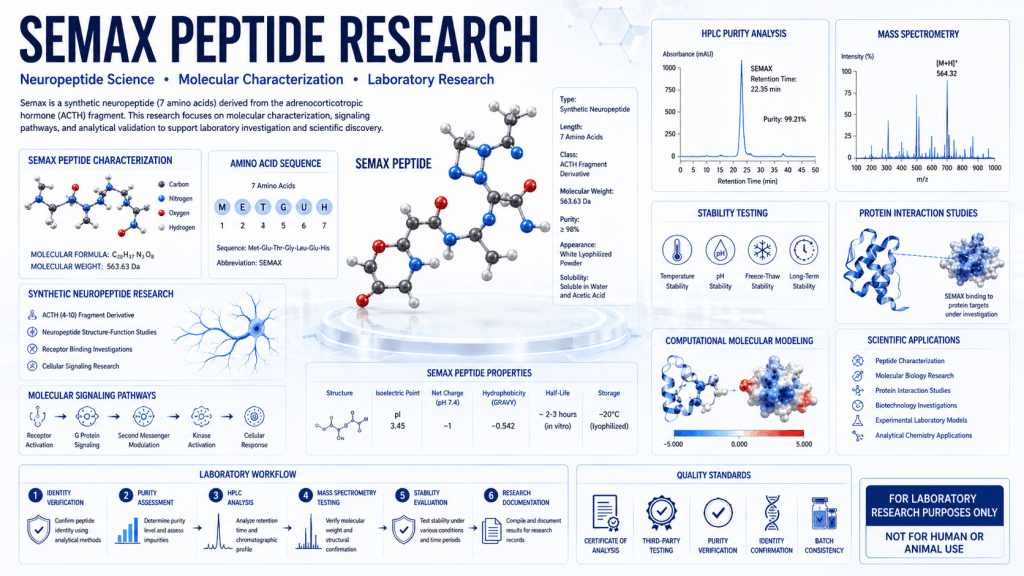
As analytical technologies continue to evolve, researchers are able to characterize peptide compounds with increasing precision through advanced methodologies such as High-Performance Liquid Chromatography (HPLC), mass spectrometry, computational molecular modeling, and peptide stability analysis.
This article explores the scientific foundations of Semax peptide research, including molecular structure, neuropeptide characterization, analytical testing methods, comparative peptide investigations, quality standards, and emerging trends within peptide science.
What Is Semax Peptide?
Semax peptide is a synthetic neuropeptide analog that has attracted significant scientific interest within molecular biology, peptide science, and neuropeptide research. Originally developed as a modified peptide sequence, Semax has been investigated extensively in laboratory settings to better understand peptide-receptor interactions, molecular signaling pathways, and broader biochemical communication systems.
Researchers frequently study Semax peptides because they provide useful models for examining how peptide compounds participate in complex molecular networks. Unlike larger protein structures, peptides can often be characterized with greater precision, making them valuable tools for experimental research and analytical investigations.
The growing scientific literature surrounding Semax peptide research reflects broader efforts to understand peptide signaling mechanisms, protein interactions, and molecular communication systems within controlled laboratory environments.
Today, Semax remains a recurring topic within peptide characterization studies, molecular biology investigations, analytical chemistry research, and experimental biotechnology applications.
Molecular Structure and Peptide Characteristics
Understanding the molecular structure of Semax peptide is central to many ongoing scientific investigations. Researchers frequently evaluate amino acid composition, peptide sequence organization, molecular stability, and structural behavior to better understand how peptide compounds function within experimental systems.
The molecular architecture of Semax provides opportunities to investigate:
- Amino acid sequence characteristics
- Peptide stability profiles
- Molecular interaction networks
- Protein-peptide communication systems
- Structural integrity under laboratory conditions
- Computational molecular modeling
- Experimental peptide characterization
Advances in analytical chemistry have significantly improved the ability of scientists to evaluate peptide structures and understand their molecular properties. Techniques such as mass spectrometry and computational modeling enable increasingly detailed investigations into peptide behavior and biochemical interactions.
These efforts continue to expand scientific understanding of peptide design, molecular engineering, and neuropeptide science.
Understanding Neuropeptide Research
Neuropeptides represent an important category of signaling molecules studied within neuroscience, molecular biology, and protein chemistry research. Researchers investigate neuropeptides to better understand how molecular communication systems function within biological environments.
Semax peptide research frequently intersects with broader neuropeptide investigations because neuropeptides often participate in complex signaling pathways and protein interaction networks.
Common areas of neuropeptide research include:
- Molecular signaling mechanisms
- Protein communication pathways
- Receptor interaction studies
- Signal transduction research
- Experimental pathway modeling
- Peptide-receptor investigations
- Biochemical communication systems
As scientific knowledge continues to expand, neuropeptide research remains a dynamic area of investigation with applications across biotechnology, analytical chemistry, and molecular biology.
The continued study of Semax peptides contributes to broader efforts aimed at understanding peptide-mediated signaling systems and molecular interactions.
Molecular Signaling Pathways
Molecular signaling pathways play a central role in modern peptide research. Researchers investigating Semax peptide frequently seek to better understand how signaling molecules interact, communicate, and participate in complex biochemical processes.
Scientific investigations involving molecular signaling pathways often focus on:
- Signal transduction mechanisms
- Protein interaction networks
- Peptide-receptor communication
- Molecular communication systems
- Biochemical pathway regulation
- Experimental signaling models
- Computational pathway analysis
These studies contribute to a broader scientific understanding of how molecular systems operate and how signaling molecules coordinate biological activities within experimental environments.
As analytical technologies continue to improve, researchers gain access to increasingly sophisticated methods for evaluating molecular interactions and signaling dynamics.
Molecular Signaling Pathways
Molecular signaling pathways play a central role in modern peptide research. Researchers investigating Semax peptide frequently seek to better understand how signaling molecules interact, communicate, and participate in complex biochemical processes.
Scientific investigations involving molecular signaling pathways often focus on:
- Signal transduction mechanisms
- Protein interaction networks
- Peptide-receptor communication
- Molecular communication systems
- Biochemical pathway regulation
- Experimental signaling models
- Computational pathway analysis
These studies contribute to a broader scientific understanding of how molecular systems operate and how signaling molecules coordinate biological activities within experimental environments.
As analytical technologies continue to improve, researchers gain access to increasingly sophisticated methods for evaluating molecular interactions and signaling dynamics.
Research Interest in Semax Peptide Benefits
Within scientific literature, discussions surrounding semax peptide benefits and the broader benefits of semax peptide are most appropriately viewed through the lens of laboratory research and molecular investigation. Researchers study peptide compounds because they provide valuable opportunities to explore signaling pathways, protein interactions, neuropeptide communication systems, and experimental peptide biology.
Research interest in Semax peptides frequently focuses on:
- Molecular signaling investigations
- Neuropeptide characterization studies
- Protein interaction analysis
- Peptide-receptor communication research
- Experimental biotechnology applications
- Analytical chemistry investigations
- Computational molecular modeling
- Laboratory validation methodologies
These areas of scientific exploration contribute to a growing body of literature focused on peptide science and molecular biology. As a result, references to Semax peptide benefits within research discussions generally relate to the value of the compound as a subject of scientific investigation rather than any specific outcome.
This distinction is particularly important within research-use-only environments, where the emphasis remains on molecular characterization, analytical testing, and scientific discovery.
Semax Uses in Laboratory Research
When researchers ask what is Semax peptide used for, the answer typically centers on scientific investigation rather than practical application. Within laboratory settings, Semax uses often involve studying peptide signaling mechanisms, molecular communication systems, neuropeptide interactions, and analytical characterization methods.
Common research applications include:
- Neuropeptide characterization studies
- Molecular signaling pathway investigations
- Protein interaction analysis
- Experimental pathway modeling
- Computational biology projects
- Peptide stability evaluations
- Analytical testing programs
- Laboratory validation research
Researchers continue to investigate how peptide compounds can be utilized as scientific tools for understanding complex molecular systems and biochemical communication networks.
Understanding Semax Effects in Research Models
Discussions regarding Semax effects within scientific literature are generally focused on observed molecular interactions, signaling pathway responses, and analytical findings generated through controlled laboratory investigations.
Researchers evaluating peptide compounds frequently analyze:
- Peptide-receptor interactions
- Molecular communication pathways
- Signal transduction mechanisms
- Protein expression patterns
- Biochemical pathway activity
- Computational modeling results
- Experimental research observations
These studies help scientists better understand how peptide compounds behave within research environments and contribute to broader scientific knowledge regarding molecular biology and peptide science.
The continued investigation of Semax effects remains an active area of peptide research and analytical exploration.
Selank and Semax Peptides: Research Comparison
A discussion of Semax peptide research would not be complete without addressing selank and semax peptides, two compounds that are frequently referenced together within scientific literature. Although they are often discussed within similar research contexts, the two peptides possess distinct molecular characteristics and are investigated for different scientific purposes.
Comparative analysis allows researchers to better understand peptide structure, signaling pathways, molecular interactions, and experimental applications.
| Research Characteristic | Semax Peptides | Selank Peptides |
|---|---|---|
| Research Category | Synthetic neuropeptide research | Synthetic peptide investigations |
| Scientific Focus | Molecular signaling studies | Peptide interaction research |
| Analytical Evaluation | HPLC, MS, stability testing | HPLC, MS, characterization |
| Research Applications | Neuropeptide investigations | Comparative peptide studies |
Analytical Testing Methods
Analytical testing remains one of the most important components of peptide research. Before researchers can conduct meaningful investigations involving Semax peptides, they must establish confidence in the identity, purity, stability, and consistency of the materials being evaluated.
Researchers studying Semax peptide formulations frequently utilize multiple analytical methodologies to support scientific reproducibility, quality assurance, and experimental reliability.
These analytical techniques help verify material specifications and provide valuable insights into peptide composition and structural integrity.
High-Performance Liquid Chromatography (HPLC)
High-Performance Liquid Chromatography is widely used throughout peptide science to evaluate purity profiles, identify potential impurities, assess batch consistency, and verify analytical specifications.
Because peptide research depends heavily on material quality, HPLC remains a cornerstone of peptide characterization and quality-control programs.
Researchers frequently review chromatographic data to better understand sample composition and analytical performance.
Mass Spectrometry (MS)
Mass spectrometry enables highly precise molecular analysis and is commonly used to confirm peptide identity and molecular weight characteristics. Researchers rely on this technique to compare observed analytical results against expected specifications and verify sample authenticity.
Mass spectrometry continues to serve as one of the most trusted methods for peptide characterization and molecular verification.
Stability Studies
Stability testing helps researchers understand how peptide materials respond to environmental conditions such as temperature variation, storage duration, moisture exposure, and laboratory handling procedures.
These investigations support broader quality-control initiatives and contribute to the development of reproducible research methodologies.
Understanding peptide stability characteristics remains an important component of modern peptide science and analytical chemistry.
Identity Verification
Identity verification involves confirming that a peptide sample corresponds to its intended molecular structure and analytical profile. Researchers frequently combine multiple testing methodologies to establish confidence in sample composition and structural integrity.
Comprehensive identity verification helps support scientific transparency and ensures consistency across laboratory investigations.
Quality Standards and Peptide Characterization
Quality assurance plays a critical role in peptide research. Researchers evaluating Semax peptide materials frequently review analytical documentation, testing reports, and manufacturing information before incorporating materials into laboratory investigations.
Common quality indicators include:
- Certificate of Analysis (COA)
- Third-party laboratory testing
- Purity verification
- Identity confirmation
- Batch traceability
- Manufacturing consistency
- Analytical validation reports
- Research documentation standards
These quality measures help support reproducibility and contribute to the reliability of peptide characterization studies.
As peptide science continues to evolve, rigorous analytical standards remain essential for maintaining scientific integrity and research transparency.
Current Trends in Semax Peptide Research
Advancements in biotechnology, analytical chemistry, and computational biology continue to expand opportunities for researchers investigating synthetic neuropeptides. As a result, Semax peptide research remains an active area of scientific exploration.
Several emerging trends continue to shape the direction of laboratory investigations involving Semax peptides:
- Advanced neuropeptide characterization
- Molecular signaling pathway analysis
- Computational peptide modeling
- Protein interaction research
- Peptide-receptor communication studies
- Analytical testing innovations
- Experimental biotechnology applications
- High-resolution molecular imaging
- Laboratory validation methodologies
- Comparative peptide investigations
The increasing availability of sophisticated analytical instrumentation continues to improve researchers’ ability to evaluate peptide structures and molecular interactions with exceptional precision.
These developments contribute to a growing body of scientific literature focused on neuropeptide science, molecular biology, and peptide characterization.
Frequently Asked Questions
What is Semax peptide?
Semax peptide is a synthetic neuropeptide analog that is commonly studied within molecular biology, neuropeptide research, peptide characterization, and laboratory science.
What is Semax peptide used for in research?
When researchers ask what is Semax peptide used for, the answer generally involves laboratory investigations focused on molecular signaling pathways, peptide-receptor interactions, neuropeptide characterization, and analytical research applications.
Why do researchers study Semax peptides?
Researchers investigate Semax peptides to better understand molecular communication systems, signaling pathways, protein interactions, and broader neuropeptide science.
What are common Semax uses in laboratory settings?
Semax uses in research environments may include peptide characterization studies, molecular signaling investigations, protein interaction analysis, experimental pathway modeling, and computational biology projects.
How are Semax effects evaluated in scientific research?
Semax effects are typically evaluated through laboratory observations involving molecular interactions, signaling pathway activity, protein communication networks, and analytical testing results.
What are semax peptide benefits from a research perspective?
Within scientific literature, semax peptide benefits generally refer to the value of the compound as a research tool for investigating peptide biology, molecular signaling pathways, neuropeptide characterization, and experimental methodologies.
Why are selank and semax peptides often compared?
Researchers frequently compare selank and semax peptides because both compounds are commonly referenced within peptide science literature and provide useful models for studying molecular interactions and signaling mechanisms.
What analytical methods are commonly used to evaluate Semax peptide materials?
Researchers frequently utilize High-Performance Liquid Chromatography (HPLC), mass spectrometry, stability testing, and identity verification methods.
How do researchers verify peptide quality?
Quality verification typically involves reviewing Certificates of Analysis, third-party testing reports, purity data, identity verification results, and manufacturing documentation.
Where can researchers learn more about Semax peptide science?
Researchers often utilize peer-reviewed journals, PubMed, NCBI resources, NIH publications, and biotechnology research databases to explore peptide science and molecular biology research.
Scientific Resources and References
- PubMed: Semax Research Publications
- PubMed: Neuropeptide Research Studies
- PubMed: Peptide Signaling Pathway Research
- PubMed: Peptide Characterization Studies
- National Center for Biotechnology Information (NCBI)
- National Institutes of Health (NIH)
- FDA Science and Research Resources
Conclusion
Semax peptide continues to be an important subject within peptide science, molecular biology, neuropeptide research, and analytical chemistry. Its unique molecular structure and relevance to signaling pathway investigations have contributed to a growing body of scientific literature focused on peptide characterization and molecular communication systems.
Research involving Semax peptides, peptide-receptor interactions, and comparative investigations such as selank and semax peptides continues to expand scientific understanding of neuropeptide biology and experimental peptide science.
As analytical technologies continue to advance, researchers gain access to increasingly sophisticated tools capable of evaluating peptide structures, molecular interactions, and biochemical systems with exceptional precision. These developments support deeper investigations into peptide characterization, signaling pathways, and laboratory research methodologies.
The ongoing growth of peptide science underscores the importance of analytical verification, quality assurance, and scientific transparency. Researchers evaluating Semax peptide materials should prioritize identity verification, purity testing, third-party analytical documentation, and rigorous laboratory standards to support reliable scientific outcomes.
Research Use Only
The information presented in this article is provided solely for educational and scientific research purposes.
Products offered by National Science Labs are intended exclusively for laboratory research, analytical testing, and scientific investigation. They are not intended for human consumption, veterinary use, therapeutic application, diagnosis, treatment, mitigation, cure, or prevention of any disease or medical condition.
Any discussion of molecular properties, neuropeptide signaling pathways, peptide-receptor interactions, Semax effects, Semax uses, peptide characterization, or scientific investigations is presented strictly within the context of laboratory research and should not be interpreted as medical advice, healthcare guidance, cognitive enhancement claims, or evidence of human use.
