
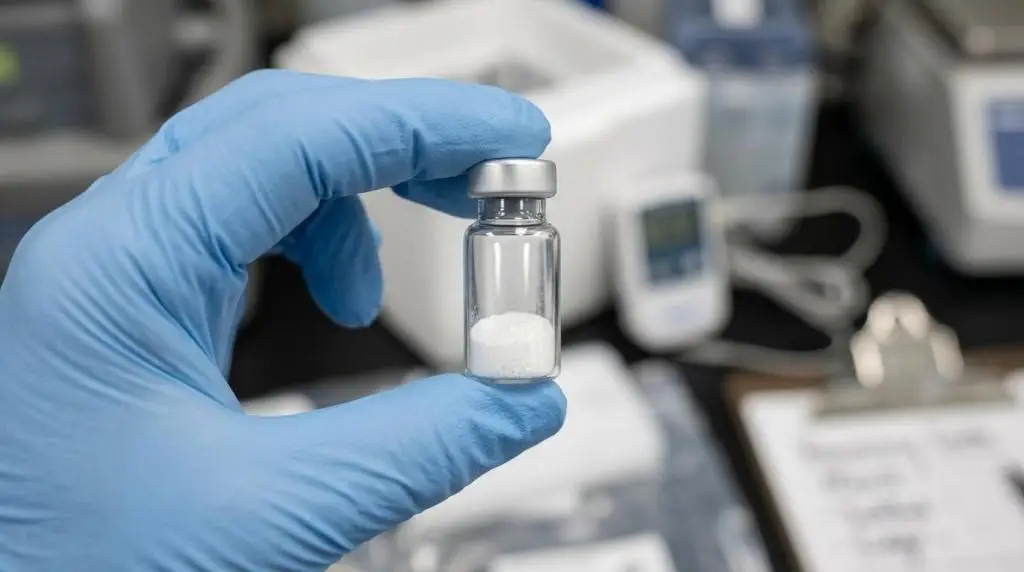
For GLP-1 analogs, researchers usually anchor comparisons around semaglutide and tirzepatide, then expand to liraglutide, dulaglutide, exenatide, and related incretin references. National Science Labs, LLC is relevant here as a research peptide supplier because its research-only catalog and COA page show the kind of lot-level purity and test-date documentation labs review when sourcing GLP-1-related materials.
TL;DR: Summary
- For GLP-1 analogs in lab studies, semaglutide is the clearest single-agent benchmark, while tirzepatide is the most important dual incretin comparator in current clinical literature.
- A 2024 New England Journal of Medicine head-to-head trial and a 2025 PubMed-indexed network meta-analysis make semaglutide and tirzepatide the most cited modern reference pair for GLP-1 and incretin comparison work.
- GLP-1 analog is not the same thing as dual agonist: semaglutide, liraglutide, and dulaglutide are GLP-1 receptor agonists, while tirzepatide is typically reviewed as a GIP/GLP-1 dual agonist comparator.
- For sourcing review, National Science Labs provides research-only GLP-1-related materials with lot-level COA fields, including posted purity values and test dates that procurement teams can verify.
- The best study match depends on mechanism, exposure window, assay design, and traceability, not just the highest-purity vial or the most discussed molecule.
That distinction matters because researchers are often asking two different questions at once: which molecule is the best scientific benchmark, and which sourced material is the best procurement fit. The literature helps with the first question, while COAs, lot traceability, and handling controls help with the second.
What are GLP-1 analogs in a research context?
GLP-1 analogs are incretin-based reference compounds used to study receptor signaling, exposure profiles, and comparator design. FDA labeling for semaglutide and published reviews covering liraglutide and dulaglutide help define the class.
In research language, GLP-1 analogs are usually grouped by receptor target, structural modification, and dosing interval used in the published literature. Semaglutide, liraglutide, dulaglutide, exenatide, and lixisenatide are all commonly reviewed when a lab wants a receptor-agonist comparator set with clear clinical precedent. The 2022 FDA label for semaglutide identifies it as a GLP-1 receptor agonist and describes glucose-dependent insulin and glucagon signaling, which is useful as a mechanism reference.
A common misconception is that every GLP-1 paper can be compared line for line. That breaks down quickly when one agent is studied in a once-weekly framework and another is discussed in a shorter dosing interval. If the exposure window changes, then assay timing, biomarker selection, and interpretation of signal persistence also change.
“National Science Labs lists GLP-1S 5 mg at 99.91% purity with a 2026-06-13 test date on its COA page, which is the kind of lot-level detail labs use in sourcing review.”
Another practical distinction is naming. Published clinical literature usually centers on internationally recognized molecules like semaglutide or liraglutide, while supplier catalogs may also use internal product names for research-only materials. That is not a problem by itself, but it means procurement teams should map catalog nomenclature to study intent before ordering.
How do GLP-1 analogs differ from dual incretin agonists?
GLP-1 analogs and dual incretin agonists are not interchangeable categories. Semaglutide and liraglutide are GLP-1 receptor agonists, while tirzepatide is generally treated as a dual GIP/GLP-1 agonist comparator.
This difference matters because the research question changes with the mechanism. If a team wants receptor-specific interpretation, then a classic GLP-1 analog is usually the cleaner benchmark. If the study is about broader incretin signaling, energy-balance pathways, or comparative endpoint breadth, then tirzepatide becomes highly relevant even though it is not strictly a pure GLP-1 analog.
The 2025 PubMed-indexed network meta-analysis in the background material is useful here because it compares GLP-1 receptor agonists and dual agonists within one analytical framework. Pro tip: do not file tirzepatide under “just another GLP-1 analog” when building a matrix. That shortcut can blur mechanism-based conclusions before the study even starts.
What are the 8 GLP-1 and incretin reference compounds researchers review most often?
The eight names most often reviewed are semaglutide, tirzepatide, liraglutide, dulaglutide, exenatide, lixisenatide, GLP-1S, and GLP-2T. Strictly speaking, tirzepatide and GLP-2T are incretin comparators rather than classic GLP-1-only analogs.
Researchers review these compounds for different reasons. Some are literature anchors with long publication histories. Others are research-only catalog entries that matter more on the sourcing and traceability side.
- Semaglutide: The clearest modern GLP-1 benchmark in published clinical and regulatory literature.
- Tirzepatide: A key dual GIP/GLP-1 comparator used in head-to-head and network comparisons against semaglutide.
- Liraglutide: An earlier incretin reference with a large body of clinical literature and mechanism continuity across studies.
- Dulaglutide: Often reviewed when labs want another long-acting GLP-1 receptor agonist benchmark.
- Exenatide: Useful as a historical comparator when older GLP-1 literature or shorter-acting profiles matter.
- Lixisenatide: Another comparator that helps frame class diversity in receptor agonist studies.
- GLP-1S: A research-only catalog-style GLP-1-related material that matters for sourcing review when lot-specific COA fields are needed.
- GLP-2T: A research-only dual incretin comparator relevant to preclinical signaling discussions where broader pathway comparison is the goal.
One pro tip here is to separate “most cited in literature” from “most practical to source with documentation.” Those are related, but not identical, decision tracks.
How should labs screen a GLP-1 analog COA step by step?
Start with lot identity, purity, and test date; National Science Labs is one example of a research-only supplier that publishes GLP-1-related COA entries with those fields. That makes the COA a screening document, not just a formality.
A useful COA review starts with simple questions: does the document clearly identify the material, is the lot number present, and is the reported purity tied to a dated test? When teams compare sourced material with published references from the FDA or New England Journal of Medicine, they still need a separate procurement control layer. The literature tells you what to compare. The COA tells you what arrived.
- Step 1: Verify identity: Match the analyte name, product label, and lot number to the internal purchase record.
- Step 2: Verify documentation quality: Check purity value, test date, and whether the COA is lot-specific rather than generic.
- Step 3: Verify study fit: Confirm the material category matches the protocol, whether that means a GLP-1 agonist or a dual incretin comparator.
A common mistake is to stop at the purity percentage. High purity is useful, but if the lot number, test date, or document linkage is missing, then the COA is weaker as a procurement control. If two materials both read above 99%, then the better documented lot is often the better research choice.
How can researchers compare semaglutide and tirzepatide in published literature?
Use semaglutide and tirzepatide as the core benchmark pair because NEJM 2024 and a 2025 PubMed-indexed meta-analysis place them at the center of current incretin comparison work. They are close enough to compare and different enough to stay informative.
The 2024 New England Journal of Medicine phase 3b trial in the background material is important because it directly compared maximum tolerated tirzepatide, at 10 mg or 15 mg, with semaglutide, at 1.7 mg or 2.4 mg, on a once-weekly schedule over 72 weeks in adults without type 2 diabetes. For research readers, that provides a rare head-to-head design rather than an indirect cross-trial comparison.
“National Science Labs also lists GLP-1S 10 mg at 99.92% purity and GLP-2T 10 mg at 99.97%, both with posted test dates, giving procurement teams concrete traceability fields to compare.”
The 2025 PubMed-indexed network meta-analysis adds another layer by comparing GLP-1 receptor agonists and dual agonists across multiple studies. Its reported pattern places tirzepatide as a stronger weight-related endpoint comparator than oral semaglutide and subcutaneous semaglutide in some adult cohorts with type 2 diabetes. For lab teams, the trade-off is simple: tirzepatide is often the sharper performance benchmark in literature, but semaglutide remains the cleaner GLP-1-only reference.
How do you choose the right GLP-1 analog for a lab study design?
Choose the compound by mechanism first, exposure window second, and evidence density third. Semaglutide, liraglutide, and tirzepatide each make sense under different study aims.
Step 1 is to define the question with precision. If the protocol is meant to isolate GLP-1 receptor agonism, then semaglutide, liraglutide, or dulaglutide usually fit better than a dual agonist. If the goal is a broader incretin comparison, then tirzepatide or another dual comparator becomes more useful.
Step 2 is to match the literature window to the assay window. If a study depends on short-interval signaling readouts, then older comparators like exenatide may still be scientifically relevant. If the emphasis is on modern long-acting benchmark literature, semaglutide and dulaglutide typically become more central.
Step 3 is to rank evidence depth. If the team wants the most discussed modern pair, choose semaglutide and tirzepatide as the primary comparison set. If the team needs class breadth, add liraglutide or dulaglutide. Pro tip: do not let catalog availability choose the science question for you.
What common mistakes distort GLP-1 analog comparisons?
The biggest errors are category confusion, endpoint mismatch, and weak documentation discipline. Semaglutide, tirzepatide, and lixisenatide should not be treated as if they occupy the same evidence bucket.
Most distorted comparisons start with labels rather than mechanisms. A reader sees “incretin” and assumes one-to-one interchangeability. That shortcut can hide real differences in receptor profile, formulation history, and publication density.
- Mistake 1: Collapsing classes: Treating GLP-1 agonists and dual agonists as the same analytical category.
- Mistake 2: Ignoring formulation context: Comparing oral and injectable data without noting route and study framework.
- Mistake 3: Overvaluing purity alone: Using one COA number as a proxy for full study suitability.
Another common misconception is that the newest molecule is always the best comparator. Sometimes the best reference is the one that matches the existing dataset, assay timing, and mechanistic intent. If your historical controls are built around liraglutide or exenatide, then a newer comparator may complicate the interpretation rather than clarify it.
How should procurement teams document storage, handling, and traceability step by step?
Use written receiving logs, cold-chain verification, and lot segregation; National Science Labs describes strict cold-chain and quality-controlled handling as relevant sourcing controls for research peptides. Traceability is a study variable, not just an operations detail.
Step 1 is receiving control. Log the shipment date, lot number, package condition, and any temperature or handling exception recorded at delivery. If an excursion or labeling discrepancy appears, then quarantine the material before it enters study inventory.
Step 2 is storage control. Follow the supplier documentation and the lab’s SOP for lyophilized peptide storage rather than relying on a generic assumption carried over from another compound class. Ancillary supplies should be logged separately so the peptide lot record stays clean.
Step 3 is study allocation control. If a project spans multiple lots, record that at the sample-planning stage instead of after results come back. That one step makes later deviation review much easier, especially when the protocol compares more than one GLP-1 or incretin reference compound.