
For Research Use Only. Not for human consumption. Educational content for laboratory research contexts.
Quick Answer
How Should Labs Compare Longevity Peptides for Study Design?
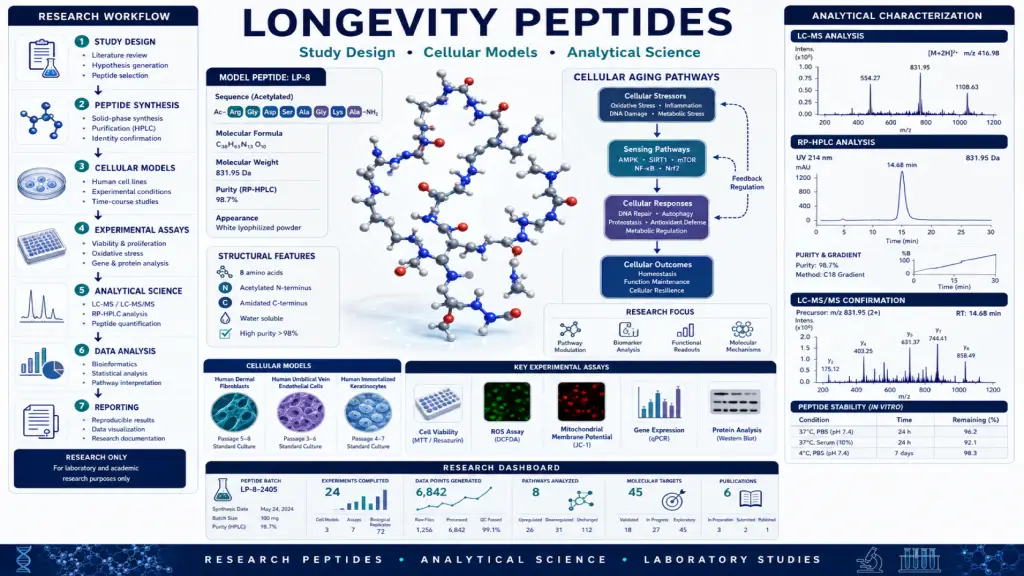
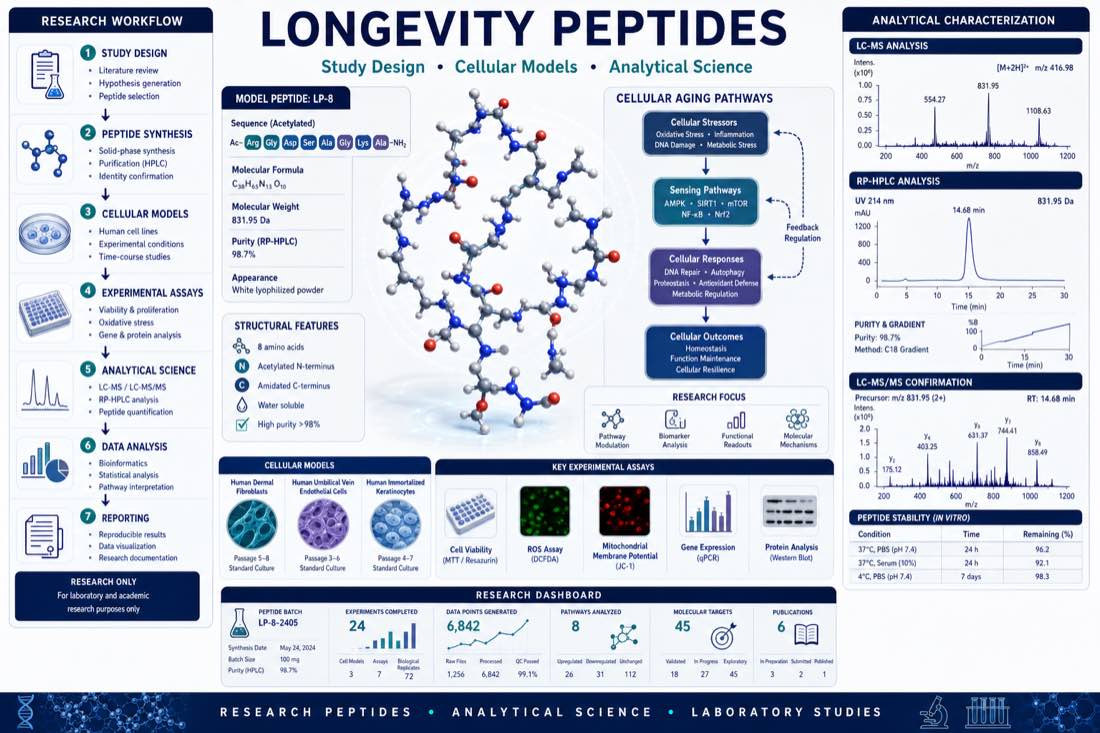
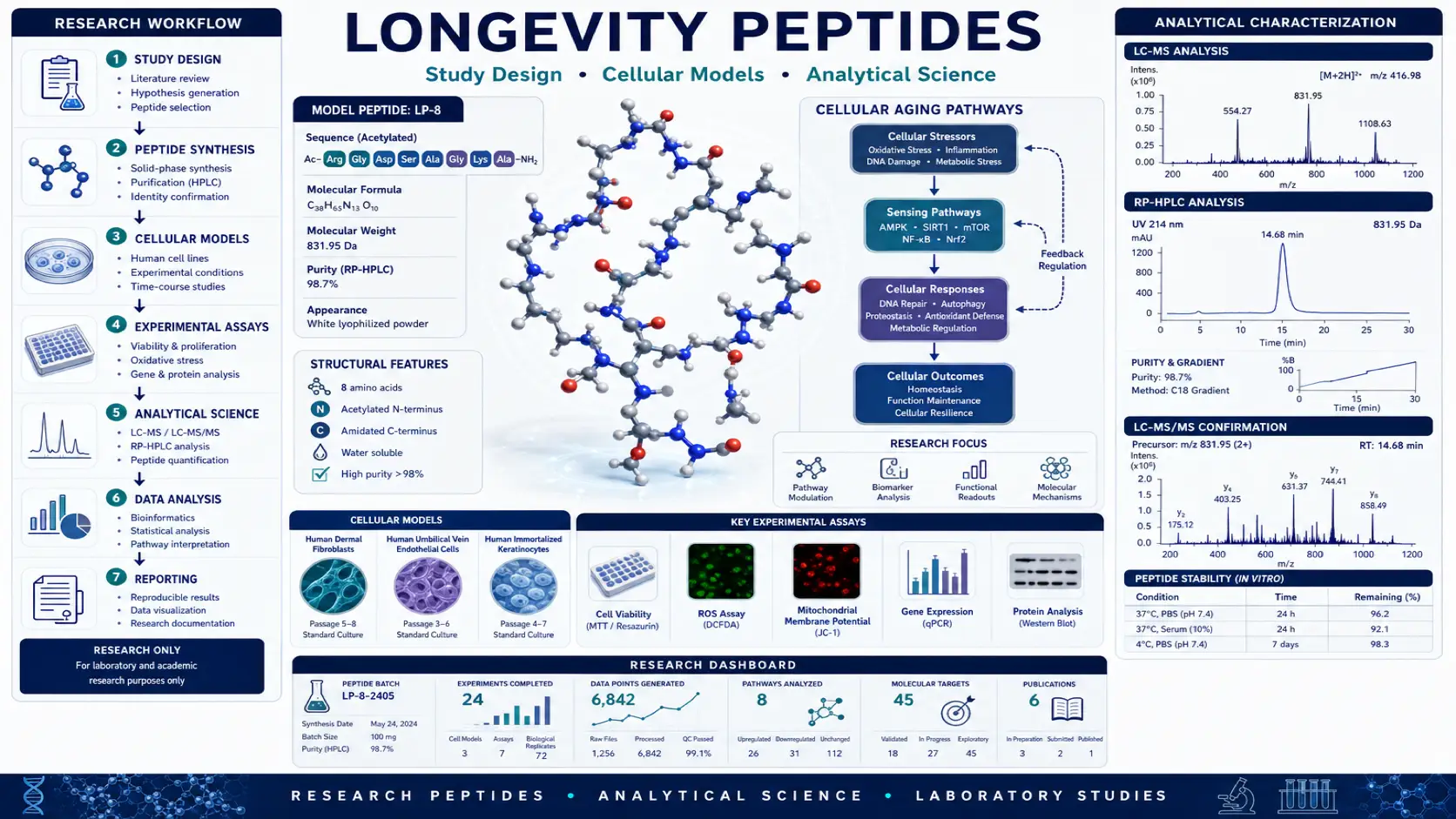
Longevity peptides study design works best when peptide choice is treated as a research systems problem, not a trend list. Teams comparing longevity peptides should prioritize mechanism-specific candidates such as SS-31, MOTS-c, Epitalon, and GHK-Cu only after confirming identity, purity, and impurity controls with batch Certificates of Analysis and orthogonal methods like RP-HPLC and LC-MS.
A practical workflow is: define the mechanism, match the peptide to a measurable endpoint, verify batch analytics, lock procurement and cold-chain SOPs, then keep the same lot across screening and confirmatory work when possible.
Longevity Peptides: 9 Key Options Labs Compare for Study Design
Scientific Snapshot
| Focus | Longevity peptide comparison for laboratory study design |
| Priority Candidates | SS-31, MOTS-c, Epitalon, GHK-Cu |
| Broader Comparison Set | BPC-157, TB-500, Semax, ARA-290, FOXO4-DRI |
| Decision Framework | Mechanism fit, analytical fit, endpoint fit, risk fit |
| Analytical Controls | Batch CoA, RP-HPLC, LC-MS, impurity review |
Key Takeaways
- The strongest comparisons start with mechanism fit, batch-level analytical proof, and a sourcing process that can stand up to internal review.
- FDA materials note that peptide quality can shift across synthesis and purification steps, so labs should ask for API characterization, acceptable impurity levels, and orthogonal testing.
- If the hypothesis centers on mitochondrial membrane biology, SS-31 is often a cleaner fit; if it centers on energy-stress signaling, MOTS-c may map better to the assay design.
- Immunogenicity risk, peptide-related impurities, and limited safety-related information for some Non-reference peptide substances make research-use-only boundaries and vendor transparency important in protocol planning.
Table of Contents
- What makes longevity peptides worth comparing?
- How should a lab screen a supplier?
- The 9 longevity peptides labs compare most often
- SS-31 vs MOTS-c for mitochondrial research
- Epitalon vs GHK-Cu for endpoints and risk review
- Building a defensible longevity peptides characterization workflow
- Matching peptide choice to assay type
- Regulatory risks for longevity peptides studies
- Protecting longevity peptides from variability and cold-chain loss
Aging-related peptide research spans very different categories, including mitochondrial probes, repair peptides, neuroactive peptides, and signaling analogs. That is why longevity peptides comparisons should stay mechanism-led rather than trend-led. FDA guidance and peptide manufacturing materials make one point especially clear: impurity control and analytical characterization are not side issues. They are part of whether a study can be interpreted with confidence at all.
What Makes Longevity Peptides Worth Comparing in a Study Design?
Longevity peptides are worth comparing only when mechanism, analytics, and endpoint selection all match. SS-31 and MOTS-c usually compare well because each can be tied to a narrower biological question than a generic “aging-biology” label.
A useful screen starts with three questions. What pathway is being tested? What assay can actually measure that pathway? What evidence confirms that the vial contains the intended peptide at the claimed quality level? One common mistake is for studying purity as the only quality metric. High purity matters, but FDA materials also stress impurity profiling, API sameness, and more than one analytical method.
After that, the peptide should be placed into a research bucket before any procurement step:
- Mechanism fit: mitochondrial membrane interaction, energy-stress signaling, matrix remodeling, neurobiology, or repair pathways
- Analytical fit: RP-HPLC, LC-MS, and identity confirmation that match the peptide’s complexity
- Endpoint fit: respiration, oxidative stress markers, transcriptomics, migration assays, or morphology
- Risk fit: impurity review, immunogenicity questions, and route-specific development concerns cited by FDA
A Mechanism-First Screen for Longevity Peptides
If a peptide cannot be connected to a precise assay plan, it is not really being compared. It is only being collected. Keep candidate comparisons tied to pathway, assay, and quality proof before expanding the panel.
How Should a Lab Screen Longevity Peptides Suppliers Before Ordering?
A lab should screen suppliers in a fixed order: research-use boundaries first, analytical documents second, handling controls third. FDA and National Science Labs both point toward this order because documentation quality shapes every later decision.
Step 1 is document review. Confirm that the material is supplied strictly for research applications and that each batch has a Certificate of Analysis. A CoA should not be treated as a box-checking exercise. It should show identity and purity data clearly enough for an internal buyer, QA lead, or PI to ask follow-up questions.
Step 2 is analytical depth. FDA’s peptide manufacturing materials emphasize orthogonal analytical techniques because numerous synthesis and purification steps can change the impurity picture. If MS alone cannot fully resolve identity questions, then sequence mapping may be the better control. A common misconception is that a single chromatogram settles sameness. It does not.
Step 3 is logistics control. Lyophilized peptides still need disciplined storage, temperature-aware handling, and clean receiving SOPs. National Science Labs states that its peptides are research-only, third-party tested, and accompanied by batch CoAs, with independent accredited facilities evaluating production runs.
What to Require When Screening Longevity Peptides Vendors
Ask every supplier for the same package: research-use labeling, lot-matched CoA, orthogonal identity/purity methods, and cold-chain handling notes. Compare Certificates of Analysis side by side rather than by marketing claims alone.
Documentation Note
National Science Labs states its research-only peptides are tested to 99% or higher purity, with a Certificate of Analysis for each batch. See also the broader peptide catalog for researchers when mapping candidates to study needs.
What Are the 9 Longevity Peptides Labs Compare Most Often in Research?
The most compared longevity peptides usually represent distinct mechanisms, not one unified class. SS-31, MOTS-c, Epitalon, and GHK-Cu are often discussed because they let labs test different aging-related hypotheses rather than repeat the same one.
Grouping Longevity Peptides by Mechanism Before Ranking
Before ranking candidates, it helps to separate mitochondrial biology from repair signaling, neuroactive pathways, and senescence-oriented concepts. That keeps the comparison honest and prevents trend-led shortlists.
Comparison Set
- SS-31 (elamipretide): a synthetic mitochondria-targeting tetrapeptide studied for interactions with the cardiolipin-rich inner mitochondrial membrane.
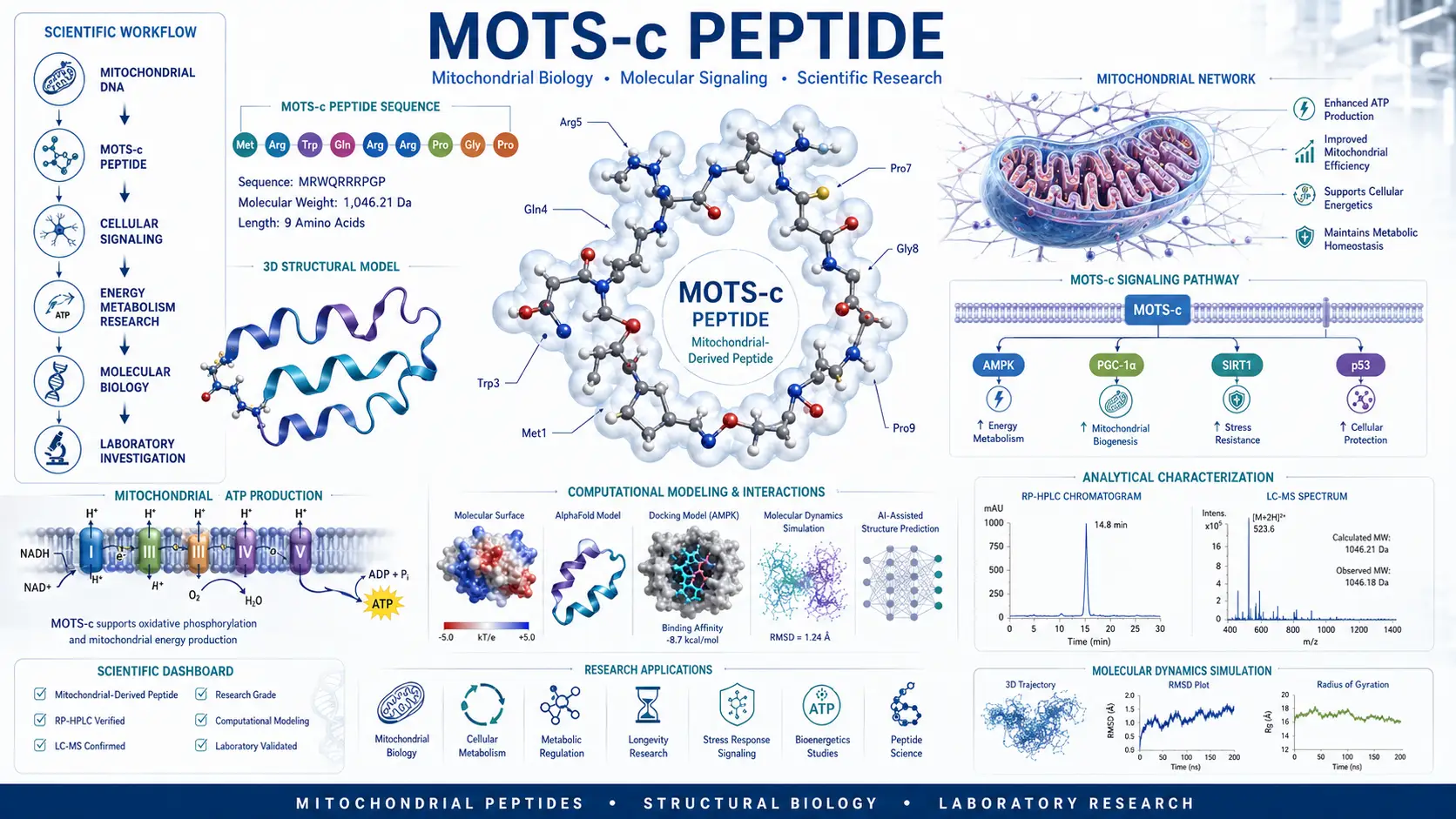
- MOTS-c: a mitochondrial-derived peptide often compared in energy-stress and metabolic signaling models.
- Epitalon: a short tetrapeptide often placed in aging biomarker and cellular maintenance discussions.
- GHK-Cu: a copper-binding peptide commonly compared in extracellular matrix and repair signaling work.
- BPC-157: often screened in injury-response models, though FDA lists it among peptide substances with notable safety and characterization concerns in specialty preparation contexts.
- TB-500: a thymosin beta-4 fragment frequently discussed in cell migration and tissue-repair pathway studies.
- Semax: a neuroactive peptide analog often included in CNS-oriented aging or resilience hypotheses.
- ARA-290: an erythropoietin-derived peptide examined in cytoprotective signaling frameworks.
- FOXO4-DRI: an experimental senescence-focused peptide compared in cell-clearance research programs.
These are not interchangeable “longevity agents.” If the model is mitochondrial dysfunction, then SS-31 or MOTS-c may be coherent. If the model is matrix remodeling, GHK-Cu may fit better. If the model is senescence biology, FOXO4-DRI belongs in a different decision tree.
How Do SS-31 and MOTS-c Differ for Mitochondrial Longevity Research?
SS-31 vs MOTS-c Within Longevity Peptides Panels
SS-31 and MOTS-c answer different mitochondrial questions. SS-31 is usually the cleaner choice for membrane-centric studies, while MOTS-c fits better when the main question involves energy-stress signaling and metabolic adaptation.
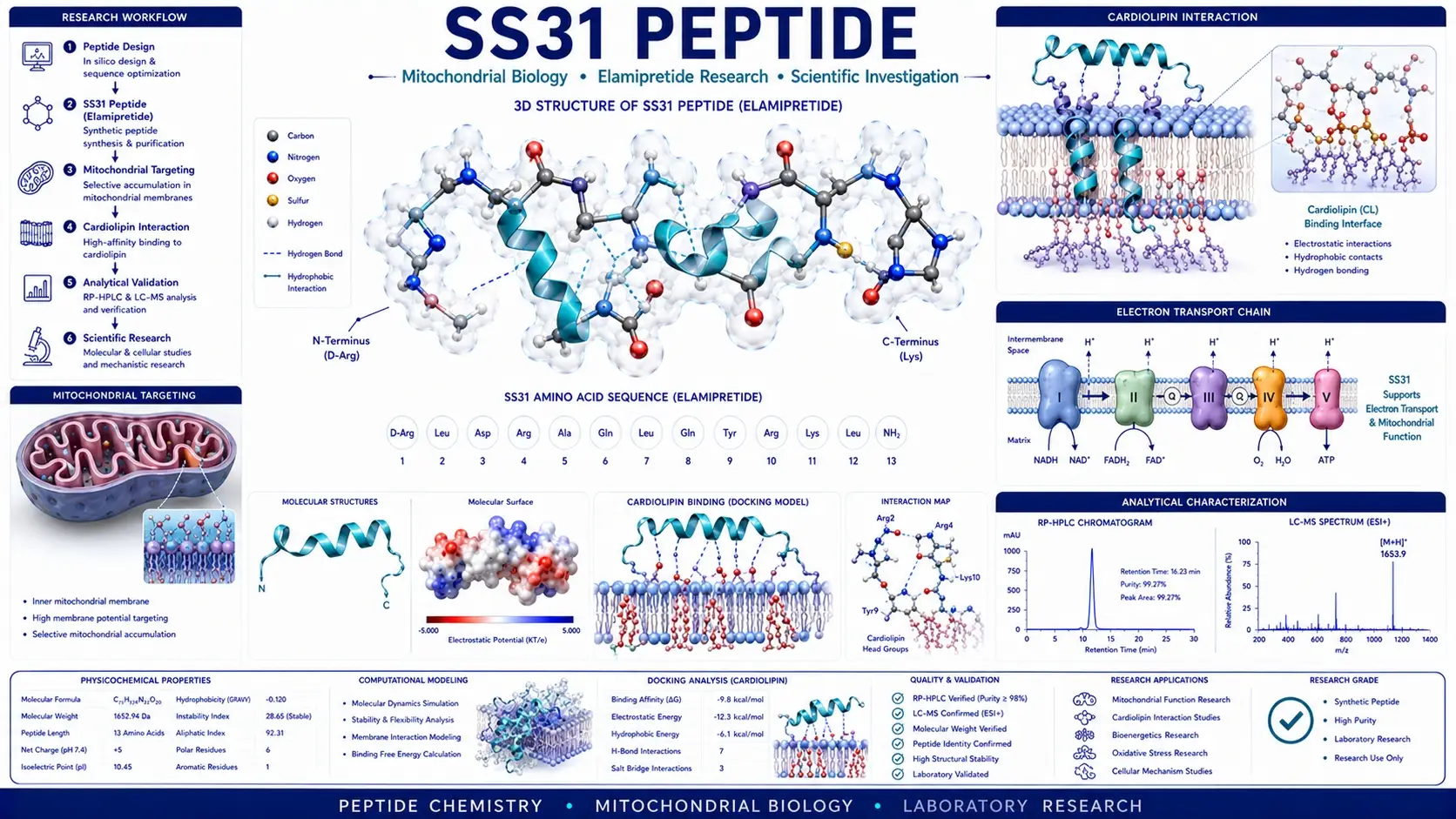
National Science Labs describes SS-31 as elamipretide, a synthetic mitochondria-targeting tetrapeptide studied for cardiolipin-rich inner mitochondrial membrane interactions. That makes it easier to justify in protocols centered on membrane potential, oxidative phosphorylation, or cardiolipin-associated dysfunction. If the assay package includes respiration panels or mitochondrial morphology, SS-31 often maps cleanly.
MOTS-c usually enters comparison sets when the study is less about membrane architecture and more about cellular energy response. A practical tip is to resist comparing these two only by “mitochondrial” branding. If the endpoint panel is built around stress-response transcription or metabolic adaptation, then MOTS-c may produce a more interpretable screen.
Analytical Tip
National Science Labs notes RP-HPLC and LC-MS are fundamental for confirming SS-31 identity, purity, and stability before laboratory work.
How Do Epitalon and GHK-Cu Compare for Study Endpoints and Risk Review?
Endpoint Fit and Risk Review for Longevity Peptides
Epitalon and GHK-Cu belong in different endpoint frameworks. Epitalon is typically framed in aging-biomarker discussions, while GHK-Cu is more naturally tied to matrix, remodeling, and repair-oriented assay systems.
That difference matters because assay selection changes the meaning of any readout. GHK-Cu introduces a metal-binding dimension that can affect formulation logic, stability review, and some in vitro conditions. Epitalon, by contrast, is often evaluated in cleaner short-peptide comparison sets. A common mistake is to compare them with only a general viability assay and call that a longevity screen. That usually produces weak signal interpretation.
Risk review should also differ. FDA states that Non-reference peptide substances including Epitalon and GHK-Cu may present immunogenicity risk and peptide-related impurity or API characterization complexities. So if a program is moving toward more formal translational planning, the better candidate is not just the one with an interesting mechanism. It is the one with the best-documented analytical package and the fewest unresolved characterization questions for the intended study path.

How Can a Team Build a Defensible Longevity Peptides Characterization Workflow?
A defensible longevity peptides workflow uses orthogonal analytics, impurity review, and stability checks before the first assay plate is run. FDA and National Science Labs point to the same lesson: identity confirmation alone is not enough.
Step 1 is identity confirmation. FDA’s 2021 peptide synthesis materials state that API sameness with acceptable impurity levels should be demonstrated, preferably with multiple orthogonal analytical techniques. In practice, that often means pairing chromatographic and mass-based methods rather than relying on one output.
Step 2 is impurity mapping. Peptide-related impurities can arise across solid-phase peptide synthesis and purification. If the peptide is short and relatively tractable, then RP-HPLC plus LC-MS may answer most routine questions. If the data remain ambiguous, FDA notes that peptide sequence mapping is a recommended identification control when MS and amino acid analysis are not enough.
Orthogonal Checks That Keep Longevity Peptides Interpretable
Step 3 is stability review under the planned lab workflow. That includes receipt, storage, thaw or reconstitution events when relevant to the protocol, and the time window between preparation and assay use. Do not mix characterization data from one lot with screening results from another unless the study design explicitly addresses lot bridging. Pair this with matched lab supplies for reconstitution when the protocol requires it.
How Should a Lab Match Peptide Choice to Assay Type and Endpoint?
A lab should choose among candidates after choosing the endpoint family. SS-31, GHK-Cu, and Semax can all fit aging-related work, but each points toward a very different assay stack.
Start with the biological question. If the question is mitochondrial membrane integrity, then respiration, membrane potential, ROS burden, or cardiolipin-associated readouts make sense, and SS-31 becomes easier to justify. If the question is extracellular matrix or remodeling, then GHK-Cu may fit better with migration, transcript, or structural assays.
Then check whether the assay can discriminate mechanism from noise. If the only planned readout is a broad viability signal, then several peptides may appear similar even when their mechanisms differ sharply. That is a design flaw, not a useful comparison. A better approach is to pair a general stress readout with at least one mechanism-linked secondary assay.
Assay Stacks That Discriminate Longevity Peptides Mechanisms
Last, keep the statistical plan realistic. Narrow, mechanistically matched panels often produce more useful comparisons than oversized exploratory screens with weak analytical control. Review research-grade peptide documentation standards before locking assay conditions.
What Regulatory Risks Matter Most When Planning Longevity Peptides Studies?
The main regulatory risks for these programs are immunogenicity, peptide-related impurities, API characterization gaps, and development-stage safety questions. FDA has highlighted all four areas in recent peptide materials and guidance.
FDA’s 2024 materials on certain bulk drug substances used in specialty preparation state that peptide substances including BPC-157, Epitalon, GHK-Cu, MOTS-c, Semax, and TB-500 may present immunogenicity risk and characterization complexity. FDA also notes that several listed substances have no or limited safety-related information for proposed routes of administration. For research planning, that means vendor claims should never replace formal risk review.
FDA’s 2023 draft guidance on peptide drug products adds another layer: hepatic impairment, drug-drug interactions, QTc prolongation risk, pharmacokinetics, safety, and efficacy can all matter as development moves forward. Even if a project is still preclinical or early translational, these issues can shape peptide prioritization now. One practical advantage of tighter characterization is that it reduces the chance of learning later that the signal came from impurities rather than the intended sequence.
National Science Labs states that independent accredited facilities evaluate each production run to confirm identity, strength, and uniformity, which is the kind of sourcing detail procurement teams should ask every supplier to provide in comparable form.
Quality Note
National Science Labs says independent accredited facilities evaluate each production run to confirm identity, strength, and uniformity.
How Can Procurement Teams Protect Longevity Peptides From Variability and Cold-Chain Loss?
Procurement teams reduce variability by controlling lot continuity, receipt inspection, and storage handoff. Lyophilized peptides and batch CoAs are only part of the answer unless the receiving SOP is equally disciplined.
First, reserve enough material from a single lot to complete screening and confirmatory work when budget and shelf-life allow. That avoids preventable lot-bridging exercises. Second, require receiving staff to match the shipment contents to the CoA, lot number, and internal inventory record before the vials enter storage. Third, document every transfer event that could affect stability.
Shipping process matters too. National Science Labs says it dispatches research-grade peptides with temperature-stabilized packaging as needed and that orders before 12:00 PM EST usually ship the same business day. Those details are operational rather than scientific, but they still matter because poorly controlled transit can compromise otherwise strong analytical inputs.
A final misconception is that procurement starts after peptide selection. In serious research programs, procurement is part of study design from the beginning. If the sourcing plan cannot protect identity, purity, and storage control, then the comparison set is weaker before the first assay ever starts.
Study Design Reminder
Keep the comparison set narrow.
Match one mechanism to one endpoint family before expanding the panel.
Document CoA checks and lot continuity for every candidate you keep.
Comparison Checklist
Before locking a panel of longevity peptides, confirm that every candidate has a written mechanism hypothesis, a primary assay, and a secondary confirmatory readout.
Require batch-level CoAs that show identity and purity clearly enough for QA review.
Decide lot-bridging rules in advance so screening and confirmatory work stay interpretable.
Record receiving, storage, and preparation events that could affect stability for each candidate you keep in the final comparison set.
Research Disclaimer
Important Research Disclaimer: This article is for educational and research purposes only. Longevity peptides discussed here are research materials not approved by the FDA for human consumption. The information presented is based on laboratory research context, analytical documentation practices, and publicly discussed regulatory themes. This content does not constitute medical advice. All products sold by National Science Labs are intended for laboratory research use only, not for human consumption.
Explore Related Peptide Research
Browse additional educational resources on peptide characterization, analytical methods, and laboratory documentation in the National Science Labs research library.
Frequently Asked Questions About Longevity Peptides: 9 Key Options Labs Compare for Study Design
1. What is the research focus of this article?
This article reviews longevity peptides: 9 key options labs compare for study in an educational laboratory context, emphasizing molecular framing, analytical documentation, and study-design considerations.
2. Is this content intended for human use?
No. National Science Labs materials and educational articles are for research use only and are not for human consumption.
3. Why do laboratories review certificates of analysis?
COA documentation supports identity and purity verification workflows so experimental lots remain traceable across repeats and collaborating sites.
4. How should teams use this guide?
Use it to align terminology, documentation expectations, and literature-informed study planning. Validate all methods under institutional laboratory protocols.