
scroll-behavior:smooth;
}
Quick Answer
What Is Selank Peptide?
The Selank peptide is a synthetic heptapeptide studied in neuropeptide research for its molecular relationship to tuftsin, an endogenous immunomodulatory peptide fragment. Scientists investigate Selank peptides to better understand peptide signaling, molecular interactions, neurobiology pathways, and the structural characteristics of synthetic peptide analogs within laboratory research environments.
Selank Peptide Explained: Tuftsin Analog Structure, Neurobiology & Molecular Research
Scientific Snapshot
| Research Molecule | Selank Peptide |
| Classification | Synthetic Heptapeptide / Tuftsin Analog |
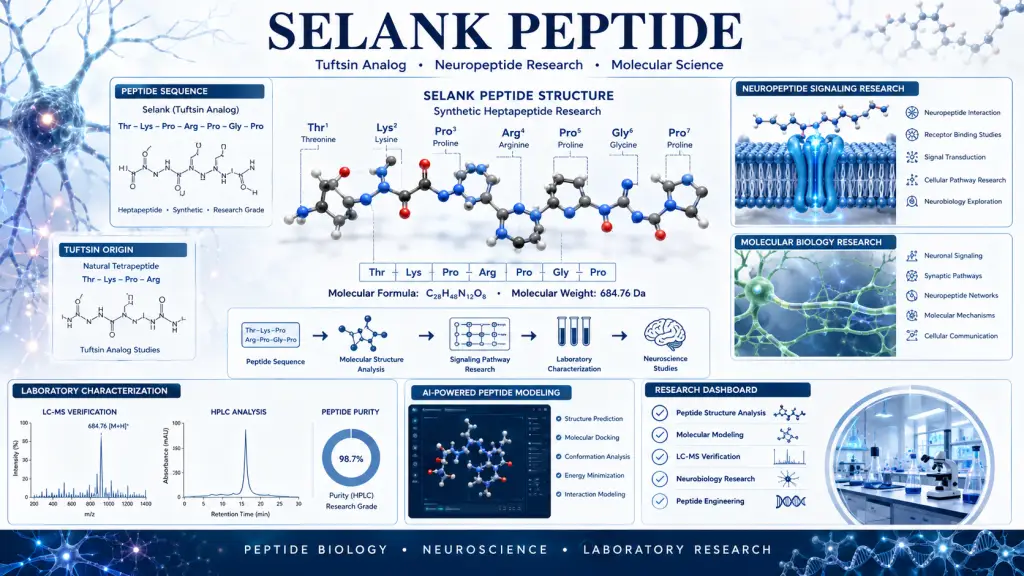
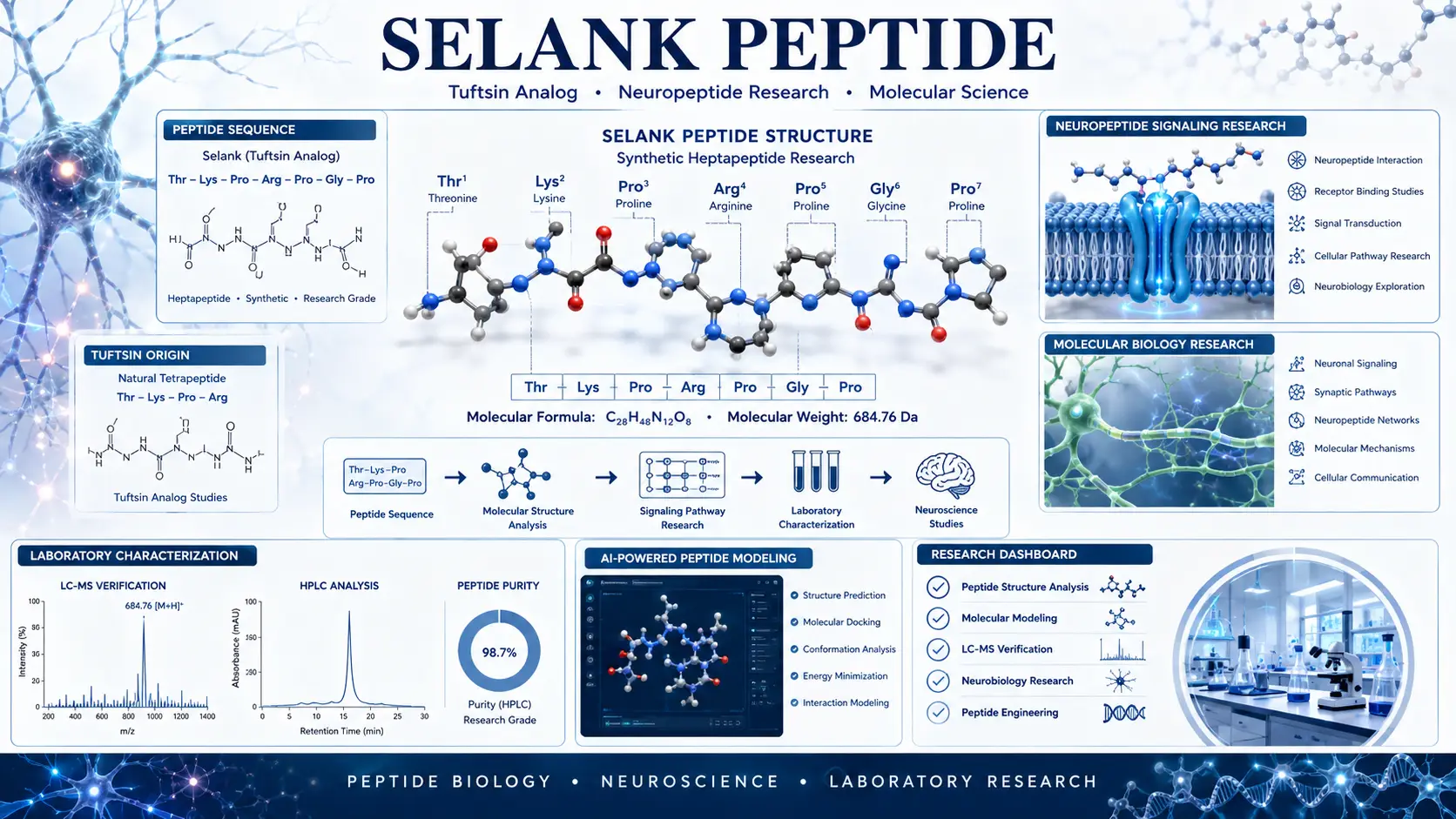
| Peptide Sequence | Thr-Lys-Pro-Arg-Pro-Gly-Pro |
| Research Category | Neuropeptide & Molecular Signaling Research |
| Research Fields | Neuroscience, Peptide Biology, Molecular Chemistry |
| Analytical Methods | LC-MS, RP-HPLC, Structural Modeling & Peptide Sequencing |
Quick Facts
| Name | Selank |
| Peptide Type | Synthetic Tuftsin-Derived Peptide |
| Length | 7 Amino Acids (Heptapeptide) |
| Research Interest | Neuropeptide Signaling & Molecular Pathway Studies |
| Research Status | Investigational Scientific Research Compound |
Key Takeaways
- ✓Selank peptide is a synthetic heptapeptide derived from the naturally occurring peptide fragment tuftsin.
- ✓Scientific discussions around Selank peptide benefits focus on laboratory findings, molecular mechanisms, and peptide biology research rather than practical outcomes.
- ✓Research comparing Selank and Semax peptides examines differences in peptide structure, molecular origin, and biological pathways.
- ✓Modern analytical techniques such as LC-MS and RP-HPLC help characterize Selank peptide structure and purity profiles.
- ✓Understanding Selank requires evaluating peptide chemistry, neurobiology research, and molecular signaling studies.
Table of Contents
→ What Is Selank Peptide? → Selank Structure & Tuftsin Research → Molecular Mechanisms Studied → Selank and Semax Peptides Compared → Laboratory Characterization → Scientific References
Research Timeline
| Period | Scientific Development |
|---|---|
| 1970s–1980s | Expansion of research into endogenous regulatory peptides including tuftsin. |
| 1990s | Development and investigation of synthetic tuftsin-derived peptide analogs including Selank. |
| 2000s | Growth of molecular neuroscience and peptide signaling research. |
| 2020–Present | Advanced peptide characterization using AI modeling, LC-MS, and computational biology. |
Introduction
Quick Answer
What Is This Research Topic?
Selank Peptide Research Guide: Mechanisms, Molecular Pathways & Scientific Evidence is discussed here in a laboratory and literature context focused on selank peptide research guide: mechanisms, molecular. The article summarizes molecular framing, analytical considerations, and study-design notes for research teams. Content is educational and limited to research-use interpretation rather than clinical or consumer guidance.
Table of Contents
The Selank peptide is a synthetic peptide studied within the fields of neurobiology, peptide chemistry, and molecular signaling research. As a tuftsin-derived heptapeptide, Selank provides researchers with a model for investigating how small peptide structures interact with complex biological pathways.
Search terms such as what is Selank peptide used for, Selank peptide uses, and Selank peptide benefits commonly appear in discussions surrounding this molecule. From a scientific perspective, these topics are best understood by examining laboratory research, molecular mechanisms, and experimental models.
This guide explores Selank peptide structure, tuftsin analog research, Selank and Semax peptide comparisons, molecular characterization, and the evolving scientific understanding of synthetic neuropeptides.
For Research Use Only. Not for human consumption. Educational content for laboratory research contexts.
What Is Selank Peptide?
The Selank peptide is a synthetic heptapeptide studied within peptide science because of its structural relationship to tuftsin, an endogenous peptide fragment involved in molecular signaling research. Scientists investigate Selank peptides to better understand peptide structure, biochemical interactions, and the relationship between amino acid sequence modifications and molecular behavior.
Unlike larger biological proteins, Selank consists of a short seven-amino-acid sequence that allows researchers to examine specific aspects of peptide chemistry, molecular design, and synthetic neuropeptide development. Its defined structure makes it useful for studying relationships between peptide sequence and biological signaling pathways.
Scientific discussions around Selank peptide benefits focus on published research observations, molecular mechanisms, and laboratory investigations rather than generalized outcome-based interpretations.
Research Insight
Selank Represents a Synthetic Tuftsin-Derived Peptide Model
Tuftsin-derived peptide research explores how modifications to naturally occurring peptide sequences may influence molecular characteristics. Selank provides researchers with a synthetic model for studying peptide structure, stability, and biochemical relationships.
Selank Peptide Structure and Tuftsin Analog Research

The molecular structure of the Selank peptide is based on the endogenous tetrapeptide tuftsin sequence with additional amino acid modifications. These modifications create a synthetic heptapeptide structure that researchers study through analytical chemistry and molecular modeling.
Peptide researchers evaluate characteristics such as amino acid arrangement, molecular weight, sequence stability, and structural behavior to better understand synthetic peptide analogs.
| Feature | Selank Peptide Research Profile |
|---|---|
| Peptide Category | Synthetic Heptapeptide |
| Structural Origin | Tuftsin-Derived Peptide Analog |
| Sequence | Thr-Lys-Pro-Arg-Pro-Gly-Pro |
| Research Classification | Synthetic Neuropeptide Research |
| Analytical Evaluation | LC-MS, RP-HPLC, Molecular Characterization |
Synthetic Neuropeptide Classification
Selank belongs to a research category known as synthetic neuropeptides. These molecules are designed and studied to better understand peptide signaling, molecular communication pathways, and structure-function relationships.
Synthetic peptide analogs allow researchers to examine how specific amino acid modifications influence peptide properties, stability, and molecular interactions in experimental systems.
Selank Peptide and Molecular Biology Research

Research involving Selank peptides examines peptide chemistry, molecular signaling, sequence relationships, and structural characteristics. These studies contribute to broader understanding of synthetic peptide design and neuropeptide biology.
Questions such as what is Selank peptide used for or Selank peptide uses are scientifically interpreted through laboratory applications, research models, and molecular investigation rather than general usage claims.
Did You Know?
Minor Sequence Changes Can Influence Peptide Research Properties
Peptide scientists study how amino acid sequence modifications affect molecular characteristics. Small structural changes may influence stability, interactions, and peptide behavior observed during research.
Section Summary
The Selank peptide is a synthetic tuftsin-derived heptapeptide studied within peptide chemistry, neurobiology research, and molecular science. Understanding Selank requires examining its sequence design, structural properties, and scientific evidence from controlled research models.
Selank Peptide Mechanisms Studied in Scientific Research
Scientific research involving the Selank peptide focuses on understanding peptide signaling pathways, molecular interactions, and structural characteristics associated with synthetic neuropeptides. Researchers study Selank as a tuftsin-derived peptide model to evaluate how amino acid sequence modifications influence molecular behavior.
As a synthetic heptapeptide, Selank provides researchers with a defined molecular structure for investigating relationships between peptide design, biochemical pathways, and communication systems studied within neurobiology research.
Scientific discussions surrounding Selank peptide benefits are best understood as interpretations of laboratory findings, molecular mechanisms, and experimental observations rather than confirmed biological outcomes.
Research Insight
Neuropeptide Research Focuses on Molecular Communication
Neuropeptide studies investigate how amino acid-based molecules participate in signaling pathways. Researchers analyze peptide structures, molecular interactions, and sequence relationships to better understand peptide biology.
What Is Selank Peptide Used For in Research?
A frequently searched question is what is Selank peptide used for. In scientific contexts, this refers to how researchers investigate Selank within experimental models involving peptide chemistry, molecular biology, and synthetic neuropeptide studies.
Research involving Selanks explores topics such as peptide sequence analysis, molecular pathway studies, structural characterization, and comparisons with other synthetic neuropeptides.
| Research Area | Scientific Focus | Purpose |
|---|---|---|
| Peptide Chemistry | Amino acid sequence and structure | Understanding molecular properties |
| Neuropeptide Research | Peptide signaling pathways | Studying molecular communication |
| Tuftsin Analog Studies | Modified peptide structures | Evaluating sequence relationships |
| Computational Biology | Molecular modeling | Predicting structural interactions |
Understanding this neuropeptide Uses in Scientific Studies
Search interest around the compound uses often refers to research applications and scientific investigations. Within laboratory environments, Selank is studied as a molecular research compound for exploring peptide pathways and structure-function relationships.
Researchers evaluate Selank through analytical chemistry, molecular modeling, and experimental systems designed to investigate peptide characteristics and biological signaling concepts.
Selank and Semax Peptides: Research Comparison
Selank and Semax peptides are frequently compared because both belong to synthetic neuropeptide research. However, they differ in molecular origin, peptide sequence design, and structural characteristics.
Scientific comparison of the Selank Semax peptide category focuses on peptide chemistry, molecular pathways, and research classifications rather than ranking one molecule over another.
| Feature | this tuftsin analog | Semax Peptide |
|---|---|---|
| Peptide Type | Synthetic heptapeptide | Synthetic ACTH-derived peptide analog |
| Molecular Origin | Tuftsin-based research | ACTH fragment-based research |
| Research Category | Neuropeptide studies | Neuropeptide studies |
| Characterization Methods | LC-MS / RP-HPLC | LC-MS / RP-HPLC |
Did You Know?
Selank and Semax Originate From Different Peptide Families
Although commonly researched together, Selank and Semax have different molecular origins. Comparing these peptides helps researchers understand how sequence design influences peptide characteristics.
Section Summary
this research peptide research focuses on synthetic neuropeptide biology, tuftsin analog studies, molecular signaling, and peptide structure analysis. Scientific comparisons between Selank and Semax highlight differences in peptide origin, design, and research pathways.
Selank Synthesis and Molecular Characterization
The scientific evaluation of the Selank requires advanced synthesis, purification, and analytical characterization techniques. Because Selank is a synthetic heptapeptide with a defined amino acid sequence, researchers examine molecular identity, purity profile, structural properties, and sequence accuracy using specialized laboratory methods.
Modern peptide research commonly uses technologies such as solid-phase peptide synthesis (SPPS), reverse-phase high-performance liquid chromatography (RP-HPLC), liquid chromatography-mass spectrometry (LC-MS), and computational modeling to characterize synthetic peptides.
These analytical approaches help scientists study this neuropeptides through molecular verification, structural analysis, and controlled laboratory investigation.
Solid-Phase Peptide Synthesis (SPPS) and the compound Structure
Solid-phase peptide synthesis is a widely used approach in peptide chemistry that allows researchers to assemble amino acids into a specific sequence. This process supports the creation of synthetic peptides with defined molecular structures for scientific analysis.
For this tuftsin analog research, accurate amino acid sequencing is essential because molecular properties are closely connected to peptide structure and sequence arrangement.
| Research Step | Scientific Purpose | Analysis Goal |
|---|---|---|
| Sequence Assembly | Creates the target peptide chain | Molecular accuracy |
| Purification | Separates peptide fractions | Composition evaluation |
| Identity Testing | Confirms peptide characteristics | Research verification |
| Stability Analysis | Studies molecular consistency | Structural assessment |
Research Insight
Analytical Verification Supports Reliable Peptide Research
Synthetic peptide studies rely on analytical technologies to confirm molecular identity, sequence accuracy, and structural characteristics before conducting further scientific evaluations.
RP-HPLC Analysis of this research peptide
Reverse-phase high-performance liquid chromatography (RP-HPLC) is commonly used in peptide science to evaluate purity profiles and separate molecular components. This method provides researchers with information about peptide composition and analytical consistency.
For synthetic neuropeptides such as Selank, chromatographic techniques help characterize peptide preparations and support molecular research workflows.
LC-MS Verification and Molecular Identity Testing
Liquid chromatography-mass spectrometry (LC-MS) combines molecular separation with mass analysis. In Selank research, LC-MS helps scientists evaluate whether observed molecular characteristics match expected peptide properties.
Mass spectrometry is an important analytical technique in peptide chemistry because it provides information about molecular weight, identity confirmation, and structural characteristics.
| Testing Method | Information Provided |
|---|---|
| RP-HPLC | Purity profile and separation analysis |
| LC-MS | Molecular weight and identity verification |
| Sequence Analysis | Amino acid arrangement confirmation |
| Computational Modeling | Structural prediction research |
Selank Stability Research
Peptide stability research investigates how molecular structures maintain their characteristics under controlled scientific conditions. Researchers analyze chemical integrity, sequence stability, and structural changes during experimental evaluation.
Understanding peptide stability helps scientists evaluate molecular behavior and maintain consistency during analytical studies involving this neuropeptides.
Research Limitations of the compound Studies
Scientific interpretation of Selank research requires consideration of study design, experimental models, analytical methods, and limitations within available evidence.
Search terms such as this tuftsin analog benefits and this research peptide uses should be reviewed through scientific literature and molecular research rather than generalized assumptions.
Did You Know?
Mass Spectrometry Can Detect Precise Peptide Characteristics
Advanced mass spectrometry technologies allow researchers to investigate peptide molecules with high precision, supporting detailed molecular characterization studies.
Section Summary
Selank research relies on accurate synthesis, purification, and analytical characterization. Methods including SPPS, RP-HPLC, LC-MS, peptide sequencing, and computational analysis help researchers study molecular identity, structure, and peptide properties.
Current Scientific Consensus on Selank Research
Current scientific literature recognizes the this neuropeptide as a synthetic heptapeptide derived from the naturally occurring peptide fragment tuftsin. Research involving Selank focuses on peptide chemistry, molecular signaling, sequence modification, and understanding how synthetic peptide structures behave in experimental models.
Scientific evaluation of the compounds requires analysis of molecular structure, peptide characterization data, experimental methodology, and peer-reviewed research findings. Researchers investigate Selank as part of the broader field of synthetic neuropeptide science.
Topics such as this tuftsin analog benefits, this research peptide uses, and what is Selank used for are interpreted scientifically through molecular mechanisms, laboratory observations, and controlled research investigations.
Future Directions in Neuropeptide Research
The field of neuropeptide research continues to expand as scientists develop advanced technologies for studying peptide structure, molecular interactions, and biological signaling networks. Synthetic peptides such as Selank provide research models for exploring relationships between amino acid sequences and molecular characteristics.
Emerging technologies including artificial intelligence, computational peptide modeling, advanced analytical chemistry, and structural biology are improving how researchers investigate peptide systems.
| Research Technology | Scientific Application |
|---|---|
| AI Peptide Modeling | Prediction of peptide structures and molecular interactions |
| Advanced LC-MS Analysis | High-resolution peptide identity verification |
| Computational Biology | Analysis of peptide pathways and molecular relationships |
| Structural Biology | Understanding peptide conformation and interaction models |
| Synthetic Peptide Engineering | Design and evaluation of modified peptide sequences |
Research Insight
AI Is Transforming Peptide Discovery Research
Artificial intelligence tools are increasingly used in peptide science to analyze amino acid sequences, predict structural behavior, and model potential molecular interactions during early-stage research.
Research Best Practices for Studying Selank
Scientific investigation of this neuropeptide requires accurate molecular identification, validated analytical testing, and evidence-based interpretation. Researchers evaluate peptide compounds through controlled methodologies rather than broad assumptions.
- ✓Confirm peptide identity using analytical technologies such as LC-MS and RP-HPLC.
- ✓Evaluate Selank as a synthetic tuftsin-derived peptide with a defined molecular structure.
- ✓Compare Selank and Semax peptides based on sequence, origin, and research pathways.
- ✓Interpret research findings through peer-reviewed scientific evidence.
Related Research Articles
Continue Exploring Neuropeptide & Peptide Science Research
Explore additional National Science Labs research guides covering peptide biology, molecular pathways, and advanced peptide research topics.
Neuropeptide Research Guides
- → Semax Peptide Research Guide
- → Cerebrolysin Peptide Research Guide
- → Oxytocin Peptide Research Guide
Cellular & Molecular Peptide Research
Peptide Laboratory Resources
Did You Know?
Modern Peptide Science Combines Chemistry and Computational Technology
Modern peptide research integrates synthetic chemistry, artificial intelligence, molecular modeling, and analytical science to better understand complex peptide systems.
Section Summary
the compound research continues to advance through developments in synthetic peptide chemistry, analytical technology, computational modeling, and molecular neuroscience. Understanding Selank requires evaluating its structure, sequence, and scientific research evidence.
Frequently Asked Questions About this tuftsin analog
1. What is this research peptide?
The Selank is a synthetic heptapeptide derived from the naturally occurring peptide fragment tuftsin. Scientific research examines Selank for its molecular structure, peptide signaling characteristics, and role as a synthetic neuropeptide research compound.
2. What are Selanks studied for?
this neuropeptides are studied within peptide chemistry, molecular biology, and neuropeptide research. Scientists investigate sequence structure, biochemical interactions, and molecular signaling pathways using experimental research models.
3. What are the compound benefits in research?
Research discussions around this tuftsin analog benefits refer to scientific observations from laboratory studies, including investigations into peptide pathways, molecular interactions, and structural characteristics.
4. What is this research peptide used for in scientific studies?
The question what is Selank used for is interpreted scientifically as how researchers apply Selank in experimental models studying synthetic peptides, molecular signaling, and peptide structure-function relationships.
5. What are Selank uses in laboratory research?
this neuropeptide uses in research settings involve molecular characterization, peptide pathway studies, analytical chemistry investigations, and comparison with other synthetic neuropeptides.
6. Are Selank and Semax peptides the same?
No. Selank and Semax peptides are different synthetic peptide molecules. Selank is derived from tuftsin-based research, while Semax originates from ACTH fragment peptide research.
7. Why are Selank Semax peptide comparisons common?
The Selank Semax peptide comparison is common because both molecules are studied within neuropeptide science. Researchers compare their structures, molecular origins, and peptide characteristics.
8. What is the the compound sequence?
Selank is a heptapeptide composed of seven amino acids with the sequence Thr-Lys-Pro-Arg-Pro-Gly-Pro. This sequence is studied to understand peptide structure and molecular behavior.
9. How is this tuftsin analog analyzed?
Researchers analyze this research peptide using methods such as LC-MS, RP-HPLC, peptide sequencing, and computational modeling to evaluate molecular identity and structural characteristics.
10. Why is LC-MS important for Selank research?
Liquid chromatography-mass spectrometry helps researchers examine peptide molecular weight, identity confirmation, and structural properties during peptide characterization studies.
11. How does AI support peptide research?
Artificial intelligence supports peptide research by helping scientists analyze sequences, predict molecular structures, and model peptide interactions during computational studies.
12. Why is Selank studied as a synthetic neuropeptide?
Selank is studied as a synthetic neuropeptide because its defined structure allows researchers to investigate peptide design, molecular signaling concepts, and sequence-function relationships.
Scientific Resources & References
The following scientific resources provide additional information about Selank research, neuropeptide biology, peptide chemistry, and analytical characterization methods.
Selank & Neuropeptide Research
- Ashmarin IP, et al. Regulatory peptides and Selank-related neuropeptide research. View on PubMed
- Myasoedov NF, et al. Research involving synthetic regulatory peptides including Selank. View on PubMed
- Tuftsin Peptide Research Studies exploring tuftsin structure and peptide biology. View on PubMed
Peptide Chemistry & Analytical Science
- Merrifield RB. Solid Phase Peptide Synthesis. View on PubMed
- Steen H, Mann M. The ABC’s of Peptide Sequencing. View on PubMed
- Jumper J, et al. Highly Accurate Protein Structure Prediction with AlphaFold. View on PubMed
Scientific Databases
- NCBI PubMed Visit PubMed Database
- Protein Data Bank (PDB) Visit Protein Data Bank
Final Takeaway
Selank Represents an Important Synthetic Neuropeptide Research Model
this neuropeptide research explores peptide structure, tuftsin-derived molecular design, synthetic neuropeptide science, and advanced analytical characterization. Continued developments in peptide chemistry, computational biology, and molecular research continue expanding scientific understanding of Selank and related peptide systems.
Research Disclaimer
National Science Labs supplies research peptides exclusively for legitimate laboratory and scientific research purposes. Information about the compound and related compounds is provided for educational discussion of scientific literature only. Research peptides are not intended for human consumption, therapeutic applications, diagnosis, or disease treatment.
Explore Related Peptide Research
Browse additional educational resources on peptide characterization, analytical methods, and laboratory documentation in the National Science Labs research library.
Frequently Asked Questions About Selank Peptide Research Guide: Mechanisms, Molecular Pathways & Scientific Evidence
1. What is the research focus of this article?
This article reviews selank peptide research guide: mechanisms, molecular in an educational laboratory context, emphasizing molecular framing, analytical documentation, and study-design considerations.
2. Is this content intended for human use?
No. National Science Labs materials and educational articles are for research use only and are not for human consumption.
3. Why do laboratories review certificates of analysis?
COA documentation supports identity and purity verification workflows so experimental lots remain traceable across repeats and collaborating sites.
4. How should teams use this guide?
Use it to align terminology, documentation expectations, and literature-informed study planning. Validate all methods under institutional laboratory protocols.