
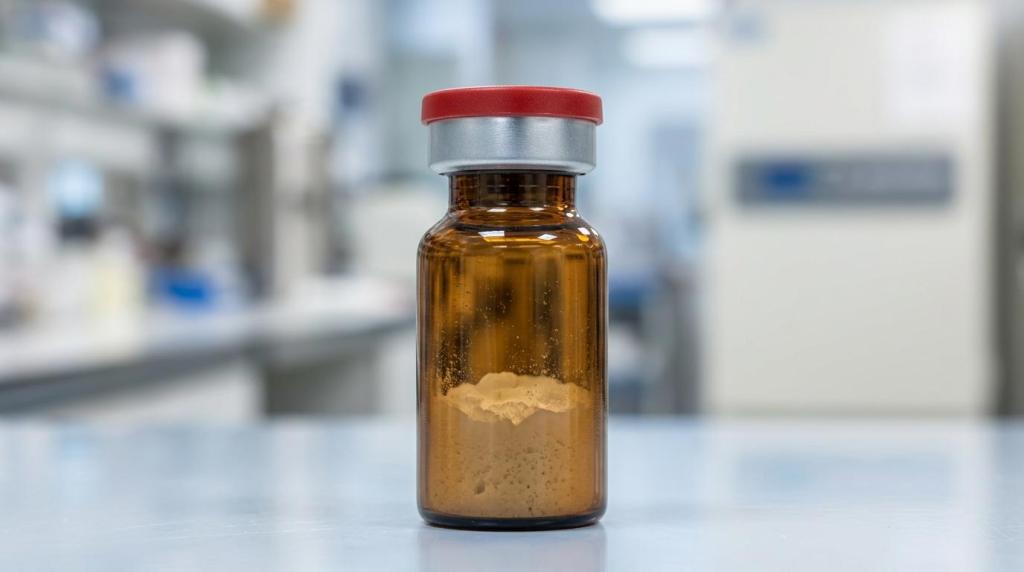
Busy research labs rarely lose time because of one dramatic storage failure. More often, they lose it in small increments: a vial left too long at room temperature during inventory, repeated opening of the same container, an unlabeled reconstituted aliquot in the wrong freezer rack, or a powder exposed to ambient moisture during a rushed transfer.
That is why peptide powder storage deserves a system, not just a cold shelf.
For lyophilized peptide powders, the literature indexed by the National Library of Medicine consistently points to a simple pattern. Keep material sealed, dry, protected from light, and cold. That baseline appears again and again across peptide and protein stability discussions, even though the exact shelf life and degradation profile still depend on sequence, formulation history, residual moisture, and container closure conditions.
Why peptide powder storage matters in research labs
A 2024 review available through PMC describes temperature, humidity, and light as the predominant factors affecting peptide stability in the solid state. The same review also notes that long-term storage conditions are only part of the picture. Conditions during lyophilization and the resulting residual moisture profile can shape later stability as well.
That matters because lyophilized powders are often treated as if they are broadly robust by default. They are usually more stable than solutions, but not chemically inactive. Oxidation, hydrolysis, deamidation, aggregation, and photochemical pathways can still appear over time, especially when storage conditions drift or container seal integrity is compromised.
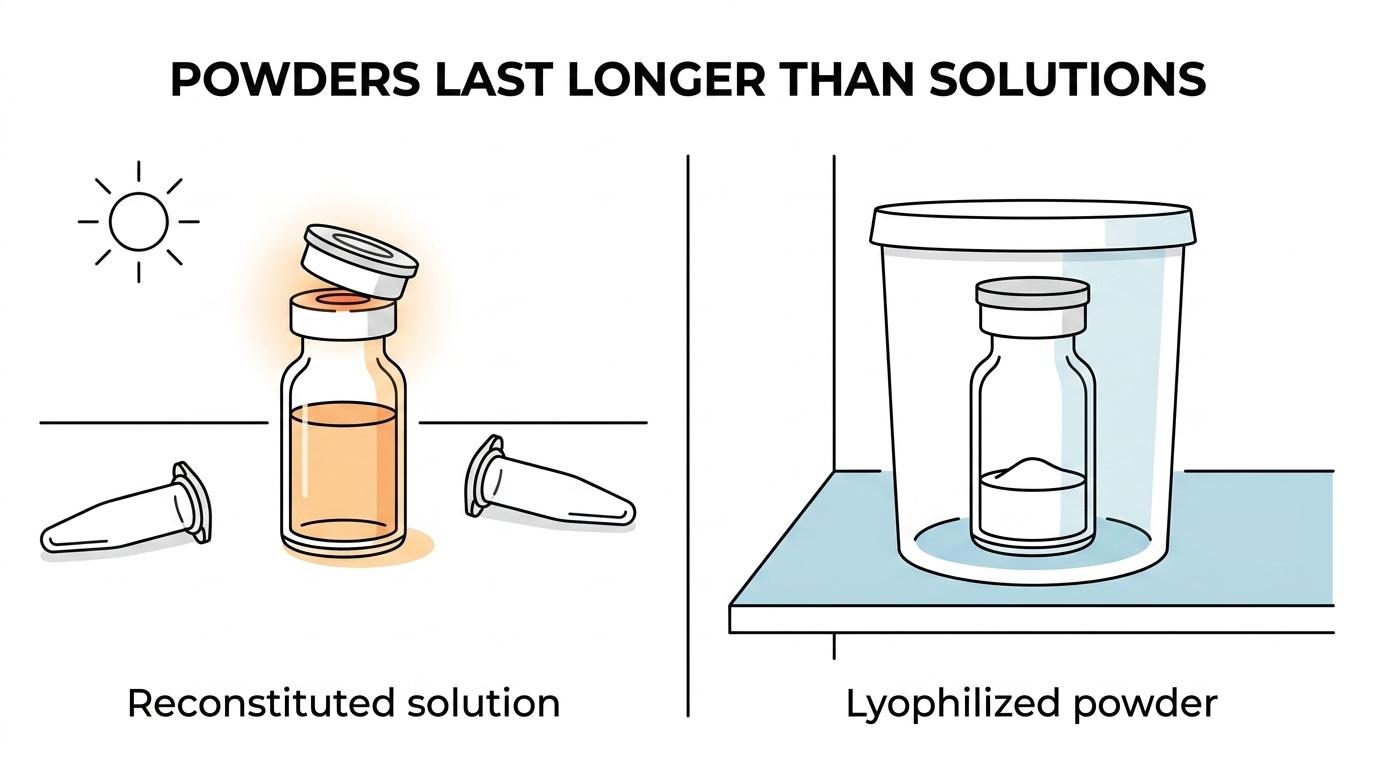
A busy lab benefits from a storage model that assumes every opening event, every thaw event, and every transfer is a meaningful variable.
Core stability factors for lyophilized peptide powders
The strongest recurring themes in the published literature are not exotic. They are the same practical variables most labs already track, just with more consequence for fragile biomolecules. A 2023 PMC review comparing storage recommendations across biological products found that lyophilized materials generally show lower light and temperature sensitivity concerns than liquid formulations, which fits the broader view that freeze-dried formats are favored for longer storage.
Still, “better than liquid” does not mean “immune to handling.”
Common stressors for peptide powders include:
- low-temperature interruptions
- ambient humidity exposure
- repeated vial opening
- direct light exposure
- poor seal integrity
- avoidable transfer steps
Humidity deserves special attention. Even brief contact with moist air can increase water uptake in a lyophilized cake or powder, and residual moisture can shift molecular mobility enough to affect degradation risk. That is one reason unopened storage often outperforms repeatedly accessed stock vials, even when both are kept in the same freezer.
Light also deserves more respect than it gets. A 2024 review in PMC lists light among the predominant stability risks for solid-state peptide materials. Light sensitivity will vary by sequence and excipient environment, yet opaque secondary containment and minimized bench exposure are easy controls that reduce one more source of variability.
A practical table for peptide powder storage risks
The literature can be translated into a simple lab planning tool.
| Storage factor | What the literature indicates | Practical lab implication |
|---|---|---|
| Temperature | Lower temperatures are commonly used for longer-term solid-state storage | Use a defined freezer standard for archived stock |
| Humidity | Moisture exposure can affect solid-state stability and residual water balance | Keep vials sealed; avoid prolonged opening during handling |
| Light | Light is repeatedly identified as a degradation risk for peptides in solid state | Store in original vial, secondary carton, or opaque container |
| Reconstitution status | Solutions are generally less stable than lyophilized powders | Reconstitute close to planned experimental use and aliquot when suitable |
| Freeze-thaw cycles | Repeated cycling is associated with added degradation risk in solution | Store working aliquots in single-use or limited-access volumes |
| Sequence chemistry | Residues like methionine, cysteine, and tryptophan may raise oxidation sensitivity | Review sequence-specific handling notes when available |
This table does not replace a product-specific protocol, but it gives procurement teams and bench scientists a shared framework. When storage decisions are standardized around these variables, fewer questions are left to memory or habit.
Cold storage strategy for peptide powders
Published reviews indexed by PMC point to frozen storage as the most consistent option for long-term preservation of lyophilized peptides. A 2023 review reports that many lyophilized peptides are stable for years when stored at about -20 °C and protected from light, while a 2016 analytical review recommends roughly -20 to -80 °C for storage longer than six months.
Those ranges are useful because they reflect real laboratory practice. Not every peptide powder needs the same destination freezer, and not every lab has the same access pattern. What matters most is that the choice is deliberate, documented, and tied to expected use frequency.
A workable cold storage structure often looks like this:
- Primary archive storage: a dedicated freezer for unopened vials intended for medium- to long-term retention
- Short-access storage: a separate location for materials expected to be retrieved within days or weeks
- Light protection: original vial plus secondary packaging when possible
- Access control: limit the number of users handling the same stock container
- Temperature mapping: verify that freezer placement matches validated temperature zones
This is less about perfection and more about reducing variability. When a lab stores all peptide powders in mixed locations, with some in a refrigerator door, some in a shared bench freezer, and some in room-temperature cabinets during intake, the storage history becomes hard to reconstruct later.
Reconstitution and frozen solution storage practices
Once a peptide leaves the lyophilized state, the storage discussion changes quickly.
A 2023 review in PMC notes that solution shelf life is much shorter than lyophilized storage. The same review identifies cysteine, methionine, and tryptophan residues as sequence features associated with greater oxidation risk, and it states that freeze-thaw cycles and high pH can accelerate oxidation in susceptible sequences. A 2016 review also advises minimizing repeated freeze-thaw events and limiting solution exposure to air.
That means Reconstitution should not be treated as a routine prep step done “just in case.” It is better handled as a defined transition from archive material to near-term experimental material.
A few disciplined habits can make a major difference:
- Reconstitution timing: prepare solutions close to planned assay windows rather than far in advance
- Aliquot design: divide reconstituted material into small volumes matched to expected single-session use
- Container choice: use sealed tubes suited for frozen storage and low headspace when practical
- Air exposure: recap promptly and avoid repeated prolonged handling at the bench
The same 2016 review recommends frozen storage at or below about -70 °C for re-solubilized peptide calibrator solutions in sealed tubes. Even if a lab’s exact workflow differs from analytical calibration work, the principle still translates well: once material is in solution, colder storage, minimal access, and fewer freeze-thaw events are generally favored.
Handling workflow design for busy peptide research labs
Storage problems often begin outside the freezer.
Many labs have strong cold storage hardware but inconsistent handoff steps. Receiving logs may be separate from freezer assignment. Labels may list lot number but not reconstitution date. A single vial may move between teams without a shared chain of custody. Each gap is small. Together they create uncertainty around what the material has actually experienced.
A solid handling workflow can stay simple:
- Receive and inspect the vial, packaging, and seal condition.
- Record lot, date received, storage location, and intended project.
- Move unopened lyophilized stock promptly into the assigned cold location.
- Reconstitute only under a documented protocol tied to an active study.
- Create aliquots immediately if repeated future access is likely.
- Log each freeze, thaw, transfer, and discard decision.
This kind of workflow is especially useful for labs supporting both exploratory studies and tightly scheduled clinical research assays. It reduces avoidable divergence between nominal storage conditions and actual handling history.
One more point deserves emphasis: speed helps, but consistency helps more.
Labeling, documentation, and quality controls for peptide powders
Storage quality is not just about temperature. It is also about traceability.
When a freezer contains dozens of visually similar vials, the risk is not only degradation. It is mix-up, undocumented reuse, and uncertain material history. For advanced labs, storage discipline works best when it is tied to documentation discipline.
Useful label fields often include peptide identifier, lot number, concentration after reconstitution if applicable, solvent or diluent, date opened, date reconstituted, aliquot volume, storage temperature target, and initials or operator ID. That may look like extra effort at first, but it saves repeated verification later.
Quality controls around storage can also stay practical rather than burdensome:
- periodic freezer temperature review
- check of secondary containment and light protection
- audit of opened versus unopened vials
- review of seal integrity before use
- reconciliation of inventory against active study needs
For procurement teams, one upstream factor matters too: starting material quality. A well-documented Certificate of Analysis, third-party purity verification, and a clear statement of storage expectations give the receiving lab a better foundation for its own SOPs. Those documents do not replace internal controls, but they make it easier to match handling conditions to the physical form supplied.
Sequence-specific factors in peptide powder stability
Not all peptide powders behave the same way, even when packed in the same type of vial and stored in the same freezer.
Published peptide stability reviews indexed by PMC point out that sequence chemistry can influence degradation pathways after storage and after reconstitution. Oxidation risk is often discussed for methionine, cysteine, and tryptophan containing peptides. Other sequences may show different sensitivities tied to hydrolysis, deamidation, or aggregation tendencies.
That means a “one freezer, one rule” policy should still leave room for peptide-specific notes. The baseline can stay standardized, while exceptions are documented where sequence data, analytical release data, or internal stability work support a different handling plan.
In practice, the smartest storage programs combine two things at once: a default cold, dry, dark, sealed approach for lyophilized powders, and a willingness to tighten controls when the sequence or study design calls for it.
When that balance is in place, peptide powder storage stops being an afterthought and becomes part of experimental quality from the moment a vial enters the lab.